When Britain became the first country to reach a trade agreement with President Trump in May, critics warned that the terms were loose and the commitments vague. Now, the risks of that ambiguity are becoming apparent.
The United States informed the British government this month that it would pause fulfilling a technology-related agreement between the two countries, which included more collaboration on artificial intelligence and nuclear energy, according to two people familiar with the decision who were not authorized to speak publicly. The move came because American officials felt that Britain wasn’t making sufficient progress in lowering trade barriers, as promised in the May trade agreement, the people said.
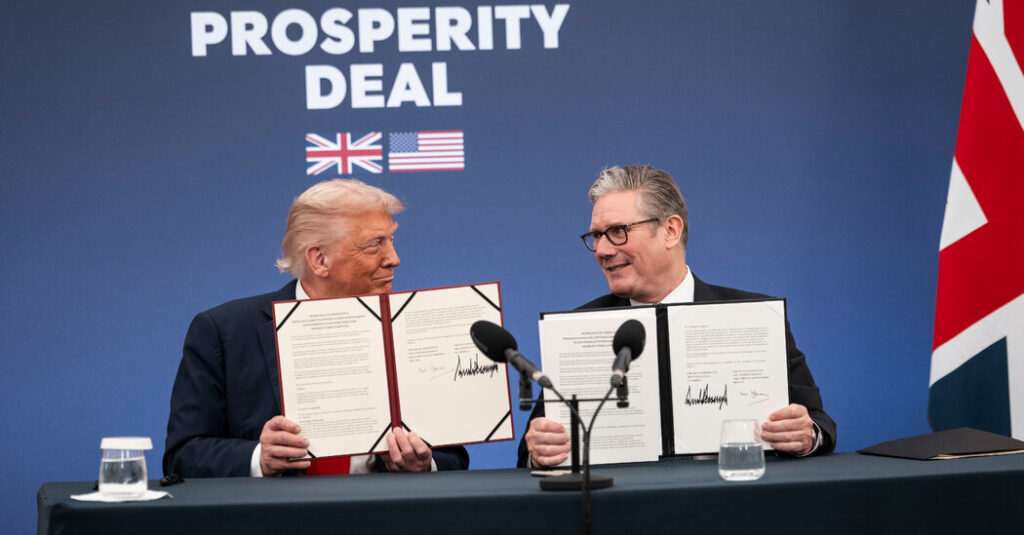
Earlier this year, when Prime Minister Keir Starmer of Britain was courting Mr. Trump to avoid punitive trade tariffs, he delivered an invitation from King Charles for a state visit. When Mr. Trump arrived for the visit in September, British officials were keen to show that it wasn’t just about banquets and pageantry. At the time, the two countries vowed to deepen their partnership and signed the so-called Tech Prosperity Deal, which extended research collaborations and encouraged deeper commercial partnerships. America’s biggest tech companies announced more than $40 billion in investments in Britain for A.I., data centers and other technologies.
But the language in the tech deal between Britain and the United States said it only “becomes operative alongside substantive progress being made to formalize and implement” the May trade agreement, which was called the Economic Prosperity Deal.
Now, the Trump administration has argued that Britain has made insufficient effort. It shows how the administration is continuing to leverage trade policy to push foreign governments to make more concessions on trade and other policies. The White House has kept negotiations with countries open months after the president has proclaimed that deals were done.
Some of the terms in Britain’s agreement were particularly loose. While there were firm commitments to lower tariffs on British cars exported to the United States, up to a quota, and to increase American beef exports to Britain, other issues were left unresolved.
Those included the United States’ desire to increase agricultural exports and for Britain to loosen its food safety standards. American officials have also expressed frustration with Britain’s online safety rules and digital services taxes. The agreement said the two countries would “plan to work constructively in an effort to enhance agricultural market access” and “negotiate an ambitious set of digital trade provisions.”
In the subsequent months, Britain hasn’t made changes to its digital services tax, which raises most of its money from big American firms like Amazon and Google. There also hasn’t been a new agreement on food exports.
Peter Kyle, Britain’s minister for business and trade, was in the United States earlier this month and met with U.S. officials to discuss advancing the May trade agreement.
Mr. Kyle’s department did not respond immediately to a request for comment. A spokeswoman for the U.S. trade representative declined to comment.
The Trump administration has now struck limited trade agreements with 15 nations in an attempt to change what it perceives as unfair trade practices and boost U.S. exports.
But negotiators have often hit obstacles as they have worked to turn verbal pledges between leaders into the text of a trade deal. Some agreements that have been announced verbally have yet to be finalized.
Another issue has been whether some foreign countries are growing more reluctant to make concessions to the United States. The Trump administration has begun offering some exemptions to tariffs amid growing concerns about the effects of the levies on prices and affordability. The administration is also facing a Supreme Court case that could invalidate many of the president’s tariffs, though administration officials have said they could use other legal authorities to replace them.
Eshe Nelson is a Times reporter based in London, covering economics and business news.
The post U.S.-U.K. Trade Deal Hits Stumbling Block appeared first on New York Times.