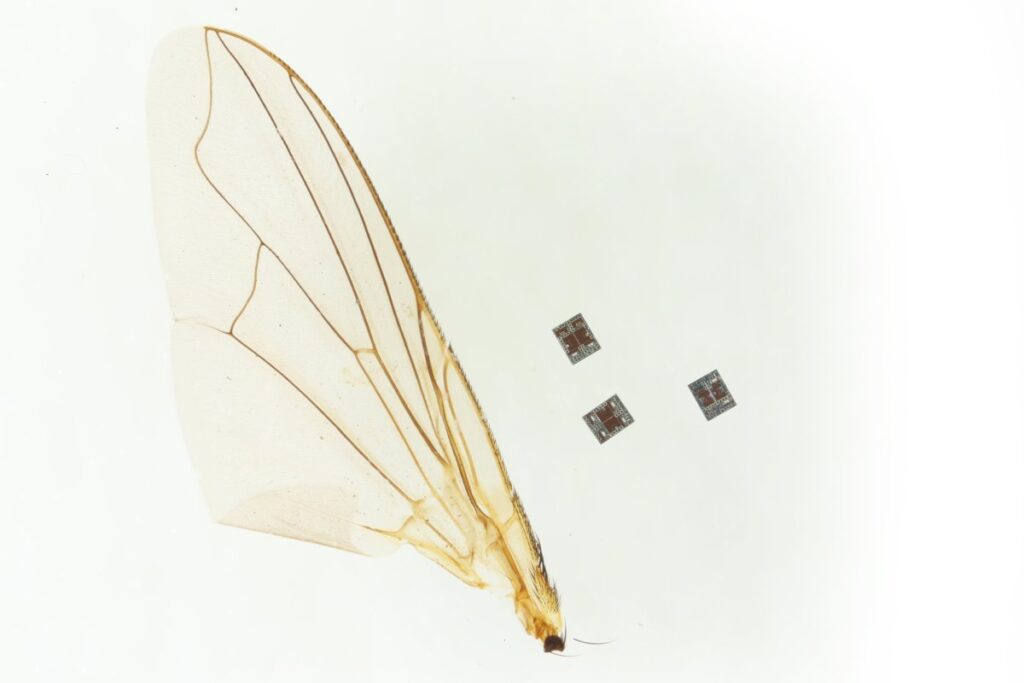
We’re far from realizing the kind of nanomachines envisioned in media like “The Diamond Age” and Metal Gear Solid, but scientists have just taken a meaningful step towards the next best thing.
A team of researchers from the University of Pennsylvania and University of Michigan say they’ve built a sub-millimeter sized robot packed with a computer, motor, and sensors, the Washington Post reports. It’s not an actual billionth of a meter in size, but being smaller than a grain of salt, it is still outrageously tiny: a microrobot.
The work, described in a new study in the journal Science Robotics, could be a platform for one day building microscopic robots that could be deployed inside the human body to perform all sorts of medical miracles, like repairing tissues or delivering treatment to areas difficult for surgeons to access.
“It’s the first tiny robot to be able to sense, think and act,” coauthor Marc Miskin, assistant professor of electrical and systems engineering at UPenn, told WaPo.
At present, the device is still highly experimental and isn’t suited to be used inside a human body — but “it would not surprise me if in 10 years, we would have real uses for this type of robot,” coauthor David Blaauw from U-M told the newspaper.
Building a microscopic robot that can move, sense its surroundings, and make decisions on its own has evaded scientists for decades. According to the team, roboticists have typically relied on externally controlling the microrobots so they can operate at smaller scales, but sacrificing their ability to process information. That prevents the robots from reacting with their environment, leaving them with a limited number of pre-programmed behaviors they can carry out — and as a result, limited real-world usefulness.
Having a robot on the scale of microns, or one millionth of a meter, would give us access to what corresponds to the smallest units of our biology, Miskin told WaPo.
“Every living thing is basically a giant composite of 100-micron robots, and if you think about that it’s quite profound that nature has singled out this one size as being how it wanted to organize life,” he said.
Visually, the researchers’ robot resembles a microchip, and is made of the same kinds of materials, including silicon, platinum, and titanium, WaPo noted. It’s sealed in a layer of what is essentially glass, Miskin said, protecting it from fluids.
The robot uses solar cells to convert energy that powers its onboard computer and its propulsion system, which uses a pair of electrodes to generate a flow in the water particles surrounding it. In a word, the robot swims. Its onboard computer is less than a thousandth of the speed of a modern laptop, per WaPo, but it’s enough to let it respond to changes it detects in its environment like temperature.
“At this scale, the robot’s size and power budget are comparable to many unicellular microorganisms,” the team wrote in the study.
Crucially, the robot is designed to still communicate with its human operators.
“We can send messages down to it telling it what we want it to do,” using a laptop, Miskin told WaPo, “and it can send messages back up to us to tell us what it saw and what it was doing.”
But the next step? Inter-microrobot communication.
“So the next holy grail really is for them to communicate with each other,” Blaauw told WaPo.
More on robots: Video Shows Robot Attacking CEO
The post Scientists Reveal Robot Small Enough to Travel Through Human Body appeared first on Futurism.