Yoshitomo Nara, an obsessive recorder of Japanese girlhood, might seem hard to separate from commerce. His solitary figures, with their widely spaced eyes and teenage-diary emotions, have been multiplying steadily across the surfaces of posters, phone cases, lampshades, skateboards and, at the Museum of Modern Art gift shop, adhesive bandages — a reminder of the artist’s enormous popular reach.
The sprawling Nara exhibition opening Thursday at David Zwirner’s two galleries in Chelsea is the reintroduction to his work you didn’t know you needed. In truth, the mounds of sleek merch surrounding Nara have distorted his achievement and concealed what makes his work interesting, in particular his feeling for paper.
It matters that Nara paints and draws on textured surfaces, from old envelopes and brown paper bags to photocopies of pages from a novel. He stretches his own canvases and often overlays his images on collaged surfaces made from leftover duck cloth that he cuts into strips and applies like so much medical bandaging. His way with materials suggests an empathy for the irregular, the distressed and even the damaged, and lends his best work an unexpected weight.
What does an original work of art offer that a reproduction cannot? I posed the question to Nara last week, when he flew here from his home outside Tokyo to install his show. “The originals are covered with imperfections,” he replied, a bit cryptically. “They have lived a life and have wrinkles like Keith Richards” — the guitarist, now 82, with a face that is admirably unlifted.
The Zwirner exhibition, Nara’s first at the gallery, has been organized on a grand, nearly baronial scale. It gathers an enormous amount of work: around 80 drawings and paintings that span four decades, in addition to a recent series of 13 monumental white-painted heads that bring the tradition of sculpture unnervingly close to the forms of soft ice cream. Three additional sculptures, his “Sentinels of Stillness,” went on view in Washington, D.C., last Saturday when the Hirshhorn Museum reopened its sculpture garden after a four-year redesign.
Nara, who is 66, is not a newcomer. He rose to international prominence in the late ’90s as part of a generation of Japanese artists who elevated manga, anime and pop culture cuteness into a major painting style. But unlike, say, Takashi Murakami, who was Nara’s onetime roommate and coined the phrase Superflat to characterize a style of art that satirized the shallowness of Japanese consumer culture, Nara is not interested in satirizing anything.
Rather, he believes that cuteness can be an expression of authentic feeling. His cartoony girls, typically rendered in simple outline and isolated against blank grounds, combine the graphic directness of illustration with a subtle emotional inwardness. Their disproportionately large heads suggest babies, but their personalities approximate those of sensitive adolescents — they harbor deep hurts and in turn hurt others.
In a forceful early drawing entitled “Maetel” (1995), a girl with a pronounced forehead gazes from beneath a red beret with an expression that evokes both punk insouciance and the severe, scowling faces of the German Expressionist Max Beckmann. For years, Nara reprised the theme of an angry girl who curses, carries weapons and tears through the world lighting pyromaniacal fires.
These days, his characters are more likely to have a social conscience and a placard protesting the spread of nuclear power plants. “Peace,” a casually enchanting four-foot-tall painting, shows a blond girl in a lime-green shirt seated at a table, projecting uncertainty. Her eyes well with tears as she gingerly arranges five toy letters to spell out “peace,” as if assembling not only a word but the beginnings of her life as an activist.
Who are these women?
“I think of all my paintings as self-portraits,” Nara said.
Why present himself as a girl?
“I think my sensibility is a lot more in tune with women,” he replied. “Since I was little I was never into the kind of games that little boys play, like superhero battles. I didn’t like violent games. I was much more interested in the games that little girls were playing where you pick flowers and you collect them and you appreciate how beautiful they are.”
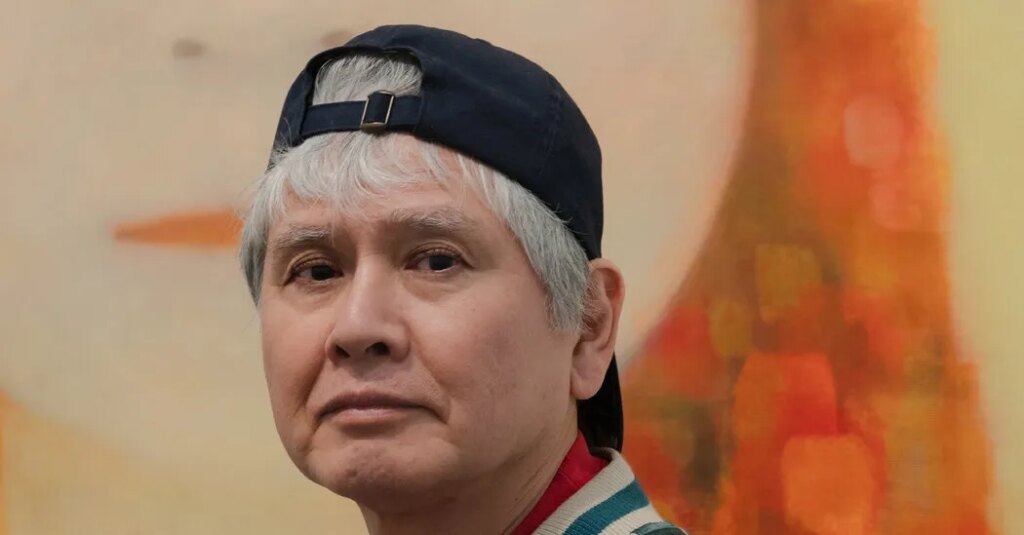
Nara is an intense, reserved man who is usually photographed in a baseball cap, his shaggy gray bangs falling below the rim. He prefers answering questions in Japanese and seems amused by the small confusions of translation. Asked to describe the town where he grew up, he turned to his translator, who told me in short order: “They have buffaloes.”
Buffaloes? Who knew? After conferring again with him, his translator clarified what he had meant: “The town where he lived is a lot like Buffalo, N.Y.”
Perhaps he thought of Buffalo because of the snow. Nara grew up in the northern Japan town of Hirosaki, in the Aomori Prefecture, which holds a world record for snowfall, receiving an average of 25 feet a year. His family was financially strapped, and, by his own description, he was a lonely child who played with paper dolls, designing costumes for them. In the summer, he helped in his mother’s garden. “My mother was very busy,” he said, “but because of that, the time we did spend together was very deep and precious.”
Life in the countrified north instilled a keen sense of Japan’s social inequities and rural-urban imbalances. “The central parts of the country are wealthier and have more power,” he said. “For instance, nuclear power that is being used in the central areas is being dumped in the rural areas, so an anger gradually grew in me.”
Much of the scholarship on his work cites record album covers as a key influence. Not enough has been said about the 12 years he spent in Germany, where he moved in 1988 “to extend my life as an art student,” he told me. He studied under A. R. Penck, one of the leading lights of German Neo-Expressionism. A painter of scribbly figures and signs, Penck gave Nara advice that could have crushed a lesser artist. “Why don’t you paint like you draw,” he suggested, and a linear freedom soon entered Nara’s work.
Lately, however, Nara has been constructing form through color contrasts, rather than crisp drawing. “Girl From the North Country” (2026), whose title is taken from the Bob Dylan song and conveniently evokes the terrain of Nara’s childhood, depicts a woman who, compared to the rebel girls of his youth, seems rounder, fleshier and nearly tranquilized. Her green irises are rendered with a glassy depth that catches light like the eyes of an old-fashioned bisque doll. When you stand close, her long hair and shirt dissolve into shifting blocks of peach and green that nuzzle each other and amount to a miniature geometric abstraction.
Asked if the change in his work was motivated by a shift in his ideas about painting, Nara shook his head. The shift, he said, was in his health. He has been diagnosed with glaucoma, he said, limiting his ability to render fine details. Now he is using wider brushes and exploring the optical effects of soft-edged rectangles of color.
These days he resides in Nasu, a scenic resort town three hours from Tokyo by car. Although his paintings fetch predictable millions at auction — his record is $25 million, in 2019 — he emphasizes that he lives modestly and has no studio assistants. He works on one painting at a time and often sleeps on a cot in his studio, not wanting to break his concentration or risk sacrificing his connection to a painting-in-progress. His output, he said, has fallen over the years. “If a were a child, I could draw a lot more,” he said.
“I don’t want to go back to childhood,” he added with a straight face. “But if I could go back to high school, I might.” He wouldn’t object if he were offered the chance to be an art student forever.
The day after our interview in New York, the Hirshhorn Museum was holding a ribbon-cutting ceremony to inaugurate its revamped sculpture garden. Nara flew down to Washington with David Zwirner, while I took the train. The museum was buzzing with artists who had come to see the finished garden, which has added about a dozen new works (including pieces by KAWS, Lauren Halsey, Hiroshi Sugimoto, Elmgreen & Dragset and Arlene Shechet) to an outdoor site known for its modernist bronzes by Auguste Rodin and Alberto Giacometti.
It was an unseasonably warm fall day, and sunlight glinted off the milky-white surface of Nara’s “Sentinels of Stillness,” three separate monumental heads whose contours were surprisingly shapeless, like melting marshmallows. Nara had begun the series in his studio, molding clay into small heads, poking and pressing with his thumbs to create an expressive surface. Fabricators equipped with scanners and printers enlarged the clay models 16 times over and had them made in aluminum. After the coat of paint went on, Nara realized the sculptures were probably inspired by the snow monsters, or “Juhyo,” that he saw on fir trees in the winters of his childhood. “These will look gorgeous in the winter when it snows,” Brian Donnelly, the sculptor known as KAWS, remarked to me.
As other artists circulated in the garden, Nara stood apart, lingering in the shade of a tall fieldstone wall. He was, in the end, something of a mystery. “I can only work if I’m completely alone,” he had told me. And yet his favorite artist, he said, was Amedeo Modigliani, the Italian-born painter of long, stylized faces who became a central figure in the pre-World War I Parisian avant-garde.
Nara, the enshriner of girlhood loneliness, said he wished, like Modigliani, he could “hang out with a crew of comrades and colleagues and share a life together.”
Yoshitomo Nara
Through Dec. 12 at the David Zwirner Gallery, 533 West 19th Street and 537 West 20th Street, 212-517-8677; DavidZwirner.com.
Yoshitomo Nara: Sentinels of Stillness
Through Nov. 07, 2027, Hirshhorn Museum and Sculpture Garden, Independence Avenue SW and Seventh Street SW, Washington, D.C.
The post Nara, Dreaming of a Lost Girlhood, Finds New Freedom in Color appeared first on New York Times.