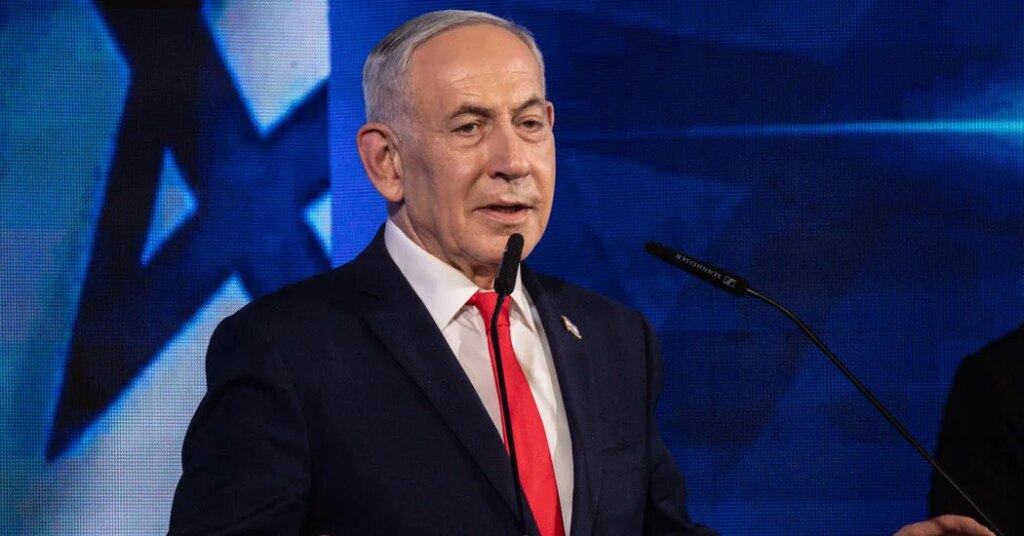
Prime Minister Benjamin Netanyahu and his allies have hit upon a new strategy for staying in power after Israel’s election last week gave his opponents an opening to unseat him.
Borrowing a page from President Trump, Mr. Netanyahu’s bloc is claiming without basis that Arab voters stole the election, with some of Mr. Netanyahu’s allies demanding that a new vote be held.
The concerted effort to cast doubt on the legitimacy of the election could benefit Mr. Netanyahu by making it more difficult for his opponents to rely on the support of Arab parties or by justifying a delay in forming a new governing coalition altogether.
The prime minister and his allies have been trumpeting a pair of investigations into alleged electoral irregularities. “Until the investigation is concluded, a dark cloud hangs over the election results in Israel,” Mr. Netanyahu wrote on social media on Monday.
Mr. Netanyahu’s rival, the former military chief Gadi Eisenkot, says the prime minister’s push is an act of desperation. “Likud and Netanyahu know that we are determined,” he said in a video address Tuesday night. “That is why they continue to cast doubt on and try to undermine the true results of the election. This is their last refuge.”
The opposition won 67 seats in Parliament, with 19 of those secured by two Arab parties, whose leaders are determined to oust Mr. Netanyahu. It is still unclear what role their parties will ultimately play as Mr. Eisenkot tries to assemble a coalition that can lead the 120-seat Parliament.
In the coming days, the Israeli president, Isaac Herzog, is likely to grant Mr. Eisenkot the first shot at assembling a governing coalition. But Mr. Netanyahu has seized on the two investigations to sow concerns about the high voter turnout among Arab citizens of Israel.
The first case involves what the Israeli police called “attempted election bribery.” But the three men who were detained have been released, with at least two judges criticizing the lack of evidence brought by investigators.
An Israeli intelligence agency, the Shin Bet is leading a second inquiry into a possible attempt by foreign agents to influence the election improperly. But Noam Sohlberg, the conservative Supreme Court justice who oversaw the vote, said that although allegations of foul play were being investigated, they would have no impact on the election’s outcome.
“Nothing in these remarks calls into question the votes cast by Arab citizens,” Mr. Sohlberg said in a video on Sunday in which he was flanked by top justice and intelligence officials including the Shin Bet’s director.
When Israel’s central election committee voted on Wednesday on whether to certify the results, representatives of Mr. Netanyahu’s bloc refused to approve them, either abstaining or voting no. The committee still had the votes to endorse the results.
Mr. Netanyahu’s bloc can act to delay the seating of a new Parliament, in which his opponents will have a majority, or try to impede the election of a new speaker, who could allow Mr. Eisenkot’s bloc to try to start enacting legislation. And experts warned that if Mr. Netanyahu were to mobilize his political base to back such moves on the grounds that the election was illegitimate, Israel could enter uncharted territory.
“We’re on the cusp potentially of our own Jan. 6 moment,” said Reuven Hazan, a political science professor at the Hebrew University of Jerusalem. “It’s touch and go, because they could turn this into a social issue and not just an institutional issue. They could call people out to the streets.”
Mr. Netanyahu’s efforts to delegitimize the Arab vote began well before the Oct. 27 election. He warned during the campaign that Arab parties would be the real power in an Eisenkot-led government, and Mr. Netanyahu’s allies announced plans to send thousands of observers into Arab precincts to guard against fraud.
On Election Day, Mr. Netanyahu ran a racially charged campaign on social media, including pictures of veiled women, warnings that the elections “are being stolen from us” and calls for right-wing voters to prevent “the end of Israel as we know it.”
The two criminal cases provided Mr. Netanyahu and his allies with further ammunition.
In the initial case, the police acted on a telephone tip provided to them by Ido Norden, Mr. Netanyahu’s chief of staff, the night before the election, according to a law enforcement official and another person briefed on the matter who insisted on anonymity because they were not authorized to speak publicly.
In a statement, Mr. Netanyahu’s office denied that account. The Israeli police declined to comment on an ongoing investigation.
The following morning, before polls opened, police officers raided the homes of three Arab citizens on the grounds of suspected election tampering.
The police raided two of the homes without first obtaining a warrant, police officials later acknowledged in court. At the third home, officers also did not present a warrant, but it was unclear if they had obtained one.
Hours later, the police announced that the men had been detained on suspicion of “attempted election bribery” and that thousands of dollars in cash had been seized that was “allegedly intended” to be handed out as bribes for voting for the United Arab List, or Raam. Party officials have denied the allegation.
Mr. Netanyahu seized on the announcement, posting about it on social media, demanding an investigation and urging right-wing Israelis to vote. His allies in the Israeli news media ran with the story all day.
Nobody has been charged in connection with the case. All three of the detainees have since been released.
A judge who ordered the release of one of them said that the police had provided little evidence beyond the man’s support for Raam. Another judge, in releasing a second man, said that officers had “struggled to show an evidentiary basis.”
The second case turns on information provided by David Zini, the director of Shin Bet. Mr. Sohlberg, the Supreme Court justice, said the classified intelligence suggested that foreign agents may have sought to influence the election, the judge wrote in a letter dated Oct. 28.
Mr. Zini has said he accepted the job of leading the Shin Bet because of his ability to be “loyal to the elected leadership.”
Mr. Sohlberg wrote that he gave Mr. Zini a week to substantiate or disprove the suspicions.Separately, Mr. Sohlberg called the allegations serious but said that, even if borne out, they would not undermine the election’s integrity.
Mr. Zini has sought to interrogate four prominent Arab politicians in connection with the matter, including Raam’s leader, Mansour Abbas, according to two Israeli law-enforcement officials briefed on the discussions who spoke on condition of anonymity because they were not authorized to comment publicly. The Shin Bet did not respond to a request for comment.
Israel’s attorney general, Gali Baharav-Miara, refused to allow those interrogations, saying the Shin Bet had produced no evidence to justify questioning them, the two officials said. “Anyone who needs to be investigated will be investigated, but no one will be investigated without an evidentiary basis,” Ms. Baharav-Miara’s office said.
The shortcomings of the two cases have not stopped Mr. Netanyahu’s allies in the Israeli news media from claiming that he might have had a better shot at forming a majority coalition but for the actions of Arab operatives.
Channel 14, which assiduously repeats Mr. Netanyahu’s talking points, accused Arab citizens of carrying out “ballot-box terrorism.”
Mr. Netanyahu’s political aides are continuing to assert that the voting should be tossed aside. “Half of the country does not believe in the election results,” said Guy Levy, a Likud spokesman, in an interview.
Election officials said on Wednesday that they had checked thousands of complaints and found “no evidence of irregularities that compromised the integrity of the election or affected its results.”
The post Stop the Steal? Netanyahu Borrows a Page From Trump’s Playbook appeared first on New York Times.