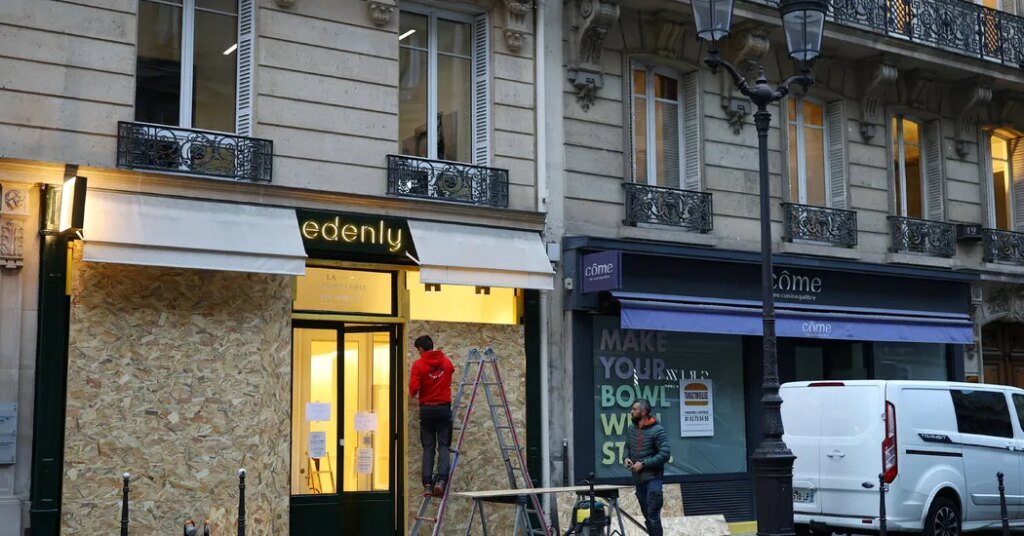
After weeks of sometimes violent protests, France braced on Thursday for a general strike that was set to paralyze transport routes and disrupt services across large parts of the country.
The strike presents another test for France’s embattled government, which has struggled to contain the reverberations of a protest movement that began in September with students barricading their high schools, before escalating in October into widespread street disorder.
Labor unions are mobilizing nationwide demonstrations against the rising cost of living and the government’s proposed budget cuts. Public and private sector workers are joining the action, which is expected to disrupt air and rail travel, hospitals, schools, banks and other institutions.
More than 220 demonstrations and gatherings are expected to take place across France, Laurent Nuñez, the Interior Minister, said on Wednesday. He said that 70,000 police officers would be deployed, matching the police presence during nationwide demonstrations over the last two weekends.
Though the demonstrations, called for by unions, are expected to follow a more traditional pattern than student-led protests, “there are clear attempts to make the situation escalate,” Mr. Nuñez said. “And so, the police deployment will respond accordingly, with the constant objective of ensuring that the marches proceed properly, and that there are no abuses, no violence, and no looting,” he said.
Although the strike is not, strictly speaking, part of the student-led protests, it is clearly intended to show solidarity with that movement, which has drawn hundreds of thousands of people into the streets over the last three Saturdays. Students are expected to take part in the rallies.
Members of the “yellow vest” movement, whose protests against high fuel costs convulsed France between 2018 and 2020, also plan to turn out. That underscores how protests that began in a handful of high schools around Paris in September have mushroomed into a nationwide expression of unrest, drawing in protesters, young and old.
The unrest has left France acutely on edge, particularly after mostly peaceful protests on Oct. 17 degenerated into arson, looting and violence in multiple cities. The demonstrations on Oct. 24 and Oct. 31 were less destructive, though both ended with clashes between protesters and the police.
Images of protesters lobbing Molotov cocktails at the riot police last Saturday, briefly engulfing at least one officer in flames, drew expressions of outrage from government officials and political figures.
In a Parliament hearing about what went wrong on Oct. 17, Mr. Nuñez acknowledged a “failure.” While risks for unauthorized protests, violence and looting had been identified, he said, officials did not anticipate that all three would erupt at once.
“I take responsibility for this failure to anticipate,” Mr. Nuñez said, “for not having foreseen that all these events, which had been predicted by intelligence agencies, would occur simultaneously in a scattered manner, thereby overwhelming the police response.”
Officials in the cities hit hardest have cracked down on unrest. Unauthorized gatherings were banned, curfews were imposed — sometimes only for minors — and demonstration routes were moved to the peripheries of cities, away from shopping streets and tourist areas.
There was some evidence that school protests were ebbing after a two-week midterm break that ended on Monday. Since the beginning of the week, no more than 50 of the country’s more than 3,700 high schools have been disrupted by blockades, according to the education ministry — far fewer than in September.
“Ninety-nine percent of high school students have returned to school,” Édouard Geffray, France’s education minister, told journalists on Tuesday. “And in fact, when we block a school today, we jeopardize the success of high school students.”
Still, more than 17 percent of the education ministry’s one-million-strong staff, were expected to go on strike, the ministry said. Railway unions have also called for strikes that, according to the main national and regional rail companies, will mostly affect commuter rail and regional traffic.
Unions representing workers in other public services, such as the postal system, have also urged members to join the strike.
The call has gained traction in some private industries, such as the banking sector, whose unions called for a strike over “insufficient pay raises, job cuts and deteriorating working conditions” ahead of annual wage negotiations.
The post First, France Had Riots and Protests. Now It’s Bracing for a General Strike. appeared first on New York Times.