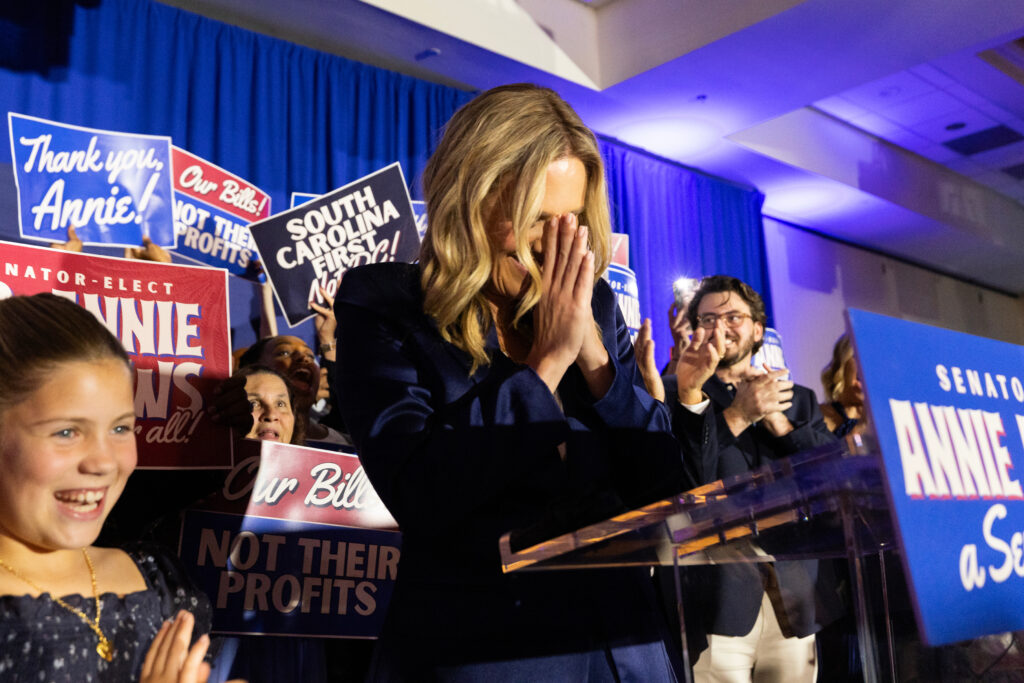
Many Democrats rode a blue tidal wave to victory Tuesday in close races across the country, including in some deep red states that have reliably elected Republicans for decades.
There were also some Republicans who withstood the tide to notch historic or notable victories.
Here are just 10 examples:
Annie Andrews — South Carolina, U.S. Senate
Andrews, a pediatrician who has never before held elected office, beat Republican incumbent Darline Graham in one of the biggest upsets of the night. Graham was appointed to the seat in July after the death of her brother, Lindsey Graham. Andrews becomes the first Democrat from the Palmetto State to win a Senate seat since Fritz Hollings in 1998, as well as the first woman elected to the U.S. Senate from the state. (Graham became the first woman to represent the state in the Senate, but was appointed.) Andrews lost a previous congressional race, to Republican Nancy Mace in 2022.
Adam Hamilton — Kansas, U.S. Senate
Hamilton, a megachurch leader and first-time political candidate, defeated incumbent Republican Roger Marshall, in another upset. Hamilton is the first Democrat elected to the U.S. Senate from Kansas in nearly a century. He founded the Church of the Resurrection, the nation’s largest United Methodist congregation, with roughly 24,000 members. Marshall’s campaign was dogged by reports that he and his medical practice sued more than 700 patients over unpaid medical bills during his decades as an OB/GYN before entering Congress.
Abdul El-Sayed — Michigan, U.S. Senate
El-Sayed, who formerly led Detroit’s health department, defeated Republican Mike Rogers in a heavily contested battle. El-Sayed, a son of Egyptian immigrants who has never before held elective office, is the first Muslim elected to the U.S. Senate and has advocated ending U.S. taxpayer support for Israel’s military. On Sunday, his Democratic primary opponent, Rep. Haley Stevens, unexpectedly withdrew her support for El-Sayed and endorsed Rogers.
Troy Jackson — Maine, U.S. Senate
Jackson, a fifth-generation logger and former president of the Maine Senate, defeated one of the Senate’s longest-serving members, Republican Susan Collins. The victory is especially notable because Democrats were thrown into turmoil after their initial nominee, Graham Platner, stepped aside following allegations of sexual misconduct. And Collins is a political institution in Maine — a five-term incumbent and chair of the Senate Appropriations Committee.
Gina Hinojosa — Texas, governor
Hinojosa, who has served in the Texas House since 2017, will become the first Latina governor of Texas and the first Democrat elected governor of the state since Ann Richards more than three decades ago. She was long considered the underdog in her challenge to Republican incumbent Greg Abbott, who was seeking a fourth term. She is a civil rights attorney and former president of the Austin school board.
James Talarico — Texas, U.S. Senate
Talarico, a Democratic Texas state representative, defeated Texas Attorney General Ken Paxton in another upset. Texas had not elected a Democrat to the U.S. Senate since 1988, when Lloyd Bentsen won his final reelection campaign. Talarico is a former public school teacher and Presbyterian seminarian. Paxton defeated Sen. John Cornyn, the incumbent, in the Republican primary with support from President Donald Trump. But some considered Paxton vulnerable because of past legal and personal scandals.
Keisha Lance Bottoms — Georgia, governor
Bottoms, a former mayor of Atlanta, defeated Republican businessman Rick Jackson in another notable victory for Democrats. She is the first Black woman ever elected governor in the United States and the first Democrat elected governor of Georgia since Roy Barnes in 1998. Bottoms, an attorney, served as mayor from 2018 to 2022 and later as a senior adviser to President Joe Biden. Georgia Gov. Brian Kemp (R) was barred from running again because of term limits.
Rob Sand — Iowa, governor
Sand, Iowa’s state auditor, defeated political newcomer Republican Zach Lahn. Republicans had controlled the governorship in Iowa since 2011, so the victory was considered another upset. Sand, a former prosecutor, is the only Democrat holding statewide elected office in Iowa. But Sand crafted an image as a moderate and stressed bipartisanship in his run. Iowa Gov. Kim Reynolds (R) decided not to run for reelection after nearly a decade in office.
Byron Donalds — Florida, governor
Donalds, a Republican congressman from Southwest Florida, will make history as Florida’s first Black governor. He survived a challenge from Democrat David Jolly, a former Republican and former congressman who later switched parties. The victory was particularly notable for Republicans because it came amid a national wave of Democratic victories, including in some congressional races in Florida. Gov. Ron DeSantis (R) could not run for reelection because of term limits. Donalds, an ally of Trump, previously served in the Florida legislature before his election to Congress in 2020.
Marshall Rawson — Florida, state House
Rawson, a Republican lawyer and farmer, won a seat in a deep-red North Florida district. The race attracted national attention after revelations that he marched alongside neo-Nazis at the 2017 Unite the Right rally in Charlottesville, where participants carried torches through the University of Virginia campus and chanted “Jews will not replace us.” Rawson told Action News Jax that he attended the rally to defend the Robert E. Lee and Stonewall Jackson monument. He has also been involved with the League of the South, a pro-secession neo-Confederate group that the Southern Poverty Law Center identifies as a white-nationalist hate group.
What surprised you about Tuesday’s election results? Share your thoughts in the comments.
The post 10 momentous midterm election victories appeared first on Washington Post.