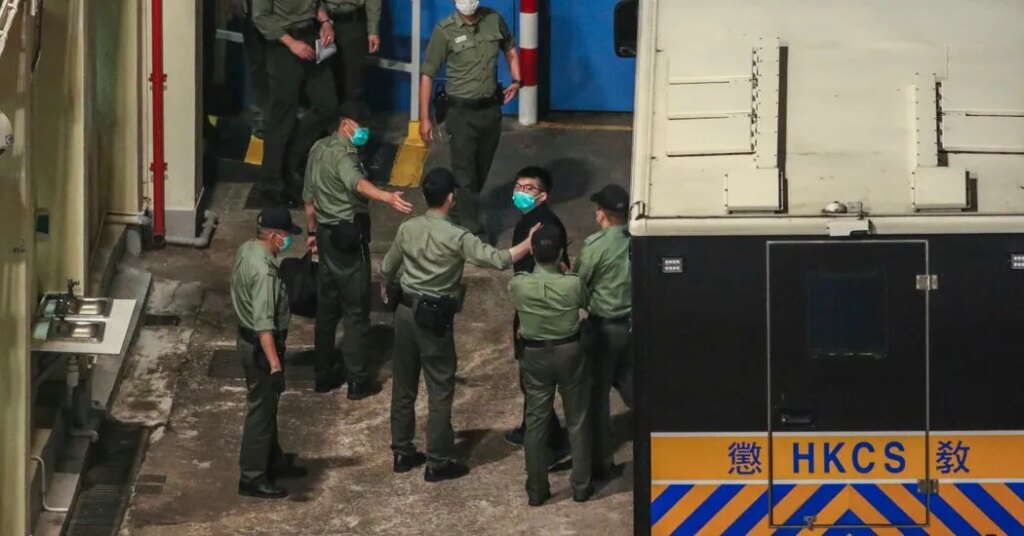
Joshua Wong, a key figure in pro-democracy protests in Hong Kong, was sentenced on Thursday by a Hong Kong court to 10 years in prison on charges of conspiracy to collude with foreign forces, a national security offense.
Speaking in court on Thursday, Judge William Tam ruled that Mr. Wong’s offense was of a “grave nature,” which the national security law stipulates must result in a sentence of no less than 10 years.
Judge Tam said that Mr. Wong and Nathan Law, a fellow activist who had fled to Britain, were the “ringleaders” of a conspiracy to lobby foreign governments with “blatant calls for sanctions and hostile measures” and it was necessary for the severity of the punishment to act as a deterrent.
Standing behind the dock, Mr. Wong, in a navy blue shirt, took notes as the judge spoke and appeared crestfallen as his sentence was announced. Before he was led away by police officers, Mr. Wong looked toward the public and press gallery. He smiled and said “thank you to you all” in Cantonese.
Mr. Wong, 30, was accused in 2025 of conspiring to lobby lawmakers, particularly those in the United States, to impose sanctions on Hong Kong and China. The maximum penalty for colluding with foreign forces is life in prison. Mr. Wong had pleaded guilty.
With virtually all national security cases ending in convictions, an increasing number of activists have chosen to plead guilty for a one-third reduction in sentence as part of a “harm reduction strategy,” said Thomas Kellogg, the executive director of the Georgetown Center for Asian Law.
Mr. Wong began his activism at age 14. He has already spent nearly six years behind bars as part of a conviction in a separate national security case and, according to friends, had been counting the months to his release in January before he was hit by the new charges.
Friends of Mr. Wong said he struggled with the prospect of another long sentence. Chin Sze-man, who visited him in prison after the new charges were filed, said in an interview that it looked like “hope had disappeared from his eyes.”
Legal experts said ahead of Thursday’s sentencing that it was aimed at dampening Mr. Wong’s influence.
“To many observers, he represented the Hong Kong pro-democracy movement’s future: not only young, but also charismatic, a gifted communicator, and an activist willing to take enormous personal risks,” said Eva Pils, a professor in international human rights law at FAU Nuremberg, Germany.
She added, “Putting Wong behind bars for so many years is probably intended to diminish his presence in the public mind and make his image fade away.”
Beijing imposed a national security law on Hong Kong in 2020 that explicitly criminalized calls for sanctions and other forms of dissent.
“The ‘conspiracy to collude with foreign forces’ charge effectively paints him as a traitor,” said Steve Tsang, director of the SOAS China Institute in London. He added that China’s ruling Communist Party had decided that Hong Kong’s pro-democracy movement in 2019 was “an open rebellion” against the party. “Joshua is seen as a leading light guiding Hong Kong’s ‘unpatriotic’ acts,” he said.
In 2012, when Mr. Wong was 14, he co-founded a student group called Scholarism opposing government plans to introduce a mandatory “moral and national education” course, which he said amounted to political indoctrination and “brainwashing.” Tens of thousands of protesters turned out outside government headquarters in support of Mr. Wong’s cause, and the government was forced to backpedal on its plans.
Two years later, in 2014, he became the distinctive face of young activists calling for freer elections in Hong Kong. The group held student strikes outside the government headquarters and pitched tents that blocked traffic in the city’s central business district for weeks. The protests became known as the Umbrella Movement.
By the time an unpopular extradition bill touched off months of antigovernment protests in 2019, “a lot of Joshuas emerged,” said Chan Kin-man, a prominent pro-democracy activist and former sociology professor at the Chinese University of Hong Kong, now living in Taiwan.
But as a pioneering young activist, Mr. Wong had something others lacked: an international profile.
“He was already an icon. Many people in the West knew him. So he was able to meet political heavyweights in the United States,” he said. “It’s also this special role that has led him to such trying circumstances.”
In his five years behind bars, Mr. Wong has maintained a routine in which he has read widely, taken business courses, exercised and written letters, his friends said in interviews.
“Typical people develop their careers for eight to ten years before they have energy left for the public good,” he wrote in a letter to a friend in January, reviewed by The New York Times. “But for most of us born after the 90s it is the opposite.”
In the letter he had said that he was looking forward to his release in 2027, and that he hoped to gather with friends in 2032 to mark 20 years since they created Scholarism.
Louis Lee, who frequently visits and writes to Mr. Wong, said that he has never given up, despite uncertainty over his future.
In a letter in 2025, also seen by The Times, Mr. Wong wrote that “the world has not been gentle” to him at all, but he would persevere.
“In this world where action seems fruitless, I will strive with all my might,” he wrote.
The post Joshua Wong, Hong Kong Democracy Activist, Is Sentenced to 10 Years in Prison appeared first on New York Times.