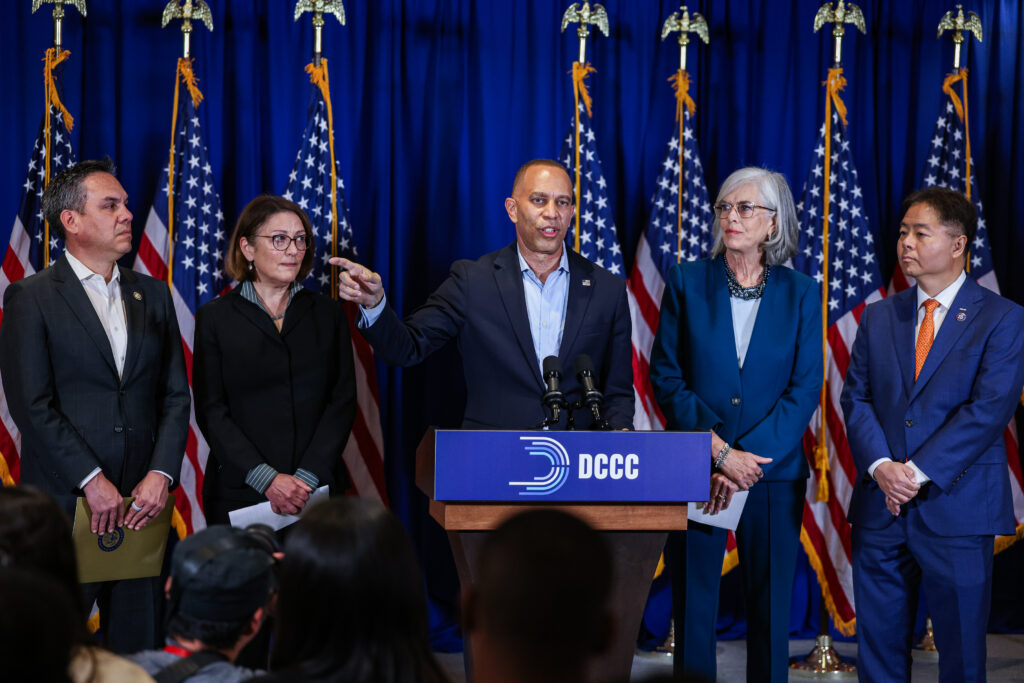
Once the euphoria fades from Tuesday night, when Democrats decisively won back both the House and Senate, their new majorities face a sobering task: figuring out how to wield their power in the final two years of President Donald Trump’s tenure.
With committee gavels in hand, Democrats will be empowered to investigate Trump — and many have already made clear they plan to probe all manner of alleged corruption by the president, his administration, his family and his corporate allies.
But Democrats also argue they cannot — and will not — only be the anti-Trump party when they take control of both chambers in January with majorities larger and more ideologically diverse than anticipated. They have repeatedly stated they must materially improve the lives of voters or risk quickly losing Congress again.
“The American people have chosen House Democrats because they want to see a dramatic change in direction,” House Minority Leader Hakeem Jeffries (D-New York), who is likely to become the nation’s first Black speaker, said Wednesday at a news conference with his leadership team. “That’s exactly what House Democrats will deliver.”
The party’s policy agenda remains vague. Though Democrats pledged on the campaign trail to tackle affordability, they have been light on legislative specifics, floating broad plans to reverse Trump’s cuts to health care funding, roll back his sweeping tariff regime and block his ability to wage war in Iran.
As long as Trump is still in the White House, most anything Democrats might hope to accomplish is dead on arrival without the president’s buy-in, setting the stage for an awkward dance in which Democratic leaders are stuck negotiating with the same man for whom they are publicly demanding accountability.
Merely keeping the government open by passing spending bills, for example, will require some give-and-take between the congressional and executive branches.
Finding a balance could be challenging as Democrats face pressure from a liberal base thirsty for revenge. Rep. Robert Garcia (D-California), the California Democrat who is expected to lead the House Oversight Committee that will be central to investigating Trump, captured the spirit of gleeful retribution in a short, all-caps statement after his party secured the House: “LAWYER UP.”
In an interview, Garcia said those priorities go hand in hand.
“People are struggling because of corruption,” Garcia said. “People can’t afford to pay the gas and the groceries because Donald Trump is ripping off the American people.”
A wave larger than American politics has seen in decades swept Democrats to at least 54 seats in the Senate, with two races still to be called, and a sizable majority in the House with a few dozen races still up in the air. Those margins give the party room next year to maneuver on passing bills, but they could also surface tensions over whether to veer to the left or the center.
Some lawmakers argued they did not emerge with a specific policy mandate from the American people, because the election was primarily a repudiation of Trump and Republican policy.
“The argument was focused, understandably, on rejecting Trump’s corruption, his wars, his cruelty and his indifference to people’s economic pain,” Sen. Chris Van Hollen (D-Maryland) said in an interview. “We need to not only tell people what we’re against, although that’s obviously very important in the midterm, but we need to show people what we stand for.”
Different wings of the party can claim important victories from Tuesday. Populist progressive Troy Jackson was the candidate to finally defeat stalwart Sen. Susan Collins (R-Maine); to win the Senate, however, Democrats captured at least six — and potentially eight — states that favored Trump by double digits in 2024. Senators from those states are likely to be cognizant of the more conservative electorates that sent them to Washington.
The Blue Dog coalition of moderate House Democrats bragged about more than doubling in size by flipping red districts, while the Congressional Progressive Caucus is also welcoming dozens of new members.
Rep. Greg Casar, the Texas Democrat who leads the Progressive Caucus, said in an interview that candidates across the country won on anti-corruption and economic populist ideas that progressives have been championing for more than a decade. He said the entire party has an opportunity now to unite around those policies, including ending super PACs, increasing the federal minimum wage, banning congressional stock trading, taxing billionaires and cracking down on high credit card interest rates.
Democrats should pass legislation that shows they “can fight for real change” and force Trump to “put up or shut up,” Casar said. If he won’t sign these measures, it just further makes the case to voters why they should elect a Democratic president in 2028.
Others Democrats argue that passing “messaging” bills with no prospect for Trump’s signature is not a good use of their time.
Rep. Adam Gray (D-California), who leads the Blue Dogs, agreed with Casar’s strategy but encouraged his colleagues “not to yell and scream about your ideas that aren’t gonna get done” and focus on practical objectives that could pass the Senate.
“I welcome the ideas of all my colleagues, including the Progressive Caucus,” he said. “I just want to spend 80 percent of our time on things that we agree on.”
There will probably be public rifts among House Democrats — particularly in a large majority — but Democrats owe it to the American public to navigate the differences and pass policy to lower prices, said Rep. Greg Stanton (D-Arizona), chair of the New Democrats Action Fund, a campaign operation.
Basking in their electoral success, lawmakers from across the ideological spectrum projected harmony on Wednesday.
Members of the moderate-leaning New Democrats Coalition will work with anyone, even Republicans, to bring down the cost of living, said Rep. Brad Schneider (D-Illinois), who chairs the group. Their “first, second, and third priority legislatively is making life easier for folks,” he said, including by addressing housing prices, expanding health care access and undoing cuts to SNAP, the nation’s largest food assistance program.
“We need everyone to put their oars in the water and start rowing forward together,” Schneider said.
Senate Minority Leader Chuck Schumer (D-New York) pointed to MS NOW’s “Morning Joe” program, where both Sen.-elect Adam Hamilton (D-Kansas), who campaigned as a moderate, and Sen. Cory Booker (D-New Jersey), who holds more progressive views, appeared Wednesday morning and took “remarkably similar” positions.
“If you listened to our candidates, whether they were progressive or more moderate — and we had some of each, because we’re a big tent party — they were saying the same things,” Schumer told reporters.
Undoing many of the cuts from Trump’s so-called One Big Beautiful Bill last year will be a major theme for Democrats, who have called to restore tax credits for the Affordable Care Act and funding for SNAP.
“In my district alone, food bank use is still off the charts and increasing,” Rep. Marilyn Strickland (D-Washington) said in an interview.
Democrats are also likely to make a renewed push to end the Iran war, which they blame for the soaring prices for gasoline, food and other goods that set off the electoral backlash to Trump and congressional Republicans.
Trump remains the biggest wild card. His administration has adopted a siege mentality as it prepares to fight back next year against wide-ranging Democratic investigations into his growing wealth in office, his remaking of the federal government and his pursuit of his political enemies.
But after being dealt a historic rebuke on Tuesday night, Trump struck a more conciliatory tone than typical, suggesting he could collaborate with Democrats in Congress.
“We’ll, you know, look forward to working with them,” he told the New York Times. “We’ll probably work something out.”
He told Politico that “I don’t want to just be sitting there for two years vetoing everything.”
Jeffries — who has dealt with racist attacks from Trump in the past — did not directly answer questions Wednesday about if or when Democratic leaders might sit down with Trump. He told reporters that neither he nor Schumer had heard yet from the president.
But some Democrats from battleground areas, possibly facing less favorable political conditions in two years, might be eager to work with the president. So could those eyeing higher office who might like to spruce up their résumés before going to the voters to ask for a promotion.
“We have got to find a way to get Republicans on board,” Sen. Mark Kelly (D-Arizona), one of many senators who have been floated as a potential 2028 contender, said in an interview. He cited suspending fuel taxes and establishing a more reasonable approach to immigration enforcement as potential areas to collaborate with Trump.
“He is often unpredictable,” Kelly said. “What does he want the last two years of his presidency to be like?”
Lurking in the background, however, is the possibility of impeaching Trump for a third time — a potential outcome of the planned investigations that many Democratic voters are eager to see.
Party leaders have publicly dismissed the idea of burning political capital on such an endeavor, given that Trump would be unlikely to be convicted in the Senate and removed from office. But not everyone is taking it off the table.
“Our goal should be ending corruption, putting a check in place on the lawless, reckless president,” Rep. Jason Crow (D-Colorado), who served as an impeachment manager during Trump’s first impeachment trial, said in an interview.
“I wouldn’t hesitate to use impeachment if I thought that that was the right tool,” Crow said. “I have in the past, and I will in the future if that’s the case. But we have to see what type of majority we have, how many votes we have, what type of coalition we can build.”
Theodoric Meyer and Erin Cox contributed to this report.
The post Democrats face a choice on Trump come January: Confrontation or compromise appeared first on Washington Post.