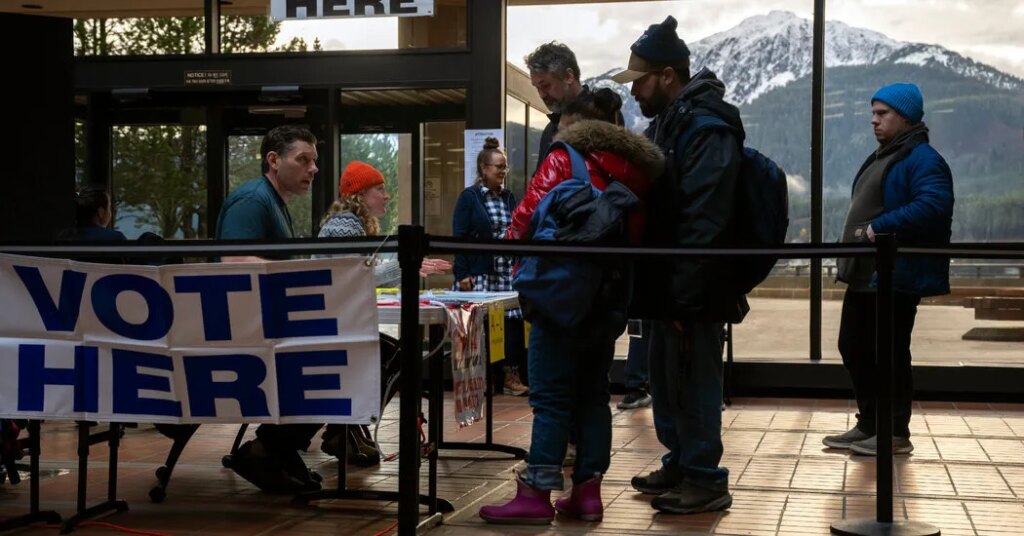
Control of the U.S. Senate has already been determined, with 33 of the 35 contests being called within hours of polls closing. In Alaska and Mississippi, however, no race calls have been made for the Senate and it could be quite some time until either contest is decided, even as some additional vote totals trickle out in the coming days.
In both cases, the Democratic nominee is clinging to a slim lead, but the reasons for the lack of a call are far different.
What We Know in the Alaska Senate Race
Alaska’s Senate race could take days or weeks to be called. Mary Peltola, the Democratic nominee, had a lead of fewer than 1,000 votes as of Wednesday afternoon, but nearly a quarter of the expected votes remain uncounted.
The bulk of the remaining vote is in the form of mail-in ballots. Some were cast close to Election Day, while others were postmarked by Election Day and will be received in the days after. A smaller chunk of early in-person ballots are also outstanding.
The deadline to tabulate all ballots, including provisional ballots, is Nov. 18. That is also the date that ranked-choice tabulation will begin, should neither Ms. Peltola nor Senator Daniel S. Sullivan, the Republican incumbent, cross the 50 percent threshold needed to win the election in the first round.
While the late mail vote typically leans toward Democrats, multiple factors could undercut Ms. Peltola’s possible advantage, including how many ballots will be received and how many are from voters who did not rank additional candidates beyond their first choice. There is also the potentially confounding presence of the other two candidates on the ballot, Gerald L. Heikes and Daniel J. Sullivan Jr.
A New York Times analysis of the available ranked-choice data pulled from each voter’s ballot shows that more than a third of voters who ranked Mr. Heikes or Daniel J. Sullivan Jr. as their first choice did not rank another candidate. That means these ballots would not count toward either Ms. Peltola or Senator Sullivan in subsequent rounds of the ranked-choice tabulation.
What We Know in the Mississippi Senate Race
As of Wednesday evening, Scott Colom, the Democratic nominee in Mississippi, had a lead of roughly 1,000 votes over Senator Cindy Hyde-Smith, the Republican incumbent. Because the margin is so tight, The Associated Press may not be able to make a race call until the state certifies a winner.
Mississippi is somewhat of an outlier in that it does not have a mechanism for automatic recounts, and has no method for a candidate to contest the election, so a court order would be required to initiate a recount.
Nearly all of the votes have been counted in the race, but a smattering of provisional ballots — which are ballots given to those with questions about their eligibility to vote — are still waiting to be counted, as are some late-arriving mail ballots. According to Mississippi’s secretary of state, there are approximately 3,600 outstanding mail ballots that could arrive in time to be counted.
Mississippi’s Supreme Court ruled in June that the state must accept mail-in ballots that arrive by the Tuesday after Election Day — this year, Nov. 10. And provisional ballots in the state must be tallied by that day as well. For a provisional ballot to be accepted, the voter is required to provide proper identification to elections officials, obtain a state voter ID card, or submit a religious exemption.
Some counties in the state have said they hope to begin releasing some results of provisional ballots on Wednesday. It is currently unknown how many ballots remain uncounted statewide. Adding a layer of complexity, ballot processing and counting, which includes ruling on provisional ballots, is conducted by each county’s five-person elections commission rather than a single elections official.
In 2024, the state had just under 15,000 provisional ballots, of which 70 percent were accepted. In 2022, the state had about 5,700 provisional ballots, of which 75 percent were accepted.
Evan Peng contributed reporting.
The post What We Know (and Don’t Know) in the Alaska and Mississippi Senate Vote Counts appeared first on New York Times.