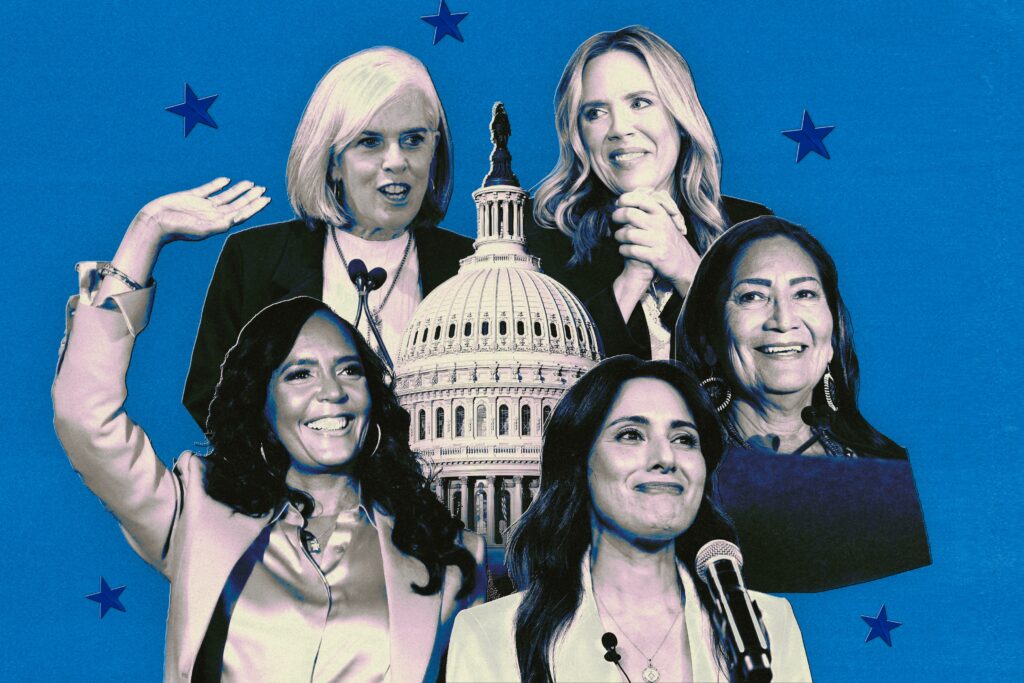
Women will lead more states as governors and represent more congressional districts than at any time in American history come January.
The blue wave putting Democrats back in control of Congress is also creating a House Democratic caucus that looks much more like the nation, in terms of gender, than ever before. Democratic women’s gains also widen a significant gap between the number of Democratic women and Republican women in power.
For the first time, next year, more than 100 Democratic women will serve in the U.S. House, according to Associated Press race calls and a tally by the Center for American Women and Politics at Rutgers University.
With dozens of races still uncalled Wednesday morning, Democratic women had already locked up at least 102 seats. And Democratic women were leading in more than a dozen other races.
“That kind of representation, seeing us move over that 100-woman mark — it matters,” House Minority Whip Katherine Clark (D-Massachusetts) said, speaking at a coffeehouse in Kissimmee, Florida, days before the election. “I think that’s important for people to be able to look at Congress and see themselves reflected back.”
Democratic women had also won more than six times as many seats as Republican women, who had claimed 16. Four more Republican women were ahead in races not yet decided. If those leads hold, Republican women’s presence in the House would shrink from 30 seats to 20.
If the current leads hold, women would make up about 30 percent of the House, though the chamber would still fall short of fully reflecting a country that is about 51 percent female.
Fifteen women won governor’s races Tuesday, and a 16th, Democrat Cindy Holscher in Kansas, was narrowly ahead in a race that had not been called. Among the winners was Democrat Keisha Lance Bottoms in Georgia, who will be the first Black woman governor in U.S. history.
It was a night of firsts. In Ohio, Democrat Amy Acton will become the first woman elected governor of Ohio. In New Mexico, Democrat Deb Haaland will be the nation’s first Native American woman governor. Democrat Gina Hinojosa will become the first Latina governor of Texas.
“A lot of Latinas in Texas grew up hearing ‘No te dejes’” — which translates to “don’t let yourself be pushed around” — “from their own mothers and abuelas,” Hinojosa said in her victory speech. “This year, we lived them, and we changed this state.”
Sen. Marsha Blackburn (R) was elected Tuesday as Tennessee’s first woman governor. And two female Republican governors, Kelly Ayotte in New Hampshire and Sarah Huckabee Sanders in Arkansas, won reelection.
In 1985, the two parties had about the same number of women in the House: 12 Democrats and 11 Republicans. That’s when Emily’s List, a group that trains, endorses and fundraises for Democratic women who support abortion rights, was founded. Democrats such as Rep. Lori Trahan (Massachusetts) credit such groups and other political infrastructure created to support women for the gains since then.
“You have to be really intentional about making progress like that,” said Trahan, who came to the House in 2019 as part of a class that Clark, the Democratic Congressional Campaign Committee’s vice chair for recruitment at the time, helped recruit.
Clark, a seven-term Democrat, is positioned to become the first woman to serve as House majority leader. It is not a glass ceiling as high as the one Rep. Nancy Pelosi (D-California) broke nearly 20 years ago when she became the first woman speaker, but it is a sign of the pipeline of Democratic women ascending Washington’s ranks of power.
Tuesday’s historic numbers come 10 years after Hillary Clinton’s loss to Donald Trump. Clinton’s defeat in the 2016 presidential election, in some ways, built this wave.
In the two years before that election, about 900 women contacted Emily’s List about running for office; by the end of 2017, more than 25,000 had, according to the group. The surge showed up in 2018, when a record 36 women were newly elected to House seats. Three members of that class will lead states in January: Abigail Spanberger and Mikie Sherrill, who won the Virginia and New Jersey governorships last year, and Haaland.
No woman has yet won the presidency, and Kamala Harris’s 2024 loss to Trump revived quiet doubts among some Democrats about whether women can win, NBC News reported last year. Sherrill said then that she heard those doubts from party insiders.
Rep. Kat Cammack (Florida), chairwoman of the Republican Women’s Caucus, said she is not surprised that gains among Republican women in recent decades have been far more meager compared with Democratic women. Plenty of barriers still hold them back, she said.
Women with children often are questioned about running for office while parenting, she said, and female candidates get labeled “a certain way” when fundraising with the “exact same amount of aggressiveness” as men.
“The fact remains that within the GOP we have to do a better job of recruiting women,” Cammack said. “We are looking at people’s résumés rather than the person themselves and how they match up to the district, and that has been a consistent struggle.”
The Florida congresswoman said she has witnessed many instances in which a Republican woman who had maybe served as a mayor, a sheriff, a business leader or a “titan” in her community was overlooked by the GOP “because the guy standing next to her could self-fund the race, and he gets all the institutional support.”
House Republican Conference Chair Lisa McClain (Michigan), the highest-ranking woman in the House GOP, sees the issue differently. Asked about the party’s struggle to build a pipeline for female candidates, she said in a statement that the GOP is the “only party that can identify what a woman is,” a reference to the debate over transgender rights.
“Moreover, we are the only party that believes in issues women care about: protecting girls’ sports, defending parental rights, and helping hardworking families keep more of their money,” she said.
Democrats are planning a variety of bills to advance issues of particular importance to many women, such as child care and maternal health, Clark said.
Clark, for one, has long championed making child care more affordable.
“Most parents make decisions around child care, but we know the majority of that burden falls on women,” she said.
Even with a new Senate majority, it may be difficult for Democrats to notch legislative wins under President Donald Trump, who can veto their bills.
Still, some Democratic women said they remain optimistic about being able to strike deals with Republicans on these issues.
“If you think about these issues, especially around caregiving, whether it is child care, caring for our disabled loved ones or caring for our elders … those issues don’t discriminate by party affiliation,” said Rep. Marilyn Strickland (D-Washington).
Cammack agreed. She has championed bipartisan legislation that serves women, including two measures that mandated clean, private lactation spaces in airports and federal buildings.
“If we have people that are wanting to work towards the goal of better care and accessibility without it actually hurting people in the long run, I think there’s room for us to come together,” she said.
Chris Hacker contributed to this report.
The post Democratic women surge past 100 House seats as Republican women lose ground appeared first on Washington Post.