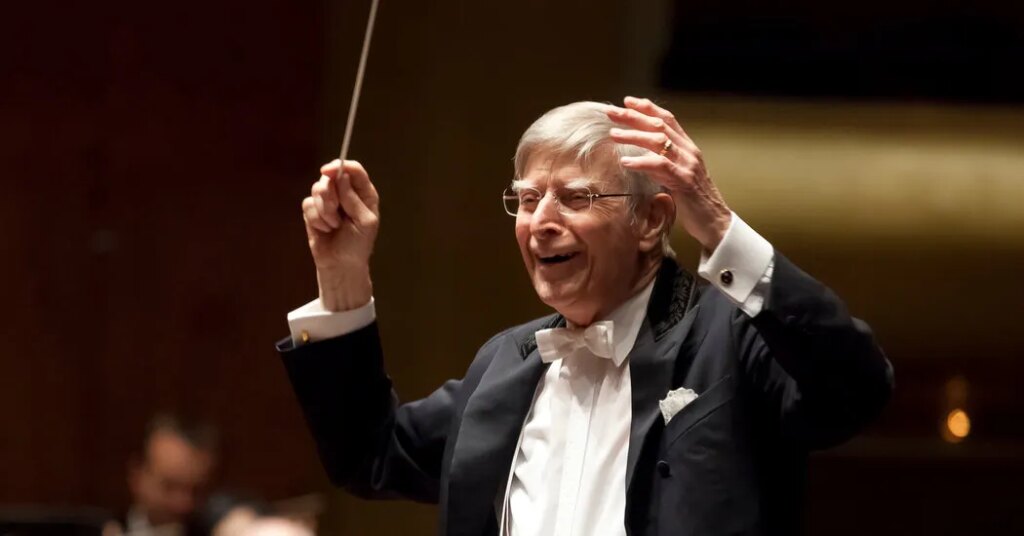
Herbert Blomstedt, a self-effacing, spiritually minded, often underrated conductor who appeared with the world’s finest orchestras until virtually the end of his long life, died on Wednesday at his home in Gothenburg, Sweden. He was 99.
The death was announced in a statement by his management company, KünstlerSekretariat am Gasteig. He last appeared in concert in May, when he led the San Francisco Symphony in Mahler’s Ninth Symphony.
Mr. Blomstedt held a series of eminent positions over his extraordinarily long career. He led the Staatskapelle Dresden in Germany from 1975 to 1985, the San Francisco Symphony from 1985 to 1995, and another venerable German orchestra, the Gewandhaus of Leipzig, from 1998 to 2005.
Despite his substantial tenures at these prestigious ensembles, he never achieved the celebrity status of more glamorous colleagues, perhaps because he believed that a conductor “is just one musician among many,” as he told The New York Times in 1986. He modestly said that he had no desire to establish “some kind of ‘Blomstedt sound’” in the groups he led.
Blomstedt sound or not, orchestras continued to want him. His calendar was still crowded as a guest conductor — and his reputation only improved — as he passed 90, then 95, well after even the most hardy maestros have usually retired their batons.
He took some breaks after falls, but kept returning to the podium. His longevity and calm authority led him to be reconsidered — and eventually deemed something of a sage — by many who had once taken him for granted.
“Wisdom may not be a given with Blomstedt’s age, but it’s undeniable in his artistry,” Joshua Barone wrote in The Times in 2024. “Perhaps because of physical limitations or personal preferences, or both, his conducting in recent years has had the kind of economy that comes with experience.”
A committed Seventh-day Adventist who abstained from alcohol and caffeine, Mr. Blomstedt refused to rehearse on Friday evenings or Saturdays — his religion’s Sabbath, when work is banned. While this hindered his early job prospects, other ensembles, including in San Francisco, proved more accommodating.
Mr. Blomstedt was happy to perform on the Sabbath, however, because he considered leading a concert not work but “a celebration, a spiritual communication.”
“I feel that I have an inner obligation to serve, which as a musician is best done by making music,” he told The Times in 1986. “I think that musicians must have a dominating spiritual dimension, they must be men of faith — Christians, Jews, Hindus, whatever — who share a longing for spiritual qualities in their lives and in their art.”
Mr. Blomstedt had a special affinity for Bruckner, describing the composer’s music in a 2011 interview as “very personal” and “full of emotions, but it’s not Bruckner’s emotions.”
He added, “It’s like Beethoven’s music: He speaks for us all.”
In 1996, Mr. Blomstedt lent “authority and deep feeling” to a performance of Bruckner’s Sixth Symphony, Anthony Tommasini wrote in a review in The Times. Mr. Blomstedt led the hourlong work from memory.
He continued to conduct from memory late in life, as in 2016, during a Beethoven performance with the Gewandhaus Orchestra at the BBC Proms in London. The Financial Times described him as “looking impressively agile for a man in his 90th year.”
Mr. Blomstedt’s work was not always praised. In 2004, Allan Kozinn, writing in The Times, described his performance with the Royal Concertgebouw Orchestra of Amsterdam as “conducting alchemy at its best.” But he was disappointed by a concert Mr. Blomstedt led later that year. The Gewandhaus, Mr. Kozinn wrote, “had just about every problem an orchestra can have,” including ragged entrances and iffy intonation.
Quibbles aside, Mr. Blomstedt largely impressed, even as a nonagenarian, with vibrant, tasteful interpretations.
A Mendelssohn performance with the Vienna Philharmonic in 2024 showed that Mr. Blomstedt was “a master of balance,” Mr. Barone wrote in The Times.
Ten years before, the critic Joshua Kosman had written in The San Francisco Chronicle that a Bruckner concert “served as yet another reminder of how assiduously Blomstedt keeps on reconsidering and reinterpreting the masterpieces of the orchestral repertoire.”
When asked in 1988 about the ultimate purpose of music, Mr. Blomstedt replied that “it has a potential for changing lives.”
“I’m not so naïve,” he said, “that I think that everybody goes out of the concert hall after a Bruckner symphony saying: ‘I won’t do so many bad things tomorrow. I’ll treat my wife nicer.’”
But, he added, “to experience the order and beauty of great music brings the listener in contact with something that is greater than himself.”
Herbert Thorson Blomstedt was born on July 11, 1927, in Springfield, Mass., to Swedish parents. His father, Adolphe Blomstedt, was an Adventist doing missionary work; his mother, Alida (Thorson) Blomstedt, was a pianist.
The family moved back to Sweden in 1929 and Mr. Blomstedt studied piano, violin and organ as a child, receiving his first lessons from his mother. One of his early musical memories was of her playing Chopin at bedtime.
He studied conducting at the Royal Academy of Music in Stockholm, and music, religion and philosophy at Uppsala University. As a postgraduate student he was mentored by Jean Morel at Juilliard and Leonard Bernstein at the Tanglewood Music Center, where Mr. Blomstedt won the prestigious Koussevitzky Prize in 1953. He later said that he got to Tanglewood by mustering up the courage to knock on Bernstein’s door in New York City, and the great conductor personally interceded in helping Mr. Blomstedt gain admission.
Mr. Blomstedt made his professional debut in 1954, leading the Royal Stockholm Philharmonic Orchestra, and the same year was appointed music director of Sweden’s Norrkoping Symphony Orchestra, where he remained for seven years. He also had stints at the helms of the Oslo Philharmonic, the Danish Radio Symphony Orchestra and the Swedish Radio Symphony Orchestra.
His extensive discography includes the complete symphonies of Beethoven and Schubert with the Dresden Staatskapelle. A champion of Scandinavian composers, he recorded the complete symphonies of Sibelius and Carl Nielsen with the San Francisco Symphony. He also recorded contemporary music, including works by Charles Wuorinen, John Harbison and Einojuhani Rautavaara.
Mr. Blomstedt’s wife, the former Waltraud Petersen, whom he married in 1955, died in 2003. They had four daughters, Elisabet Hafstad, Cecilia Blomstedt, Maria Astrom and Kristina Blomstedt, who are among his survivors.
At a certain point in his career, Mr. Blomstedt was broadly perceived as solid, old-fashioned, professional.
“Nothing went seriously wrong when he was around, and nothing went dramatically right,” Martin Bernheimer wrote in The Los Angeles Times in 1986 of his past appearances with the Los Angeles Philharmonic. “He impressed as a strong technician, a tasteful analyst and a rather bland, sometimes ponderous interpreter.”
But, Mr. Bernheimer added, Mr. Blomstedt had recently taken the position in San Francisco, where “he has become almost everyone’s hero at 59.”
Four decades later, though he remained a low-key presence on the podium, that sense of the conductor as hero was widespread.
The post Herbert Blomstedt, Low-Key, Long-Performing Maestro, Dies at 99 appeared first on New York Times.