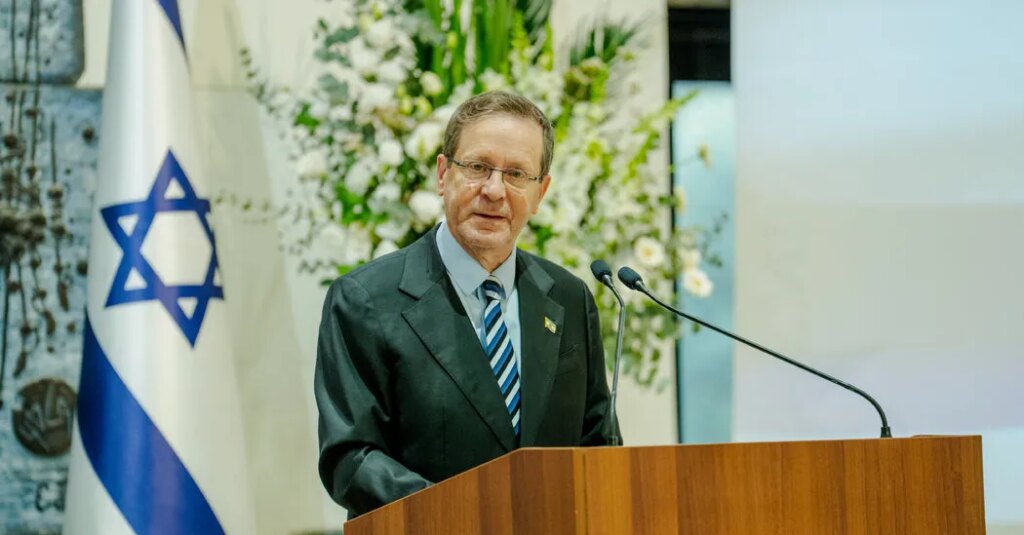
President Isaac Herzog of Israel will begin meetings with party leaders and officials on Wednesday to decide who will get the first chance at trying to form a government after last week’s inconclusive election.
Over the next two days, Israeli politicians will hold discussions with Mr. Herzog at the president’s official residence in Jerusalem. They will make their cases for why either Prime Minister Benjamin Netanyahu, his leading rival, Gadi Eisenkot, or another candidate should be given the mandate.
The Israeli president will meet on Wednesday afternoon first with the far-right Religious Zionism party, led by Finance Minister Bezalel Smotrich, then with Avigdor Liberman’s right-wing Yisrael Beiteinu party as well as the ultra-Orthodox Shas party. Parts of the discussions will be livestreamed.
Mr. Herzog urged the parties to compromise on some of their election demands in order to end the country’s political crisis.
“In the current reality, in which there is no clear winner after the elections, I ask for originality and creativity, courage and good will, so that the State of Israel emerges the winner,” he said on Wednesday.
Mr. Netanyahu and his current allies won 53 seats in Israel’s 120-member parliament in the recent election, and his Likud party won more votes than any other — defying critics who hoped that the vote would serve as a reckoning over his failure to prevent the Hamas-led Oct. 7, 2023, attacks. Mr. Eisenkot’s opposition bloc picked up 48 seats. Both fell short of a 61-seat majority.
While Mr. Herzog has few formal powers, the president does have the authority to choose the candidate whom he believes has the best chance of forming a government. That chosen party leader will then have up to six weeks to establish a coalition. If those efforts fail, Mr. Herzog can pass the mandate to another leader — and potentially a third.
If no one manages to form a government, Israel would head to new elections. Mr. Herzog has vowed to do everything in his power to prevent another vote, however that has been what has taken place at five other moments between 2019 and 2022.
Mr. Netanyahu and Mr. Eisenkot are both wrangling with allies and opponents alike to shore up their positions. Mr. Netanyahu will remain caretaker prime minister until a new government is formed.
Mr. Eisenkot is likely to be given the first chance to form a government, analysts say, as his anti-Netanyahu bloc won the most votes.
He could turn to two Arab parties, but doing so could be fraught.
Forming a coalition with Arab parties has long been taboo to many in Israeli politics, and become more contentious since the Oct. 7 attacks.
But some of his own would-be political partners are as opposed to one another as they are to the prime minister — especially over how far they are willing to cooperate with Raam and the Joint List, the two Arab parties.
On Tuesday, Mr. Netanyahu called for a “wide national government” with him as prime minister. He added that a “a clear majority of the Jewish public” had chosen his bloc and attacked the two Arab parties as “supporters of terrorism,” rhetoric that was widely seen as an effort to stymie Mr. Eisenkot’s to build a coalition.
The post Israel’s President Set to Start Talks on Who Can Form a Government appeared first on New York Times.