Welcome to this week’s Fortune Gulf Brief. We’ll be covering:
- Abu Dhabi’s flagship energy conference champions AI
- Saudi Aramco profits jump 35% as it targets full production capacity
- Why Bob Diamond is optimistic about Bahrain
- Oman and China strengthen commercial ties, establish $800 million joint investment fund
- And, the three we enjoyed reading this week
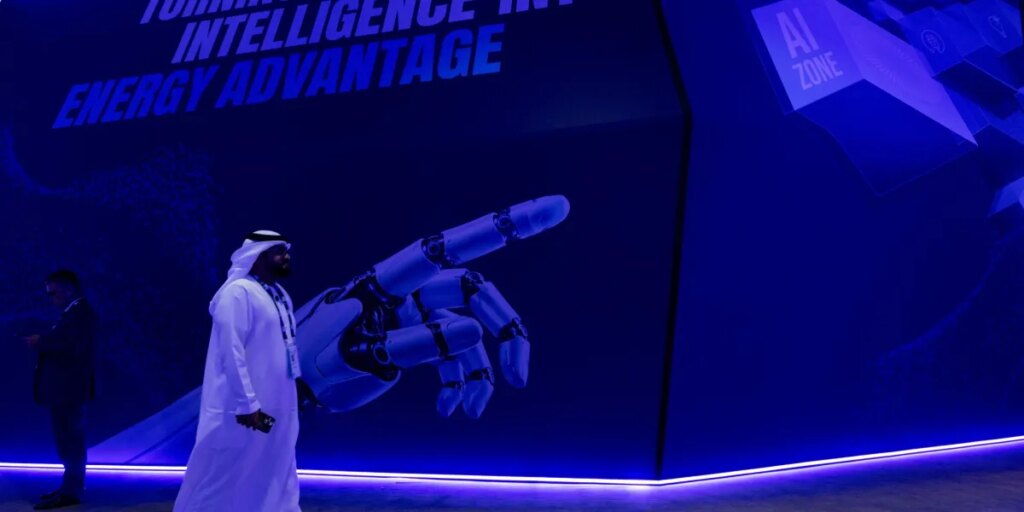
Many of the biggest names in the oil and gas industry have converged on Abu Dhabi this week to attend the emirate’s flagship annual energy conference, ADIPEC, with energy security a priority as the industry grapples with ongoing supply disruptions amid heightened geopolitical tensions.
Concerns over renewed U.S. strikes on Iran and the prospect of retaliatory action by Tehran have gripped oil markets in recent days. They also led both Exxon’s CEO Darren Woods and Chevron’s upstream president, Clay Neff, to withdraw from attending ADIPEC, citing security concerns.
But overall, the turnout has been strong, with heavyweights such as BP’s CEO Meg O’Neill, Baker Hughes CEO Lorenzo Simonelli, and Halliburton’s chairman and CEO Jeff Miller, all flying in to speak at the event.
Shell, TotalEnergies, Eni, ExxonMobil, Chevron, and Occidental Petroleum were also present among the 2,260 exhibiting companies. More than 120 U.S. companies are exhibiting this year, second only to China in number. In total, the event is expected to draw around 239,000 visitors from 170 countries.
Dr Sultan Al Jaber, UAE minister of industry and advanced technology and Group CEO of ADNOC, took to the podium during the event’s opening ceremony on Monday to set the tone for the days ahead.
“Energy leadership is not measured by what you produce in good times, it is measured by what you deliver in hard times,” he said. “The choices we make today will determine the energy landscape a decade from now.”
He urged increased investment in energy infrastructure and AI to strengthen the industry’s long-term resilience against future disruptions, noting how AI has become essential to ensuring operational continuity.
“AI must be built in, not bolted on,” he said. “In a crisis, the speed of insight and the speed of decision-making is the difference between continuity and disruption.”
Earlier that morning, ADNOC signed a deal with OpenAI and G42, an Abu Dhabi-backed AI firm, to become the world’s first energy company to deploy OpenAI’s Frontier platform to build and manage AI agents. It plans to use the technology to transform its oilfield development, well management, and commercial operations.
Referring to OpenAI CEO Sam Altman, who was seated in the front row at the ceremony as guest of honor, Al Jaber said: “Sam, from the moment ChatGPT was born, the world has asked what energy can do for AI. And now, together, we will find out what AI can do for energy.”
BP’s CEO Meg O’Neill also outlined her company’s focus on AI in a speech delivered on the first day of ADIPEC.
“Understanding the macro impact of these investments and technologies, and what it means for global energy demand is really important, and we spend quite a bit of time on that, trying to sift through the myriad of forecasts which range from gentle growth to something that is astronomical and hard to figure out, and how they underpin our investment decisions,” she said.
O’Neill explained that the two main areas where BP is focusing its AI efforts are sub-surface analysis, including seismic processing and reservoir management, and the application of physical AI to improve facility operations, reduce costs and maximise resource flows through its systems.
Nine out of 10 energy leaders (89%) increased their AI spending over the past year, while 63% expect returns from existing investments to match or exceed their costs, according to the Powering Possible report, the third annual study conducted by ADNOC, its international investment arm XRG, and Microsoft.
The report, published last week, also noted how the proportion of energy leaders ranking AI among their top two corporate priorities has increased to 62%, up from 42% a year earlier, as the industry increasingly embraces agentic AI.
In addition to AI and energy security, conversations over the last few days have focused on addressing some of the sector’s most pressing challenges, including shifting trade routes to rising electricity demand and the investment needed to build resilient energy infrastructure.
Speaking to Fortune contributor Inzamam Rashid on the sidelines of ADIPEC, Dr Carole Nakhle, CEO of Crystol Energy and Secretary General of the Arab Energy Club, described the scale of this year’s energy disruption as “unprecedented”.
“We are all sailing through a very thick fog,” Nakhle said. “Resilience doesn’t get parachuted in overnight; it requires investment over years and decades.”
Melissa Hancock And as ever, thanks for reading, and do keep in touch with your thoughts and ideas. [email protected]
The post ADNOC to expand AI use across its operations to strengthen resilience appeared first on Fortune.