The art business has long favored dynasties. Dealers pass their client lists and relationships down through generations as works accumulate in the back rooms of cavernous galleries in Chelsea and TriBeCa.
Most contemporary art scions — largely male and white — inherit savoir faire and a good tailor; they seem to move in a world as frictionless as an Anish Kapoor mirrored sphere. Lucas Zwirner, 35, Yale-educated and once engaged to the actor Sienna Miller, oversees the commercial strategy and operations of his father, David’s, international blue-chip empire. Caspar Jopling, swain of the actor Olivia Wilde, with degrees from both Oxford and Harvard, is a director of White Cube, the global mega-gallery, being groomed by his uncle, Jay, its founder. Vito Schnabel, a son of the artist Julian, presides over eponymous galleries in Chelsea and St. Moritz.
On paper, Max Levai, 39, fits the stereotype. In 2012, barely out of college, he was made a director of the Marlborough Gallery, which had opened its original New York branch on 57th Street in 1963, led by his father, Pierre. An offshoot, in turn, of the legendary London gallery co-founded two decades earlier by Pierre Levai’s uncle, Frank Lloyd, it dominated modernism for half a century, showing everyone from Wassily Kandinsky and Kurt Schwitters to Francis Bacon and Jackson Pollock. Max was named president of all operations at the age of 32.
But in reality his path has been far rockier than his peers’. His family history, a jagged trans-Atlantic saga, has proved an albatross as well as a boost. Levai, who sports a thinning thatch of curls and opts for loose tees and pajama-style pants in lieu of the cashmere uniform of the art fair class, has never felt the warmth that usually comforts children of the powerful. Ask about him in art circles, and you will hear him dismissed as a hard-partying nepo baby. “He definitely was never given that instant approval that others have had,” said Andrew Goldstein, former editor in chief of Artnet News.
Which makes the ambitious art operation he built under his own name over the past six years, in the wake of the crumbling of the Marlborough empire and his father’s death, all the more notable. In 2021, he opened a venue he dubbed The Ranch on 26 acres at the tip of Montauk, and has shown colossal outdoor sculptures by Julius von Bismarck and Nancy Rubins, while mounting indoor exhibitions by Daniel Lind-Ramos, Peter Halley and Forrest Bess in a 90-foot-long converted barn.
In October, despite industry winds that have blown chilly — even the powerhouse Pace shaved its roster of artists and staff — he opened a two-level space in Chelsea. He shares it with Oliver Newton, co-founder of the edgy 47 Canal gallery, each programming shows on separate floors and sharing back-office functions.
That many gallerists are contracting their businesses doesn’t seem to faze Levai. “I really don’t worry about what’s going on in the larger market,” he told me during a walk-through of the space, which was under heavy construction mere days before it was set to open, with a show of works by the British-Portuguese painter Paula Rego (1935-2022), long represented by Marlborough, and Thornton Dial, the outsider artist from Alabama who died in 2016. “I just care about the work. It’s all I’ve ever cared about.”
Such single-minded optimism coupled with a thick skin has powered Levai through many obstacles. Headwinds rose even before he was born: Marlborough, so mighty midcentury, never entirely recovered from Frank Lloyd’s part in a 1972 scandal involving the illegitimate sale of hundreds of Mark Rothko paintings. Although the gallery retained formidable artists through the tumult, including Bacon and Lucian Freud, others, including Robert Motherwell, left. Pierre kept the U.S. operation afloat for decades, representing Latin American artists, including Fernando Botero, and bringing in a new generation of Chinese painters, but the gallery had a fusty air.
At 24, the younger Levai dove into modernizing Marlborough’s program at its Chelsea incarnation, recruiting the avant-garde curator Leo Fitzpatrick, one of the skateboarders cast by Larry Clark in the 1995 film “Kids,” and mounting shows by such outré talents as the anarchic machine-building artist Mark Pauline, who worked under the name Survival Research Laboratories. Reviews were good, but it was a radical and costly plan: tensions mounted with the board in London, which fired father and son in 2020. Suits and countersuits ensued, with the younger Levai accused of having cost the company nearly $15 million. (Levai claims he was maliciously defamed.)
The board shut the gallery in 2024. Pierre Levai, 87, suffering from vascular dementia, died soon after.
Retreat and Restart
With Covid in full force, after his firing, Levai retreated with friends to a motel in Montauk closed for winter. One morning, he stumbled upon a horse farm for sale by Mickey Drexler, former chief executive of Gap Inc. Drexler had sold its oceanfront section, fabled acreage Andy Warhol once owned with the filmmaker Paul Morrissey, dubbed Eothen, to Adam Lindemann, another gallerist and collector.
To Levai, the inland property, with its Pop provenance, a rambling farmhouse and a pair of identical oblong barns, was the ideal place to start anew. He still believes his plan to revive Marlborough — at last wiping away the stain of the past — could have worked “if everyone had been on the same page,” but he insists he has moved on.
“I never really believed that a gallery should be handed down through a family anyway,” he said on a late summer evening, standing in the freshly mowed grass near “Friends of Pluto,” a Rubins sculpture made of 55 salvaged boats. “I think it only works if it’s one vision.”
Within weeks, he sold his apartment in Manhattan and took a loan against some works thought likely to accrue to his father (litigation surrounding his dismissal was settled shortly before Marlborough closed, but selling off its inventory will be a slow process). The price for the property was $8.2 million, and it needed extensive renovation. “In retrospect,” Levai said, “it was basically insane.”
To say he runs lean is an understatement. A few young people work the front desk of the Manhattan space, but he has no publicist. Recently he has come to depend on Juan Posso, who, until a few months ago, was working at a coffee bar Levai frequents. One afternoon, the gallerist watched him skillfully handle a customer’s violent panic attack, and hired him on the spot. “Max never stops,” Posso said. “He doesn’t panic.”
But Levai’s taste for spectacle and The Ranch’s reputation as a rowdy late-night haven for downtown creators — an art consultant jokingly deemed it “a Spahn Ranch kind of vibe,” alluding to the Manson family hide-out — has not always sat well with his neighbors. Montauk, once a sandy outpost of scraggly cool, has in recent years been caked with the glitz of the Hamptons. Zoned for agricultural use, The Ranch isn’t even technically open to the public; Levai refers to it as “a place I invite people to see the art.” (The agricultural mandate is fulfilled by his arrangement with a trail-riding operation next door.) The sleek exhibition space in one of the barns, with a kitchen large enough to cater events, doubles as Levai’s office.
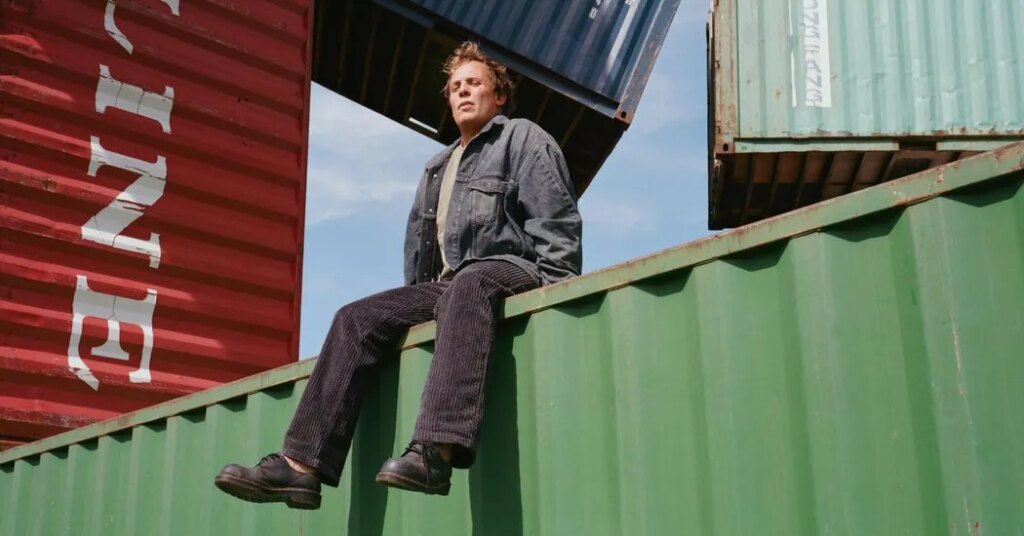
In August, after haggling about wetlands issues and other cavils, the town board lodged a suit against him over a 60-foot–tall sculpture by a Los Angeles artist, Matt Johnson, made of a dozen decommissioned shipping containers in a configuration that resembles a meditating figure. Placed where it can be seen from the road, it towers over the hedges.
The board claimed that the sculpture was a structure that needed a permit; Levai insisted it is art, which he has every right to build in his backyard. A few weeks ago, just as the sculpture was due to come down anyway, the litigation was settled, with the board allowing Levai to erect art on a bigger expanse of his property. Levai in turn chastely agreed in the future to get a permit for anything gargantuan and structurally challenging, which is pretty much everything on his list.
The Gallery Cycle
Although he has had success in getting pieces first shown at The Ranch into museum collections — the brass ring of art dealing — recruiting a roster of artists at the level to which Levai aspires has not been easy. With a New York gallery, he is back in the world from which he was summarily jettisoned. His tabloid profile has been further elevated by the publicity surrounding his lawsuit against his father’s longtime paramour, Marcia Levine, who Levai contends mistreated his father, ultimately leading to his death.
Levine’s lawyer, Jay Freiberg, said in a statement, “Marcia and Pierre were together for 40 years, and she took great care of him till the end of his life.”
His small group of artists insist such personal drama is just a distraction from his talent as a dealer. Lind-Ramos, the 73-year-old Afro-Puerto Rican assemblage sculptor who was the breakout star of the 2019 Whitney Biennial and won a 2021 MacArthur Fellowship, signed on with Levai after the Biennial, when he was swamped by representation offers.
“I just liked his energy,” Lind-Ramos said. His was the dealer’s final show at Marlborough — up for only three days before it closed for Covid — and the artist stayed loyal. Levai recently brokered one of his pieces to the National Gallery of Art and helped engineer a 2023 solo show at MoMA PS1. “Max is very patient with me even though I am very slow and I wanted to stay working in Puerto Rico,” he said. “I don’t think other people would have been all right with that.”
The gritty New Jersey-born painter Jamian Juliano-Villani, 39, whose boldly appropriative work has a satirical airbrushed edge, became a cultural phenomenon when O’Flaherty’s, the East Village gallery she and friends opened in an old bar, mounted a 2022 open call show in which they displayed over 1,100 submissions plastered on every available surface. She insists that Levai’s reputation as a mere son of privilege is undeserved. Levai, she said, has not only “sold a load of paintings for me, but also stood by me when I was a wreck and had no teeth in my mouth.” He has been “put through a conceptual wringer by the art world,” she said, “but he actually lives the art. Other dealers are all about inventory, inventory, inventory, but Max doesn’t milk you.”
Rubins, 73, who lives in Topanga Canyon in California and is the widow of the artist Chris Burden, has long been represented by Larry Gagosian. She met Levai last year when he approached her to conceive of a sculpture for the Los Angeles-themed show in which Johnson’s shipping container behemoth also appeared. An engineering feat, like much of her work, “Friends of Pluto” took nearly a month to build, and required Rubins to bring in a half-dozen workers the gallerist put up in his house. He now co-represents her. “For someone so young,” she said, “Max has an oddly old-school idea of the relationship between galleries and artists.”
That he may still not be taken seriously is perhaps more a reflection of art world culture than of Levai. “I’ve heard the sniping,” Rubins said, “but it seems to me that he has landed on his feet in a very graceful way, despite all the baggage.”
The post The Rocky Rise of Max Levai, Art World Nepo Baby appeared first on New York Times.