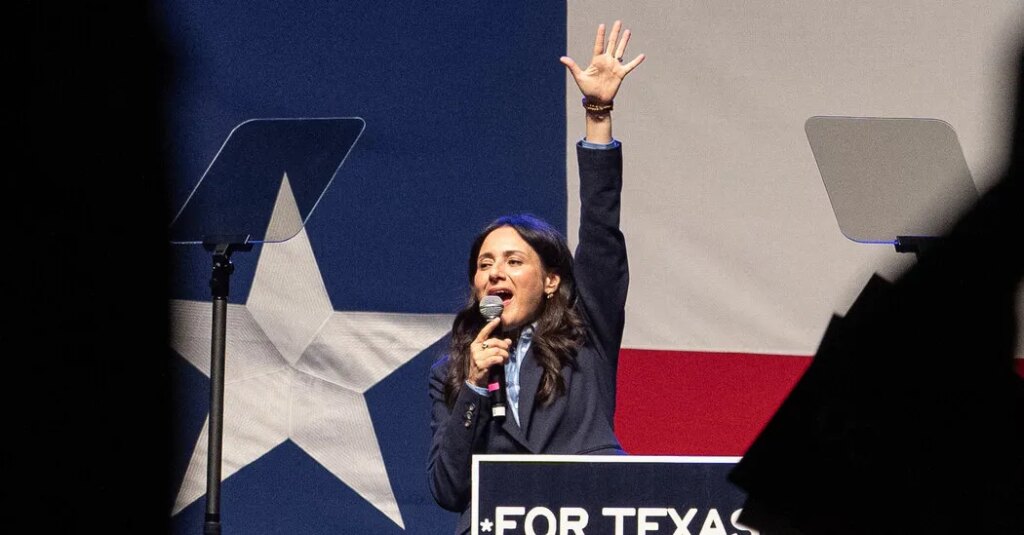
Gina Hinojosa seemed to come out of nowhere when she announced her run for Texas governor a year ago.
As a Democratic state lawmaker from Austin, she supported transgender rights and opposed enshrining the state’s income tax ban in the Texas Constitution — causes that kept her little known and far from the state’s centers of power.
The well-funded campaign of incumbent Greg Abbott, one of America’s most powerful Republicans, refused to say her name even as her campaign gained momentum over the summer, allowing her to define herself to voters on her own terms.
On Tuesday, Ms. Hinojosa denied Mr. Abbott a record-setting fourth term. She became the first Democrat to win statewide office in more than 30 years and the first Latina to be elected governor in Texas.
“Latinas led the charge,” said Maria Teresa Kumar, president of Voto Latino, a voter advocacy group. “We saw Latino participation in Texas surpass 2024 number. You don’t see that happen.”
“The candidates were speaking to the Latino experience. People who voted for Trump said, ‘This is not what I voted for,’” said Ms. Kumar, referring to the cost of living and President Trump’s aggressive immigration crackdown.
Ms. Hinojosa, 52, a native of the Rio Grande Valley, foresaw what others missed: The state’s Latino plurality — and a rural population that had been seen as a Republican redoubt — were ready for someone like her in the governor’s mansion.
Ms. Hinojosa is a civil rights and labor lawyer who spent nearly a decade in the statehouse, representing a solidly Democratic district and championing long-shot issues. In this year’s campaign, she embraced a more populist message and Mr. Abbott failed to make her more progressive policies into political millstones.
In the end, like many competitive elections this year, the race for governor of Texas became a referendum on affordability. Ms. Hinojosa successfully argued that Republicans, who have controlled every branch of state government for more than two decades, were not prioritizing the cost of living.
Ian Hogan, a 38-year-old Austin construction manager, said he had voted for Ms. Hinojosa primarily on economic grounds.
“Trump has caused some pretty serious issues with inflation and war and gas prices,” he said Tuesday, adding, “How expensive are things going to get?”
The last woman to occupy the governor’s mansion was Ann Richards, who left office in 1995. Anabel Lopez, 61, of San Antonio, said that she had longed to see a Latina become governor.
“I dreamed for a long time for a moment like this,” Ms. Lopez said. “This is monumental for Texas. We want change. We needed to send new people to represent us in the government. The Republicans had become too extreme.”
Latinos, who make up the largest ethnic population in the state, were a crucial part of Ms. Hinojosa’s coalition. Many soured on President Trump after voting for him in unprecedented numbers in 2024.
Their numbers have only grown in importance in the past two decades. In 2024, there were 6.3 million eligible Latino voters in Texas, up from three million in 2000, according to the UCLA Latino Policy and Politics Institute.
Some of Mr. Trump’s greatest gains in 2024 were along the Texas border, where he flipped several majority-Hispanic counties. But Ms. Hinojosa greatly outperformed Kamala Harris’ margins in the region: Cameron County, along the Mexican border, shifted 40 percentage points to the left.
Latina candidates have been making inroads throughout Texas in the past several election cycles. In 2018, Democrats Veronica Escobar, and Sylvia Garcia became the first Latinas elected from Texas to the U.S. House of Representatives, both from districts where Latinos are the majority of the population.
In 2022, Monica De La Cruz, a Republican, won a once-Democratic border district, though she lost Tuesday to a moderate Democrat, Tejano singer Bobby Pulido.
Ms. Hinojosa’s win followed years of tantalizing near-misses for Democrats seeking the governor’s office. In 2010, a few summer polls suggested a competitive race between Bill White, a Democrat, and Gov. Rick Perry, a Republican. By the fall, Mr. Perry was consistently leading in the polls, and he won by nearly 13 points.
In 2022, several polls had Beto O’Rourke just five points behind Mr. Abbott. But Mr. Abbott’s polling lead grew that fall, and Mr. O’Rourke lost by nearly 11 points.
Ms. Hinojosa has said that she never intended to run for political office, much less for governor.
She first ran for office in 2011, seeking a seat on the school board after state budget cuts threatened to close an elementary school that one of her sons attended. She later became a state legislator representing one of the most liberal districts in the state.
As a governor candidate, Ms. Hinojosa made public schools and concerns over affordability and her opposition to data centers centerpieces of her campaign. Those issues resonated with Latino and former republican voters alike.
Armando Gomez, an immigrant from Mexico who has lived in Texas for 25 years, said he had come out to vote for Democrats on Tuesday for “a better economy.”
Mr. Gomez, 66, who works as a contractor in Austin, believes the country has devolved during President Trump’s second term, and said the war in Iran is driving up prices. “Everything is too expensive,” he said, citing his rising health insurance premium and electricity and mortgage bills.
He particularly relished voting against Mr. Abbott and Ken Paxton, whose Senate campaign ended in a drubbing.
“I don’t like Abbott and Paxton,” he added. “Two hypocrites.”
Madaleine Rubin, David Montgomery and Jillian Anthony contributed reporting.
The post How Gina Hinojosa Captured Texas appeared first on New York Times.