The Justice Department sent a last-minute surge of election monitors into Los Angeles on Tuesday morning, amid an ongoing legal tug-of-war over California’s 20,000 contested ballots.
In a series of rulings late Monday night and early Tuesday, the U.S. 9th Circuit Court of Appeals cleared the Trump administration to threaten California election workers with criminal charges, even after its demands to segregate contested ballots were struck down by the Supreme Court.
The appellate court’s final decision came on election day, just after the Justice Department announced it was sending out “1,000 election monitors and observers” across the U.S. in what it called “the largest monitoring effort in DOJ history.”
Los Angeles, New York, Chicago and Detroit were among the dozens of jurisdictions where monitors were sent under the auspices of the Voting Rights Act of 1965 — legislation the President Trump has worked tirelessly to gut across both his administrations.
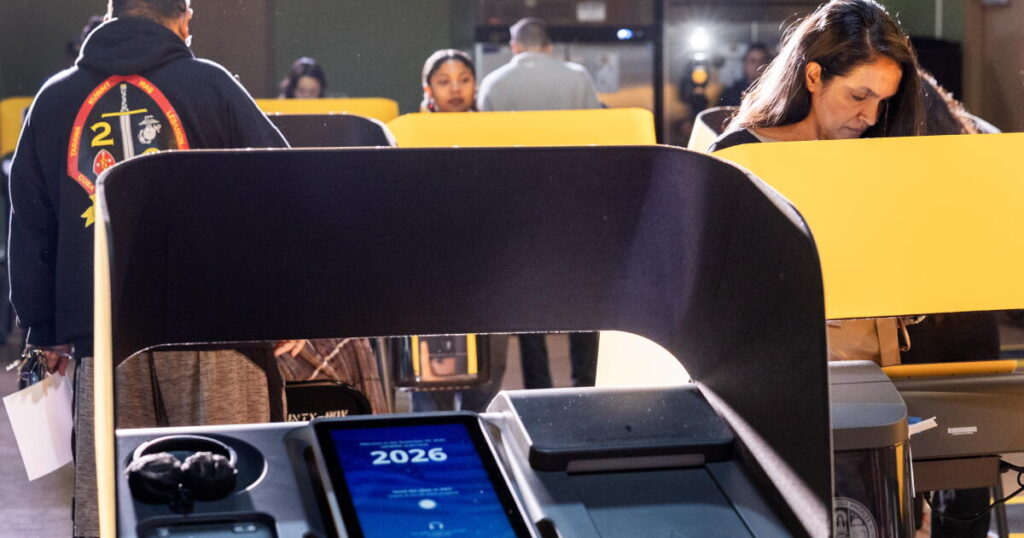
The Justice Department said it would also send monitors to San Diego, Sacramento and Alameda County in the San Francisco Bay Area. A department spokesperson said that the federal monitors “will be at polling locations,” but that the department is not “giving out precinct details.”
The move was widely seen as an intimidation tactic.
“They’re not doing this to make sure that there are free and fair elections,” said Eric J. Segall, a law professor at Georgia State University and an expert on the Supreme Court. “They’re doing this for nakedly partisan reasons, and the federal government shouldn’t be allowed do that.”
California officials were quick to hit back.
“We’ll have our observers on site keeping an eye on your monitors to ensure the integrity of California’s free, fair, safe, secure, accurate, and reliable elections,” state Atty. Gen. Rob Bonta vowed on social media as the spat escalated early Tuesday morning.
By then, the Justice Department had already removed several sworn law enforcement officers from its pool of volunteer election monitors after a review with federal agencies, according to a court filing Tuesday.
“Law enforcement agencies with sworn officers have never before been recruited as poll monitors,” said Donya Khadem of NAACP Legal Defense Fund, which sued in federal court in Washington, D.C., to block the move. “It’s unlawful and serves the plain purpose of intimidating voters.”
The remaining Justice Department-deployed monitors were directed to dress in “business casual” — khakis and polos, no Kevlar — and forbidden from wearing insignia, carrying firearms, or attempting to arrest would-be voters.
Los Angeles Mayor Karen Bass called the move “an attempt to intimidate voters into staying home.”
“The Department of Justice is laying the groundwork to dispute the results if they don’t get the outcome they want,” she said.
The influx of election monitors and the dramatic appellate court about-face were the latest swings in the Golden State’s protracted midterm brawl with the federal government — a fight that has captured national attention amid growing concerns of election interference by the Trump administration.
“On the eve of Election Day, Defendants insist they must be free to use their prosecutorial powers to do what they could not through their applications for injunctions in this court and the Supreme Court,” 9th Circuit Chief Judge Mary Helen Murguia wrote in her dissent to the initial 2-1 ruling, which appeared just after 8 p.m. Monday.
“The district court properly attempted to put a stop to Defendants’ efforts to intimidate election workers into abandoning lawful state election procedures through spurious threats of prosecution,” Murguia wrote.
By 11 p.m. the decision had been reversed, with the court setting aside its previous ruling while it reviewed the case with a larger en banc panel.
Then, just before noon Tuesday, the court reversed itself again. A panel of 11 judges reinstated the court’s initial stay, finding the administration could continue to demand ballots be set aside and threaten prosecution for election workers who count them, while also acknowledging such saber rattling was unlikely to stand up in court.
The ruling evinced a bitter 6-5 split — with five Trump appointees in the majority — between the court’s liberal wing and its growing conservative faction.
“A district court does not generally have the authority to enter an injunction prohibiting the Department of Justice from expressing its views about criminal statutes, even if the court determines that those views are incorrect,” wrote Judge Eric D. Miller, a Trump appointee who has broken with the president on key issues, including over the deployment of National Guard troops.
Judge Roopali Desai, a Biden appointee, dissented, writing that the decision creates “precisely the type of chaos and confusion that the Supreme Court repeatedly cautions against.”
“In the span of twelve hours in the middle of an ongoing election and on the literal eve of Election Day, our court issued three conflicting orders,” the judge wrote. “Reinstating the stay on the morning of Election Day also creates a serious risk of disenfranchisement.”
“The last-minute stay puts election administrators in an impossible dilemma,” Desai added. “These public servants face an impossible choice: fulfill their legal duties under state law and risk federal prosecution, or comply with the federal government’s demands and violate their duties under state law.”
The back-and-forth marked the latest dramatic twist in what had been a months-long effort to claw back ballots it claims may have been issued to noncitizens, while publicly threatening to prosecute election workers who process them when its efforts were rebuffed in court.
Last week, the Justice Department sent criminal grand jury subpoenas to election workers in Los Angeles seeking reams of data related to efforts to comply with its demands.
Unions and voting rights groups sued in federal court, saying the efforts amounted to “a coordinated campaign to intimidate, threaten, and coerce” civil servants into holding back legitimate ballots.
On Friday, after the 9th Circuit had ruled for California in the ballot claw-back case, U.S. District Court Judge Trina Thompson in San Francisco issued a blistering order blocking the Justice Department from dangling criminal liability over elections workers or demanding voters be stripped from the rolls.
“In the lead-up to the election, high-ranking DOJ and DHS officials have engaged in a campaign to intimidate, threaten, and coerce state and local officials and employees who are engaged in administering the ongoing midterm 2026 election,” Thompson wrote.
“Although Defendants claim that their actions are designed to halt unlawful voting by noncitizens, their actions are likely to have the effect of interfering with election administration and disenfranchising lawful voters,” the judge wrote.
Then on Monday afternoon, mere minutes after it was asked to consider the question, the Supreme Court returned an unsigned decision in California’s favor, appearing, at least briefly, to foreclose further efforts to stop those ballots being counted.
Instead, the late-breaking 9th Circuit decisions spurred a flurry of confusion and conjecture just hours before polls were set to open in the country’s most populous state.
Times staff writers Kevin Rector and Brittny Mejia contributed to this report.
The post Feds deploy election monitors to L.A. as 9th Circuit sides with Trump in ballot dispute appeared first on Los Angeles Times.