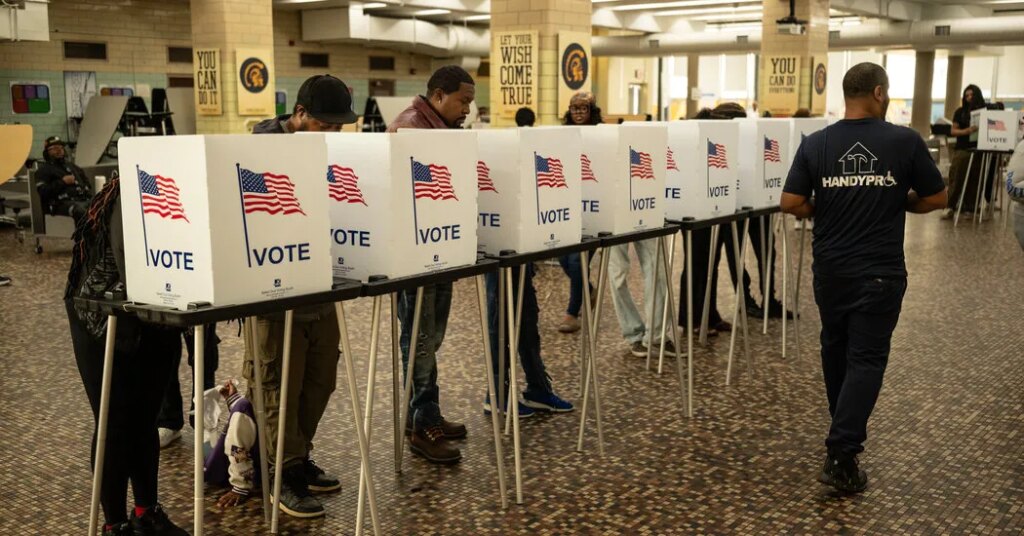
For decades, the Justice Department has sent monitors to observe polling places on Election Day and ensure that local officials are complying with federal civil rights laws.
But the Trump administration’s decision to significantly expand the program and send roughly 1,000 monitors to all 50 states on Tuesday caused Democrats and voting-rights advocates nationwide to fear that federal officials would interfere with voters casting ballots. President Trump has repeatedly made false claims about widespread election fraud, mobilized law enforcement officials to investigate voters and asked judges to intervene in state-administered elections. The Justice Department said that it had conducted its largest monitoring effort ever this year.
On Tuesday, local and state officials nationwide said the monitors had largely behaved in keeping with past elections and had not tried to interfere with or intimidate voters, although there were reports of what appeared to be minor friction.
In heavily Democratic Bernalillo County, N.M., Justice Department monitors asked voters “unusual questions,” according to a spokeswoman for the secretary of state’s office. State election officials complained to the Justice Department but had received “no additional reports of similar behavior” since, the spokeswoman said.
In Michigan, state officials said they reached out to the Justice Department after receiving reports of improprieties in Dearborn, Flint and Lansing. Among them: federal monitors asking poll workers for their training materials and trying to speak with voters inside polling places — both of which violated their agreements with local officials. No further problems had been reported as of late Tuesday afternoon, state officials said.
Even before Election Day, local governments from Arkansas to Minnesota had decided to bar federal monitors from entering polling places, requiring them to observe from outside instead. In New Haven, Conn., local election officials told the Justice Department in a letter that “rhetoric and federal actions” appeared to be intended to “cast doubt on election integrity and to intimidate voters,” and wrote that they would deny access to the monitors.
In a social media post, the Justice Department said its election monitors were “public servants doing a job the Department has done for decades: making sure that every eligible American can cast a ballot free from intimidation and discrimination.”
A spokeswoman said Justice Department officials had spoken to the New Mexico secretary of state, and the issue had been “resolved.” She also said the monitors in Michigan had asked the same standard questions that had been asked in past elections. Monitors are generally allowed to talk to voters after they have left a polling location.
The United States has sent monitors out on Election Day since the passage of the 1965 Voting Rights Act in order to ensure public access to the polls, including for people with disabilities. The monitors are also meant to be on the lookout for indications of voter intimidation or suppression based on race, color, national origin or religion. The department’s civil rights division administers the initiative.
Justice Department lawyers said at a court hearing on Monday that nearly 1,000 people would serve as monitors this year, up from a maximum of about 600 sent out in prior elections. The monitors are department employees but are not supposed to carry guns, display badges or wear law enforcement insignia.
Often, they stand a set distance away from a polling place in civilian clothes, asking voters about their experience and observations. With more than 100,000 polling places nationwide, the vast majority of voters are unlikely to see, let alone interact with, a federal monitor.
Even in Republican-led states, the presence of monitors has sometimes drawn scrutiny. During an August primary, Gov. Mark Gordon, Republican of Wyoming, complained publicly after he said the presence of federal monitors had been “aggressive, unexpected, disruptive.”
This year, the Justice Department sent monitors to several Democratic-leaning areas that it had not visited in 2022 or 2024, including Boston, Chicago, Memphis and Seattle, according to Justice Department news releases. Because the program is meant to protect minority voting rights, it is not unusual for monitors to be stationed in areas with high concentrations of minority voters.
In the cafeteria of Henry Ford High School in Detroit, Justice Department monitors walked around for about 15 minutes making notes on clipboards on Tuesday morning, poll workers and other observers who saw them later told a New York Times reporter.
The monitors asked what seemed to be standard questions about accessibility for disabled voters and whether the machines were operating normally, the workers said.
“They were satisfied with what they saw and how things were running,” said Loretta Wade, who oversaw special terminals for disabled voters.
Reporting was contributed by Eileen Sullivan, Reis Thebault, Zolan Kanno-Youngs and Neil Vigdor
The post More Federal Election Monitors Than Ever Are Fanned Out to Polling Places appeared first on New York Times.