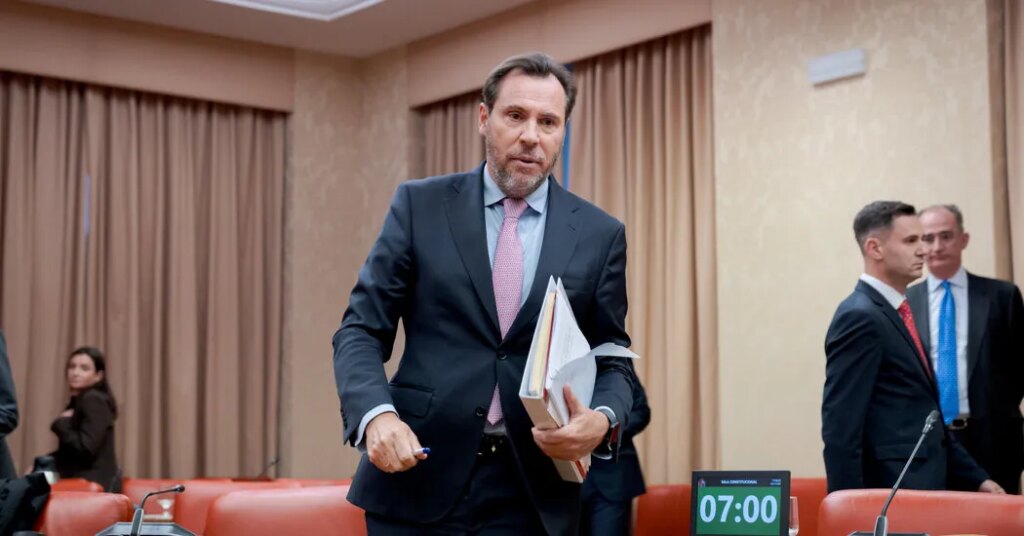
Spain’s transport minister announced his resignation on Tuesday evening, nearly a week after the deadliest train crash in a decade killed nearly 70 people and raised doubts about the country’s once-vaunted rail system ahead of national elections.
“A transport minister cannot remain in office after two accidents of such severity in less than a year,” the minister, Óscar Puente, told lawmakers on Tuesday evening after days of resisting calls for his resignation.
Mr. Puente’s resignation came at the end of a bruising day of questioning for the minister, who gave lawmakers a detailed account of the events leading to the accident, in which one high-speed train rear-ended another on the same tracks.
“You’re so good at explaining why people die on trains, and so bad at preventing them from dying on trains,” said Ester Muñoz, the spokeswoman for the main opposition conservative party, the Popular Party.
Mr. Puente’s resignation reflected his increasingly untenable position ahead of snap elections on Nov. 29 and suggested that he had become a liability to Prime Minister Pedro Sánchez, who had stood by him. Many political parties had demanded his resignation, and recent polls showed that a majority of Spaniards believed Mr. Puente should step down.
“Óscar Puente has faced up to his responsibilities, offered solutions and then stepped aside,” Mr. Sánchez said on social media after the minister’s resignation. He added, “Politicians like him bring dignity to our country.”
The crash shook Spaniards’ confidence in their high-speed railway system, long considered the jewel of a modernizing country that had shown it was on par with the rest of Europe. But in January, a crash on the same line between Madrid and Seville killed 46 people, and another 69 died in the collision last week.
After the crashes, analysts said, Spaniards increasingly felt that the country’s infrastructure was not working and was unsafe, a view that could damage Mr. Sánchez politically as party already trails in the polls.
Mr. Puente’s reputation as an attack dog for the government, known for lashing out at political rivals on social media, only increased the calls for his resignation.
Mr. Puente began his parliamentary hearing at 5 p.m. with a lengthy explanation of how the crash happened, faulting the errors of rail traffic controllers in Madrid, who had over after an automatic safety system went down in the area near Toledo, in central Spain. The controllers authorized a train to proceed at high speed though another was stalled in front of it, he said.
Mr. Puente also announced a battery of measures and new protocols to improve railway safety. But lawmakers across the political spectrum held him responsible for the accidents on his watch and demanded his resignation.
Ms. Muñoz of the Popular Party said it was “incomprehensible” that two deadly tragedies had occurred on the same rail line. “This is not an isolated failure; it is a systemic failure,” she said.
Pepa Millán, a lawmaker from the far-right party Vox, asked Mr. Puente whether he could “sleep soundly?”
But even coalition partners in the left-wing government asked him to step down, and Mr. Puente framed his resignation as a necessity.
“It is a matter of political dignity, consistency,” he said, “and empathy for the victims.”
The post Spain’s Transport Minister Resigns After Deadly High-Speed Rail Crash appeared first on New York Times.