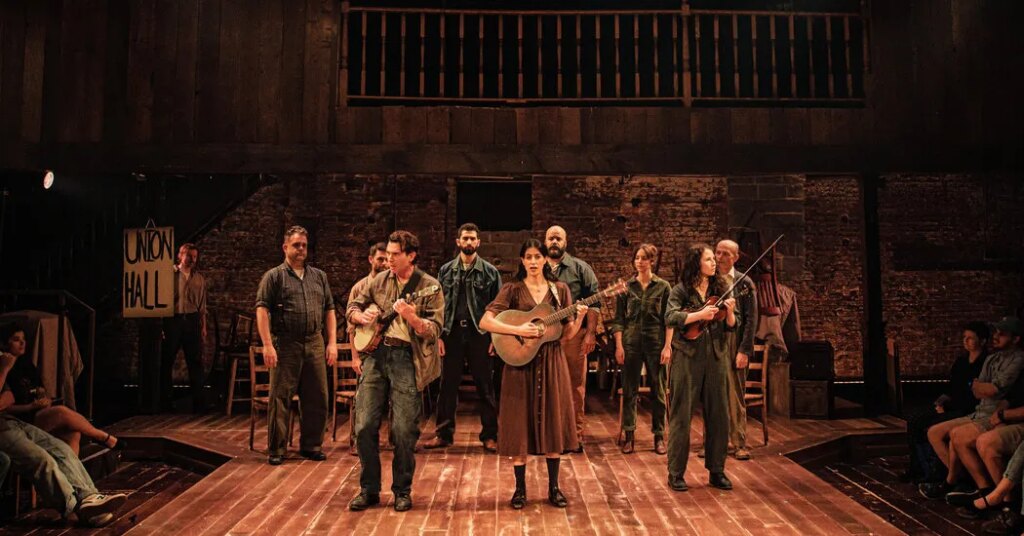
The brick walls and bare stage at Classic Stage Company certainly help summon the atmosphere of a Depression-era hiring hall for union cabdrivers. And with audiences sitting on three sides of the stage, we become part of the action — representing scores of unseen drivers — observing the debate over whether to strike because of low wages, high taxes and poor working conditions.
In the newly opened revival of Clifford Odets’s 1935 play, “Waiting for Lefty,” inspired by the real-life New York cabdriver strike of 1934, snapshots of this meeting are interspersed with disparate vignettes of coupled life and exploitation. There’s a cabdriver named Joe (Raffi Barsoumian) debating the possibility of a strike with his wife, Edna (Tala Ashe, a Tony nominee for “English”); a lab scientist (Austin Durant) encountering his boss (Henry Stram), an industrialist who wants to make poison gas; and a mordant doctor (Stram) noting that “doctors don’t run medicine in this country. The men who know their jobs don’t run anything here, except the motormen on trolley cars.”
Odets is having a moment this fall. In New York, “Lefty” will be followed by a Broadway revival of his family drama “Awake and Sing!” (1935), while a run of “Golden Boy” (1937), starring Josh O’Connor, recently ended in London. Among the challenges for any director revisiting “Lefty” are its thicket of dated language and the mostly airless interludes that divert from the meeting’s oratorical fire and brimstone. The actor Steven Pasquale’s staging is as earnestly heartfelt as Odets’s cri de coeur for equality and fair treatment, with actors playing drivers sometimes interjecting from the audience, ready to argue with the self-serving union boss, Harry Fatt (Greg Hildreth), who tries to stave off a strike from the stage.
The play’s heroic Godot-like title character, the absent Lefty, has been elected chairman of the strike committee. One of Pasquale’s major tweaks is to bring him to life — played by Zach McNally — in the production’s strange moments of expressive movement created by choreographer Susan Misner. What is gained by Lefty’s silent presence in these ghostly, slow-motion tableaus is unclear. A visible Lefty still leaves us waiting.
A more inspired, glorious addition to the production are the music and arrangements of Yeller Tooth, the married folk music duo of Sahar Milani and Cameron Scoggins. Here, they have composed original music and reanimated folk and protest standards like the 17th-century “Diggers Song,” Florence Reece’s “Which Side Are You On?” (1931), Yip Harburg and Jay Gorney’s “Brother, Can You Spare a Dime?” (1932) and John Paul O’Connor’s “Carpal Tunnel” (2006).
Whether singing and acting themselves, or leading the company in song, Milani and Scoggins anchor this revival more powerfully than Odets’s blunt-force words; the pair possess a sexy, compelling and moving onstage chemistry.
Milani and the other female cast members (Ashe and Doireann Mac Mahon) open the play with “Bella Ciao,” Chumbawamba’s version of the Italian antifascist resistance folk song of the same name; the women later sing a shimmering version of the feminist and labor anthem “Bread and Roses.” Scoggins and Milani also sing “Union Song,” with lyrics by Woody Guthrie and music by Billy Bragg.
The loveliest-sung, best-directed moment blooms in a company rendition of “If I Didn’t Care,” led by Hildreth and Adam Kantor, which briefly tips “Lefty” into a moment of deliciously giddy romance between young lovers.
Mextly Couzin’s lighting is also a standout: Forty-two imposing hanging lamps bring the Union Hall scenes to blazing life, with a stark spotlight illuminating dreamier sequences. The final clamorous refrain of “Strike, Strike, Strike” reaches its crescendo in total darkness.
That visual and aural thud feels significant. Just as Odets and his producing partner, the Group Theater, were focused on the social and political fallout flowing from the Great Depression, Pasquale and other theater makers today see potential in the playwright’s galvanizing words to strike meaningful echoes for contemporary audiences experiencing their own turbulent times.
Waiting for Lefty Through Nov. 29 at the Classic Stage Company, Manhattan; classicstage.org. Running time: 1 hour 10 minutes.
The post ‘Waiting for Lefty’ Review: Protest Songs in the Key of Life appeared first on New York Times.