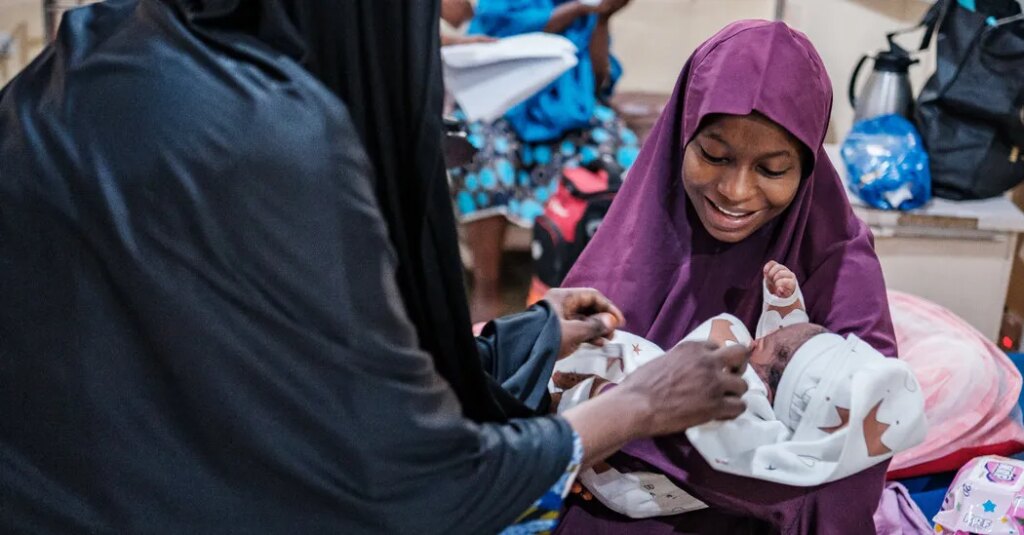
A few hours after she nearly bled to death, Husaina Balarabe was serenely unaware that her life had been in peril.
She cuddled her newborn baby, a lush-cheeked boy she had named Aabid, and showed him off to her sisters from her bed in a noisy hospital delivery ward in the northern Nigerian city of Kano.
Ms. Balarabe, a 26-year-old optometrist, had experienced a postpartum hemorrhage, a side effect of childbirth that is the leading cause of maternal death around the world.
She did not die because her midwife used a low-cost, low-tech intervention that was pioneered here and in other maternity wards in some of Africa’s poorest places, and that is now saving lives across the continent.
The device was a piece of thin, green plastic the size of a cookie sheet with a pouch at its end, called a maternal drape. It lay beneath Ms. Balarabe as she delivered, and the pouch hung off the end of the bed. The midwife who caught baby Aabid saw blood running into the pouch and quickly reaching and surpassing the danger level — 300 milliliters (or 10 ounces), indicated by a mark on the pouch
The nurse swiftly grabbed a cart stationed in the middle of the packed maternity ward, called for help and went to work. From the cart, she took a syringe of the drug oxytocin and injected it through an IV to get Ms. Balarabe’s uterus to contract. She added a dose of tranexamic acid, to prompt clotting. She massaged Ms. Balarabe’s abdomen, encouraging more uterine contractions, while another nurse started IV fluids to restore her blood volume. The bleeding slowed, and after a couple of minutes, it stopped altogether.
It was all so swift and smooth that the new mother had no idea there was cause for alarm.
One in every 10 women who give birth experiences postpartum hemorrhage, and at least 70,000 women die from it each year. Almost all of those women are in low-income countries; more women die giving birth in Nigeria than in any other country.
Maternal mortality is one of the most bedeviling problems in global health because — until recently — the main solutions have required skilled health care personnel to identify women at risk and to intervene swiftly when a delivery suddenly becomes dangerous. But there is no cheap or simple way to produce midwives and obstetricians, or to convince them to stay in underserved rural areas when they could earn more in cities or other countries.
Postpartum hemorrhage occurs after a baby is born, when the placenta separates from the mother’s body, leaving hundreds of blood vessels open and pumping blood. In a normal delivery, the uterus quickly contracts, and the pressure closes those vessels. But if that contraction doesn’t occur or happens too slowly, or if pieces of the placenta are left behind, blood pours out without stopping, and the woman can die in as little as 10 minutes.
Some bleeding is normal in childbirth. The reason many women die is that it is surprisingly difficult to tell if someone is losing too much blood. Research found that even midwives and doctors who have delivered hundreds of babies consistently underestimate how much blood a woman has lost.
“The amount of blood on the couch, on the floor, on the pads, on my clothes, on her clothes, is it 300 or 500 or 1000 milliliters ?” asked Dr. Hadiza Galadanci, a professor of obstetrics and gynecology at Bayero University in Kano who oversaw the Nigerian research into use of the drape. “A lot of times, we don’t realize the amount of blood that a woman has lost because we make a visual assessment and it’s very, very subjective.”
By the time those delivering a baby decide it’s time to act, it’s often too late.
The drape is now being rolled out across Nigeria. But it was only the first part of the intervention that saved Ms. Balarabe. Next came the series of treatments after the pouch became dangerously full of blood. None of those steps are new, but a few years ago, researchers tested what happened when they were all done at once — massage, oxytocin, tranexamic acid, IV fluids — and quickly. They found that, together with the drape, these interventions cut deaths from postpartum hemorrhage in hospitals by about two-thirds.
Previously, health workers had been trained to respond by first trying massage and then waiting 20 minutes to see if bleeding stopped. If it didn’t, they tried a drug and waited 20 more.
When all the interventions are done together, in what is called a “bundle,” bleeding stops quickly in most women. “It’s like turning off a tap,” Dr. Galadanci said.
If it doesn’t stop, the last step is escalation: getting the woman into an operating room or transferring her to a facility that has staff who can stop the bleeding surgically.
“We have not had one death from postpartum hemorrhage since we started this,” said Binta Garba, who has been the head nurse in the labor ward at Aminu Kano Teaching Hospital for seven years.
Eight or nine times each week, one of her nurses will spot a pouch with blood past the 300-millileter mark and shout, “Bring the bundle!” The person closest to the trolley wheels it to the bedside. “Everybody helps, and in a short period, the bleeding stops,” Ms. Garba said.
When Dr. Galadanci was recruited to be part of this research five years ago, she was skeptical: How could a flimsy sheet of plastic and a small procedural change in treatment save women’s lives? The research convinced her — and she went on a campaign to persuade Nigeria’s health minister to make this the national standard of care.
Now, pairs of midwife-trainers are visiting labor wards across the country to introduce the drape and the bundle. Often, they’re greeted with the same skepticism.
“I thought, We already give oxytocin and tranexamic acid, women still die — you’re wasting my time telling me about something we already do,” Kursiyya Shuaibu, one of the trainers, said of the first time she heard about the new procedure. Then she used it, and saved a woman’s life. “When you bundle it, it’s magic!”
Postpartum hemorrhage also occurs in high-income countries, but women are much less likely to die. They typically have one-on-one care from a midwife or nurse, as well as electronic monitoring of vital signs that can flag a problem early, and blood supply for transfusion is readily available.
Nigeria has high rates of severe postpartum hemorrhage because it has weak primary care. Sixty percent of women are anemic, and there is limited access to birth control. The average woman in the north has seven children, and her risk of hemorrhage rises with each pregnancy.
A quarter of Nigerian women never receive any prenatal care during pregnancy; less than half manage four visits. There is a critical shortage of health care workers throughout the system, from midwives who might screen for high-risk pregnancies to obstetricians who could safely deliver them.
Dr. Galadanci talks fast, walks faster and bristles with impatience to improve the care women receive. She believes the solutions to these basic problems have to be equally simple.
“The drape is not an A.I. thing — it’s the absolute opposite: It’s a simple, simple, intervention that can solve our problems,” she said. “You don’t need a surgeon to come and save a woman. Or to teach you how to do a technique with something you have to buy from outside the country. No. You just need a plastic calibrated drape, and you have your drugs. And it’s done.”
The drape can only do so much, of course: The critical levels of understaffing still put women at risk. On a recent afternoon in the maternity ward at the teaching hospital — the best public hospital in Kano — one woman lost 600 milliliters of blood before anyone intervened. Another woman’s drape went unchecked for nearly 45 minutes after her baby was born.
The drapes used for the research in Nigeria were imported from India, and cost about $3 each. That was more than the national health budget could afford.
Dr. Muhammad Ali Pate, the health minister, wants Nigeria to make more of what it needs. So Dr. Galdanaci and her team got in touch with a family-run plastic manufacturer in Kano that made plates, forks and containers for things like vegetable oil. Dr. Galdanaci showed the chief engineer a drape: Could they make that?
The company made a prototype, but it was clear that any significant production would require custom-built machinery, which it would need to import from Taiwan. The Gates Foundation, which had helped fund the drape research, was eager to scale up the drape’s use, and offered a $600,000 grant. (The foundation has also backed companies in Kenya and South Africa, where the drape was tested, to manufacture them.)
In exchange, the company, Systs Engineering, agreed to sell the drapes for 70 cents each to the national health system. The war in Iran has since pushed up the cost of raw materials, so these days, the drapes cost 80 cents. The company is making them for all of Nigeria, and it has started to export to some neighboring countries.
Dr. Galadanci has now moved on to the next problem: The drape and the bundle are working well in hospitals, but 60 percent of Nigerian women give birth at home. Her research team is testing a kit for community health workers who attend home births. It has an absorbent mat, and when that fills to the corners, it’s a sign a woman cannot lose any more blood and must be taken to a hospital. The kit also contains the drug misoprostol, which causes the uterus to contract, helping to stop bleeding long enough to get a woman to medical care.
Still, the hospitals are strained. On a recent morning at a maternity clinic in the center of Kano, seven women gave birth in the space of a couple of hours. The lone obstetrician, Dr. Halima Ibrahim, had three urgent cases waiting for cesareans, and a lone midwife oversaw the delivery ward. One woman was whimpering through the contractions of her 11th delivery, while in the corner, a couple of student nurses used the flashlight from a phone to stitch another woman’s episiotomy.
But the drape helps. “It used to be that we lost a woman every month: You are left holding the baby, and the mother is gone,” Dr. Ibrahim said. “Not any more.”
The post An 80-Cent Plastic Pouch Is Saving Thousands of Women From Dying in Childbirth appeared first on New York Times.