Despite the fact that the Oscars of the fashion world, otherwise known as the Council of Fashion Designers of America awards, took place the night before the midterm elections, the only person willing to talk politics onstage was Anna Wintour.
Wintour, the global editorial director of Vogue and the chief content officer of Condé Nast, there to present the positive change award to Tory Burch, announced that she had recently been at a fund-raising event for James Talarico, the Democratic Senate nominee in Texas. Then she disclosed that Burch had been there, too, and, she told the room, “Let’s hope all of Texas feels the way you do.”
For the rest of the night, despite most of the industry normally following Wintour’s example, almost all of the presenters and winners stayed away from the subject.
Demi Moore, handing the innovation award to Richard Dickson and Zac Posen of Gap Inc., didn’t touch it. Nor did Laufey, giving Eva Chen the media award. Nor did Cornelia Guest, presenting the fashion icon award to her “leather daddy,” the architect Peter Marino.
Just as they also stayed away from the other subject being discussed sotto voce at the tables in the room: the resignation, at the end of New York Fashion Week, of Steven Kolb, the former chief executive of the CFDA, after he was involved in a physical altercation with some PETA protesters who had stormed the runway of the Cos show — and that the organization had not yet announced who would replace him or how it might be reimagined for a new era.
Even Keke Palmer, the host of the evening, avoided controversy. First, by wearing all vintage — a gold Bob Mackie extravaganza once worn by Raquel Welch, as well as three more vintage looks, including a Stephen Burrows — rather than throwing her allegiance to one designer. And then by avoiding the topic of her most recent film, “I Love Boosters,” which took on unscrupulous fashion designers with unscrupulous production methods.
Indeed, there were so many unacknowledged issues in the room, it was hard not to wonder if all animals in the dioramas beneath the blue whale in the American Museum of Natural History had been replaced by elephants. So many of them in one gala!
It made for one of the weirder fashion awards ceremonies in recent history (and made the actual Oscars and even the Golden Globes look positively toothy by comparison). And it was made even weirder when Anthony Vaccarello was named international designer of the year for his work at Saint Laurent, less than a month after it was announced that he was actually leaving Saint Laurent.
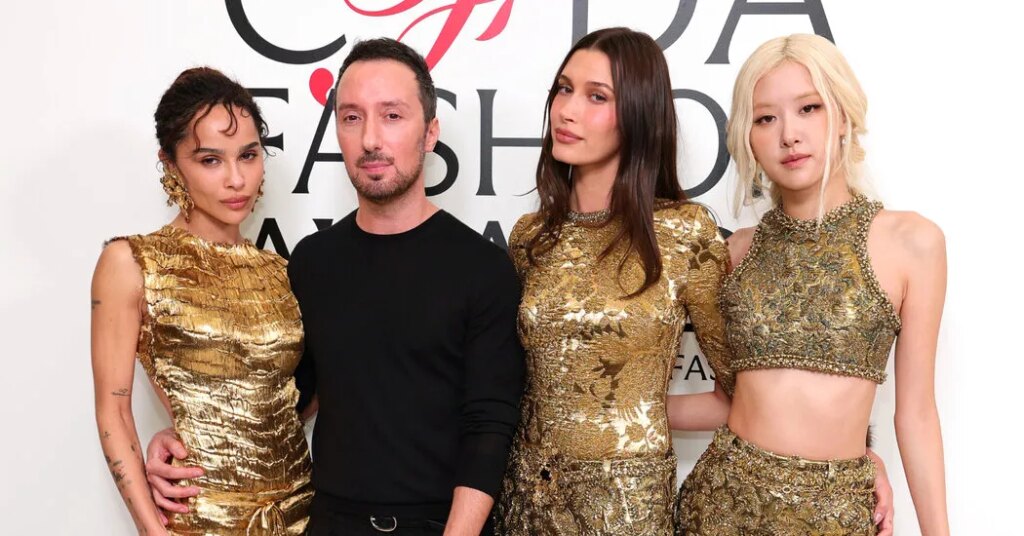
“What a year it has been for me,” Vaccarello said, with some understatement, accepting his gong from a trio of muses: Zoë Kravitz, Rosé and Hailey Bieber, all clad in gold cocktail dresses from his farewell Saint Laurent collection, held in September.
He went on to say that if there was one thing he had learned, it was that fashion “requires conviction.”
“It requires instinct, commitment and the courage to believe in it, even when others don’t,” he said, a reference, perhaps, to the rumored disagreements on strategy with the Saint Laurent owner Kering that led to his departure.
If there was any subtext to the night, it was the tension between creativity and business.
Thom Browne, chairman of the CFDA, set the tone in his welcome speech. “It’s never been more apparent that creativity is truly under the microscope and that noncreatives are trying to influence the way that we think and work,” he said. “In a time when designers are getting replaced left and right, and the business is demanding, it’s never been more important to double down on really great ideas and really great work.”
Then he exhorted the room: “Remind these business leaders that people are inspired by fashion and storytelling in its purest form and that temporary solutions do not build authenticity and communities that last forever.”
(As with Vaccarello, Browne seemed to be flicking at his own situation: His namesake label is owned by Zegna, a public company, but is experiencing a slowdown in revenue and probably in the midst of fending off ideas for change from his corporate overlords.)
The CFDA should, of course, lead the way in that, rewarding such creativity by recognizing it with its awards. Did it?
Yes-ish.
Naming Susan Cianciolo, the downtown designer, artist and teacher who is essentially the godmother of more than a generation of independent New York designers, the recipient of the Isabel Toledo board of directors’ tribute, did exactly that. (Cianciolo may be the most influential and resolutely independent designer of them all, even as she is also an insider’s insider.)
As did choosing Colleen Allen as emerging designer of the year. Allen made her name by essentially reinventing Victorian undergarments in fleece and has been deliberately building her business at her own pace, ignoring much of the industry noise.
Ditto Rachel Scott of Diotima and Proenza Schouler, accepting her second American women’s wear designer of the year award (and her third CFDA award). As Scott, a self-described immigrant, Black, queer woman, pointed out, “it’s very unusual that someone like me can stand in a space like this, and in a world where independent and marginalized voices are systematically quieted.”
But things got a little more confusing when Ralph Lauren was handed the American men’s wear designer of the year award.
It was Lauren’s 12th CFDA award, including two other men’s wear awards, two women’s wear awards (one just last year), a lifetime achievement award, a fashion legend award and the CFDA members salute, the last two awards created for him because he had won all of the other ones. He’s now the most decorated designer in CFDA history. (Marc Jacobs is next.)
It’s great to honor someone who is the embodiment of sticking to their vision, no matter what else is going on in the world. On the other hand, after you name someone a legend, maybe it’s time to start broadening the net and recognizing less established talent. Ralph is not an elephant, after all. He’s a mammoth.
The post Ralph Lauren Makes History at the Oscars of American Fashion appeared first on New York Times.