Across the country, dozens of pivotal contests today will determine which party controls the House and the Senate. Voters in California are deciding whether to pass a wealth tax on billionaires and who will be our next governor.
Meanwhile, in what appeared to be a rebuke of the Trump administration, the Supreme Court on Monday rejected a federal request to force 20,000 California ballots to be segregated. Administration officials said they had reason to believe the ballots belonged to noncitizens, but California leaders said that the list of individuals was rife with errors and that President Trump was trying to interfere with the state’s elections.
Here are five things we’re watching this Election Day:
California could have its first Latino governor in more than 100 years.
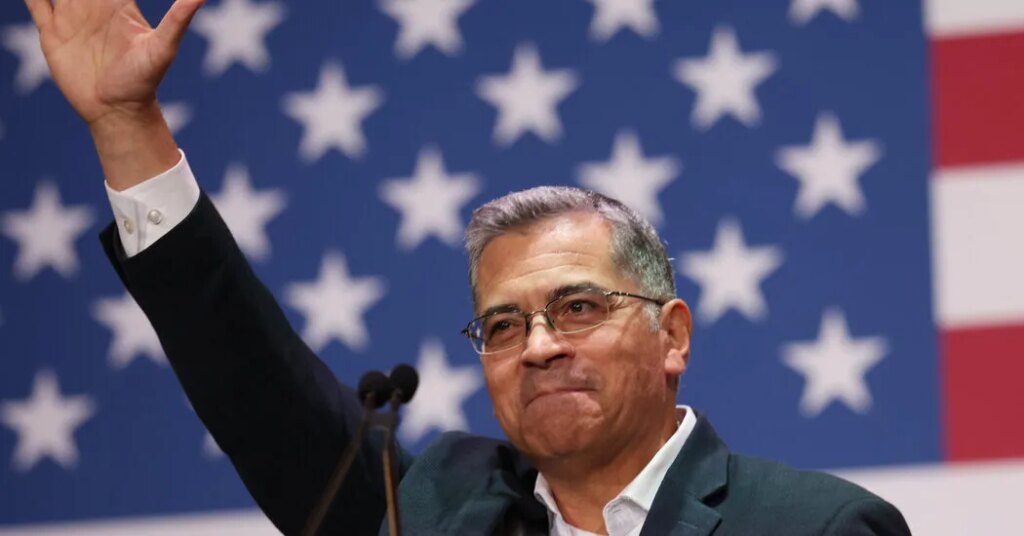
If Xavier Becerra, a Democrat, defeats Steve Hilton, a Republican endorsed by Trump, he will become the state’s first Latino governor since 1875 — and the first ever elected by voters.
A victory for Becerra, a heavy favorite in a Democratic state, would come 32 years after Gov. Pete Wilson, a Republican, targeted illegal immigration during his successful re-election campaign in 1994. That campaign has often been seen as a catalyst for Latino political action in the state.
Latinos now serve as the state’s senior senator and as the two leaders of the State Legislature, and the election of a Latino governor would punctuate a rejection of Wilson’s movement in California.
But Becerra, who built his career as a play-it-safe insider over decades in public service, has rarely mentioned making history during his campaign.
“I certainly am Latino, and I’m certainly proud of it,” Becerra said in an interview with The New York Times. “But identity has never been what has fueled my campaigns for office or public service.”
A vote on whether to tax billionaire wealth.
Dozens of the state’s billionaires have banded together to try to defeat Proposition 40, a onetime tax on the wealthiest Californians, often called the “billionaire tax.”
If approved, it would be the first wealth tax in the nation, targeting accumulated assets instead of income. The proposal would impose a onetime tax of 5 percent on the wealth of California billionaires, and most of the revenue would go toward health care.
The billionaires fighting the proposition have benefited from an unusual alliance of left-leaning opponents who argue that the tax would hurt state revenues in the long run by driving entrepreneurs out of California. Unions representing teachers and firefighters have joined tycoons in trying to stop the tax. And Gov. Gavin Newsom, along with Becerra and Hilton, oppose Proposition 40, a rare instance of bipartisan agreement.
Will L.A. oust Karen Bass?
The mayoral election in Los Angeles has become a contentious race between the incumbent, Karen Bass, and Nithya Raman, who has served on the City Council since 2020.
Bass, who has never lost an election, has been in the fight of her political life against Raman, who was less known but emerged as a front-runner in the head-to-head race months after beating out Spencer Pratt in the June primary.
Raman, a democratic socialist, has benefited from some of the same dissatisfaction with the Democratic establishment that catapulted Zohran Mamdani into the New York City mayor’s office. But political experts say her rise most likely has less to do with her progressive politics and more to do with one simple fact: She’s not Karen Bass.
Tuesday’s outcome may finally answer a nearly two-year-old question: Has Bass recaptured the faith of Angelenos after the 2025 wildfires?
The state’s biggest House tossup is in the Central Valley.
When Californians voted last year for a gerrymandered House map, it laid the groundwork for Democrats to flip as many as five seats in 2026.
One Central Valley district in particular is drawing attention and heavy campaign spending.
In the state’s 22nd Congressional District, Representative David Valadao, a Republican, is attempting to defend a district that became even more vulnerable after last year’s Democratic redistricting. His opponent, Randy Villegas, who is a progressive backed by Senator Bernie Sanders, independent of Vermont, and who has spoken openly about his desire for Medicare for all.
Villegas is betting that his populist proposals will resonate in one of California’s poorer regions, while Republicans are trying to paint him as far too liberal.
Who will take Nancy Pelosi’s seat?
Representative Nancy Pelosi, the former House speaker, is retiring after nearly four decades in office, making the San Francisco-based district competitive for the first time in generations. As her term wound down, she worked vigorously behind the scenes to help her preferred candidate, Connie Chan, a member of the San Francisco Board of Supervisors.
Chan and her opponent, State Senator Scott Wiener, are both liberal Democrats who share a disdain for the Trump administration, as well as a desire to expand rights for immigrants and gay and transgender people. But they represent different camps in the city’s combative political scene, particularly on housing.
The post What to Watch in California on Election Day appeared first on New York Times.