I’m not afraid to admit it, right here in the newspaper: It finally happened to me. I saw an A.I. video, and I thought — if that’s the right word — it was real. It showed a guy standing on a street corner somewhere in Europe, with an insane haircut and a houndstooth suit, shadowboxing while a French rap song played in the background. In his misplaced confidence and swagger, he called to mind a protomemetic figure from my youth, Napoleon Dynamite.
This was Jean Phil, someone who — as far as anyone can tell — doesn’t exist. Has never existed. Was conjured from a bunch of NVIDIA chips in a low-slung building outside of Kenosha.
I didn’t think I had to ask myself if it was real. There’s this white rapper who’s short and wears a Lord Farquaad hairdo, and has made a name for himself on Instagram from this fact alone. Jean Phil seemed to me like a European analog. His haircut was nearly identical to that of the Dutch Boy Paints mascot. I assumed there was some guy out there; I figured he was Dutch. (To whatever extent a statement like this can be true: Jean Phil is, in fact, French.)
The internet abounds with people like this, who go all-in on one thing in some way that leads to online notoriety, often on terms different from those they expected. Perhaps they thought sharing their likeness on the internet would lead them to find community. Instead it leads to them being mocked, pathologized, judged. I assumed Jean Phil was a victim (or beneficiary) of this cruel tendency on the internet.
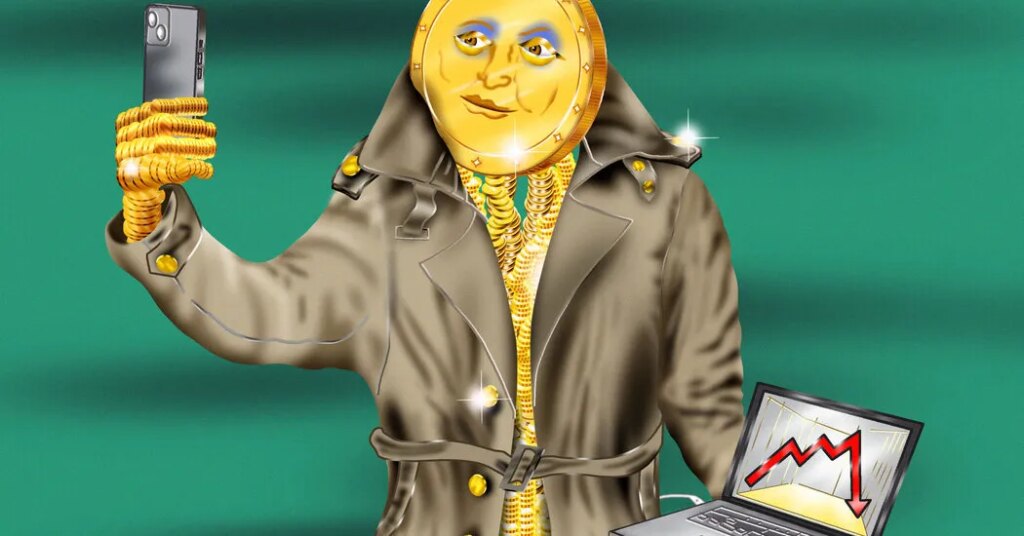
Then things took an interesting turn. Once Jean Phil was sufficiently viral, it came out that his Instagram page linked to a memecoin, $JEANPHIL. A memecoin is a form of cryptocurrency that is more transparently pointless and speculative than the other forms of cryptocurrency. They’re tradable assets, typically worth fractions of a cent, named for (and in some vague sense, indexed to the value of) internet memes. There are millions of them.
If you get in on the right one early and the price starts moving up — from some combination of awareness of the meme and self-fulfilling market momentum as everyone tries to ride the upswing — you can make a quick buck selling your coins to the even dumber money. According to a recent study by Coin Metrics, the typical memecoin reaches its all-time high soon after being issued and is essentially worthless within the space of a year.
They can be valuable to their issuers, though. If you create a coin, you’re well positioned to buy them early on, then dump them once the price goes up, leaving your investors hosed. (This is common enough that it has a name: “rug pull.”) Anyone can make one in a few minutes on websites like Pump.fun, a name that neatly captures the two most important aspects of these coins: They’re understood by everyone in the ecosystem to basically be pump-and-dump schemes; and they’re fun, which is so important these days. These coins have come to play a small but fascinating role in the attention economy, by literalizing it.
Online fame can now be monetized in many different ways, but there’s a certain type of notoriety that’s harder to monetize: the kind that comes at your expense. Those in possession of this kind of fame have, on rare occasions, turned to these cryptocoins for recompense. Hailey Welch, the so-called Hawk Tuah Girl, was part of a disastrous coin project ($HAWK). Even traditionally famous people who are somewhat loathed — Jason Derulo ($JASON) and Iggy Azalea ($MOTHER) — have gotten in the game. Most recently, Hunter Biden made a coin ($LAPTOP), which wound up being, appropriately, the crack cocaine of the asset class: It spiked astronomically high within minutes, briefly having a (notional) market cap bigger than Uber’s, and crashed to near worthlessness just as quickly. (Biden claimed no wrongdoing.)
Each of these figures possesses a sort of infamy that makes them sticky online, fixed references to point at and speculate about, the raw material for millions of internet users to make something of and benefit from in some vague way. If a photograph steals your soul, then this experience is like winding up trapped in a Bosch painting, forever. The coin allows these lost souls to claw back some dignity, in the form of tiny little payments.
But the appearance of Jean Phil in my life and in my phone raised a new question: What if you didn’t need a soul to do this?
The problem of compensation has always haunted the social internet, which descended upon us and rearranged everything quite suddenly. Social media snatched the attention once cobbled together by publications or television networks and put an unpaid public to work providing the entertainment. Turns out, we like this better. And some old arrangements reconstituted themselves in novel forms: The work of, say, a men’s fitness magazine would now be done by Instagram influencers. But independent of these deals, which are common in one sense and exceedingly rare in another, your average user is not compensated for the value he creates for platform owners and shareholders.
This is the problem Jaron Lanier foresaw in his 2013 book “Who Owns the Future?”: The creative middle class was being destroyed by the onset of the digital economy, and the same forces would come for the rest of us. Lanier, who in addition to being an influential futurist has a sideline as a musician, felt that Silicon Valley ideologues were glib about information’s supposed desire to be free. (“Why is it suddenly a service to capitalism to keep more and more value off the books?”) These entrepreneurs knew the information was a gold mine, after all — the businesses were built on this proposition. “It’s not that the market is saying ordinary people aren’t valuable online,” he writes. “It’s that most people have been repositioned out of the loop of their own commercial value.”
Lanier makes the case for monetizing information: People who contribute to these networks should be compensated (in “nanopayments”) for the value they generate. The system he imagines is (by his own admission) utopian and complicated: The human provenance of all data would be tracked and preserved, so that people could be compensated deep into the future for whatever algorithms learn from them, specifically. Lanier believed this was important because he saw that the result of all this algorithmic sorting would be artificial intelligences, which would use what they learned from humans to automate away the work we used to do. That future is now starting to arrive.
Lanier’s path not taken is interesting to consider from this vantage. Take dating sites, for example. Lanier imagines a successful marriage that follows from a digital match. “The algorithms that implement that service take note of your marriage,” he writes. “As the years go by, and you’re still together, the algorithms increasingly apply what seemed to be the correlations between you and your spouse to matching other prospective couples. When some of them also get married, it is automatically calculated that the correlations from your case were particularly relevant to the recommendations. You get extra nanopayments as a result.” This sort of thing already happens, Lanier argues, “but the payments don’t flow.”
Is it too much to suggest that Hunter Biden has something in common with this hypothetical couple? That he has been unusually valuable to the social internet? Has he not delighted its users in a way that has kept them engaged for longer, so that they could be served more advertisements? How many man hours of social internet use could be attributed to our prurient interest in Hunter Biden’s drug-fueled sex life?
This summer, Biden did a grand tour of podcasts across the political spectrum, everyone from Mehdi Hasan to Tucker Carlson, with stops on “The Adam Friedland Show” and Channel 5 in between. This culminated in September with the release of $LAPTOP, after the device our poet-slash-president named the “laptop from hell.”
On Carlson’s podcast, a month before the coin was released, Biden spoke openly about his desire to reclaim what was taken from him during his years of infamy, and the ways he might go about doing it. “I really believe in cryptocurrency,” he said. “I also want to make some money.” At last he could be compensated for having been Hunter Biden — which is, ironically, what his political opponents always accused him of having done.
Indeed, why name it for the laptop if not as an act of reclamation? This was the vector by which Biden’s private life became algorithmic fodder. This is what memecoins do; they alchemically turn attention into money. Looked at a certain way, it’s a nightmare version of Lanier’s idea: scammy, stupid and built to reward the wrong behaviors; perfect for the internet we built.
$JEANPHIL is currently trading for about four-hundredths of a cent, off an all-time high of one-tenth of a cent. There are nearly a billion of these $JEANPHIL coins in more than 19,000 different wallets, amounting to market cap of around $4 million — an approximation, perhaps, of the value of the time we spent thinking there was this guy with a funny haircut who might be going places. Or simply just the belief that there must be people out there dumber than us.
Now my Instagram algorithm — having learned how stupid I am — has been serving me more of these impossible-looking guys with insane haircuts, a parade of cheap Jean Phil imitators: a Hapsburg in full regalia, and the chin, on a skateboard; a guy with hair the size and shape (and color) of a basketball, and a neck tattoo, who dresses like a rapper. Many of the accounts seem to exist to promote software you can use to make more fake influencers. At least one I’ve encountered has a memecoin, currently even more worthless than most.
If there’s anything to be said for gawking at strange human specimens on the internet, it’s this: They remind us of the full range of human experience. If the internet can feel, at times, culturally homogenizing, these glimpses of true idiosyncrasy make the world feel big again. Aside from the humiliation at being bested by NVIDIA chips, this is what stung me about Jean Phil. My beautiful little portal to strange worlds was an illusion; I was being pickpocketed in a crowded souk — if not for my money, then my attention.
This is one terminus of the internet we acquiesced to: Whatever bad habits we developed over the last decade and a half will be tapped into and exploited by people using A.I., and perhaps eventually A.I. itself. Even, or especially, these low impulses — the very impulses our social internet encouraged — will be fed more and more by those who see in them a way to extract tiny bits of value, mere fractions of a cent, over and over and over.
Or just your time and attention, which we have come to think of as worthless, even though the businesses that have rewired us know better.
The post Even the Worst Job on the Internet Isn’t Safe From A.I. appeared first on New York Times.