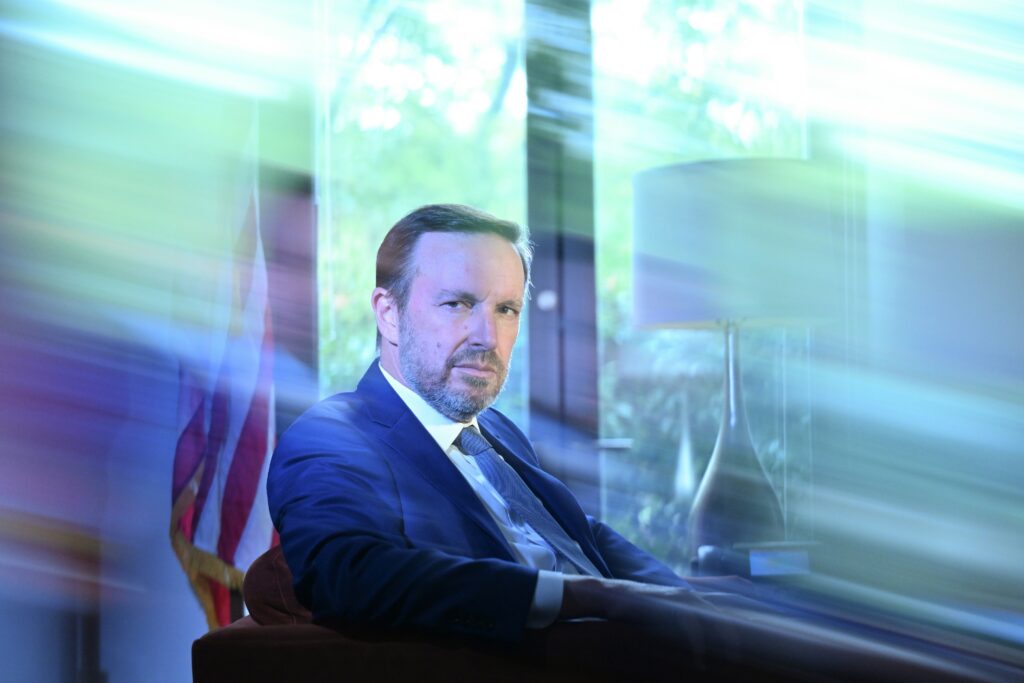
When Sen. Chris Murphy, 53, was hospitalized after a stroke Saturday, he became a high-profile example of what may be a troubling trend: Strokes seem to be more common in younger adults than they were in the past.
Over almost three decades, a team of researchers has been tracking cases in Greater Cincinnati and Northern Kentucky. This area is not random — it’s demographically similar to the United States overall in terms of age, race, education and income, said Emily Fisher, a neurologist at the University of Cincinnati and one of the researchers. “That allows us, if we see a signal in our region, to say, ‘Hey, does this need to be looked at on a greater scale because it could be reflective of what’s going on in the United States overall?’”
The results of this effort, published in September in Neurology, showed that stroke rates among 20- to 54-year-olds in the region almost doubled from 1993-94 to 2020, while declining among older people. The increase was largely driven by the ischemic type, caused by a blockage in a blood vessel — often a clot — supplying the brain.
Still, strokes remain much less common in younger adults. Their annual rate rose from about 34 to 62 cases per 100,000 people. In the older group (those 55 and older), it fell from about 619 to 453.
But younger people may face different challenges in the aftermath of a stroke than those who have them later in life. “These are folks at the prime of their life in certain situations,” Fisher said. “They’re working, they have young families, they’re critical to their communities and their neighborhoods.” Having a stroke can mean, in some cases, living with disability for four or five decades.
The findings reflect a familiar trend in clinical practice. “For those who see these people on a daily basis, it’s unfortunately not all that surprising,” said Michelle Johansen, an associate professor of neurology at Johns Hopkins Medicine, who reviewed the paper.
There’s encouraging news, though: Many strokes are preventable, Johansen said, and addressing risk factors earlier in life can help.
Why strokes may be on the rise in younger people
Conditions such as high blood pressure, diabetes and atrial fibrillation (A-fib) — an irregular and often very rapid heartbeat — are one possible explanation for the increase. “The risk factors for stroke in younger adults are really the same flavors of the same risk factors that we’re seeing in older adults,” said Christopher D. Anderson, chief of the stroke division at Mass General Brigham. “It seems like they’re starting up at younger ages than historically we’ve ever really seen.” Diet, sodium intake, sedentary lifestyles and substance use could be contributing, he said.
While obesity wasn’t specifically included in this study, Johansen pointed out that it has also been increasing in young people and is associated with other risk factors such as diabetes.
Johansen, who studies cardioembolic stroke — caused by a clot that travels from the heart to the brain — found the A-fib findings particularly interesting. These strokes account for a growing share of cases, she said, and A-fib can cause the clots that lead to them.
The increase in A-fib recorded in the study could partly reflect better detection through wearables such as the Apple Watch, she said. Some fitness trackers and smartwatches use optical sensors to monitor your pulse and flag irregular rhythms that could indicate A-fib, prompting further medical evaluation. She added that hypertension and diabetes, by contrast, appear to be growing more common — not simply being diagnosed more often.
But Fisher said she’s not convinced that these risk factors tell “the entire story.” She and her colleagues also noted an increase in substance use other than alcohol and tobacco among stroke patients.
Pregnancy–related stroke is another area that warrants further research, Fisher said. “It can be related to blood-pressure disorders during pregnancy, or due to the fact that when pregnant, it is easier for the body to form blood clots,” she explained. Some research suggests pregnancy-related strokes have increased over time, she said, but this study couldn’t establish whether they contributed to the increase in younger adults.
How to reduce your risk of stroke
“The first thing to recognize is that if these risk factors are happening when we’re younger, we need to start thinking of our bodies a little bit differently and actually being on the lookout for these conditions so that we can treat them,” Anderson said. Regular medical care can help identify conditions such as high blood pressure and elevated cholesterol, the experts said. That’s especially important if you have a strong family history of stroke, but it really goes for everyone.
In addition to monitoring risk factors, Johansen also recommended asking your doctor whether an EKG to look for A-fib is appropriate for you. If any of these conditions are detected, the next step is to work with your provider on a treatment plan.
Daily habits matter, too. The experts point to the American Heart Association’s Life’s Essential Eight, including a healthy diet, being physically active, avoiding tobacco and getting enough sleep.,
“It’s kind of a classic age-old doctor thing to say, but diet and exercise are critically important,” Anderson said. More specifically, he points to the Mediterranean diet, which has been shown to improve heart health.
Johansen also emphasized movement. She suggested focusing on what you can control, such as how much you get up and move throughout the day.
Signs of stroke — and when to get medical attention
All the experts pointed to the B.E. F.A.S.T. acronym, which stands for balance loss, eye or vision changes, face drooping or twisting, arm weakness, speech difficulty and time to call 911. “This is a good tool for everyone, not specific to younger adults,” Fisher said. (Murphy’s symptoms included arm numbness.) Call 911 immediately if you experience stroke symptoms, even if they go away.
The key is to act immediately: “There are treatments for stroke that are actually quite effective, but there’s a time limit on when we can give them,” Anderson said. “Don’t try to sleep on it and come in the next day.”
Recognizing the warning signs matters at any age. But for younger adults, Anderson said, prevention also needs to start sooner than they might think — rather than waiting until later in life to pay attention to their cardiovascular health.
“This is a wake-up call to us as doctors and as advocates for health in our population,” he said. “It’s important to start immediately taking care of your body.”
The post More people are having strokes before 55. Here’s what experts know. appeared first on Washington Post.