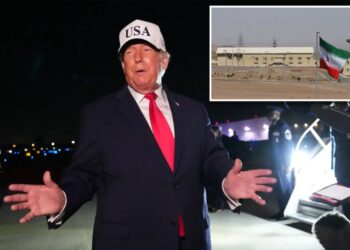
As the prospect looms of renewed attacks on Iran by the United States and Israel following Tuesday’s U.S. midterm elections, Beijing is scrambling to mount a flurry of Middle East diplomacy.
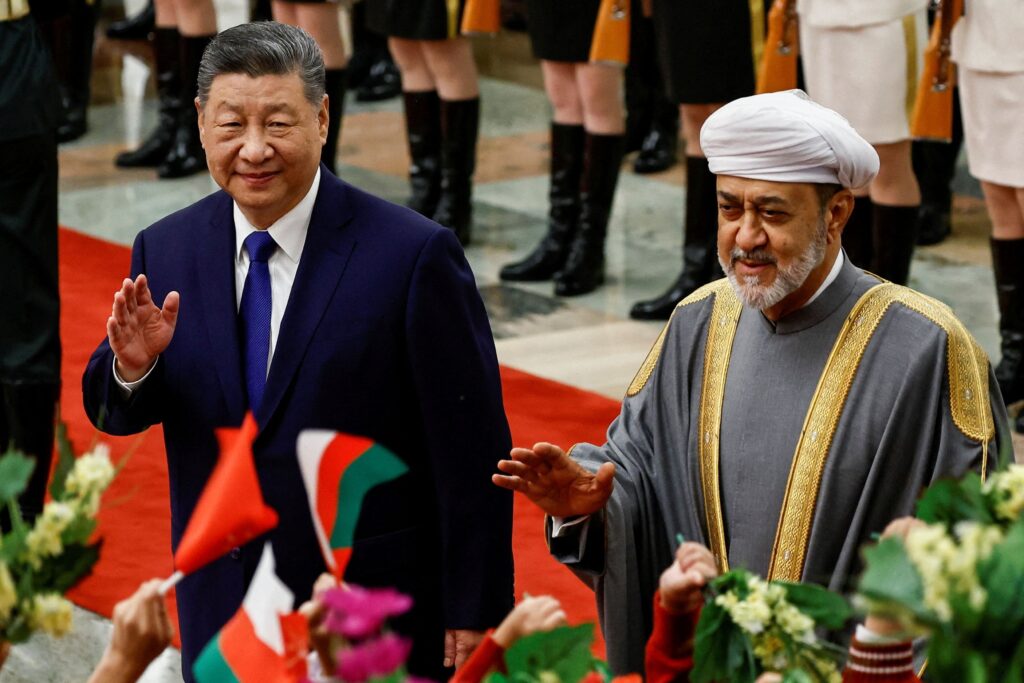
Chinese leader Xi Jinping and Foreign Minister Wang Yi hosted separate, high-level talks with Oman, Iran and Saudi Arabia in Beijing on Monday: Xi’s meeting with Oman’s Sultan Haitham bin Tariq was the first visit to Beijing by an Omani head of state since the countries established diplomatic ties 48 years ago.
The same day, China’s foreign ministry announced details of a Middle East diplomatic blitz in the coming days and weeks, with three senior envoys set to fan out across seven countries, spanning the Persian Gulf and the Horn of Africa.
The widespread push marks one of Beijing’s most intensive public diplomatic efforts since the U.S. and Israel attacked Iran in February, as China’s leaders seek to carve out a role in setting the fate of the region as it braces for a potentially dangerous new phase.
Readouts from Xi and Wang’s visits emphasized a push by Beijing for immediate de-escalation, negotiations and a larger Chinese role in shaping the regional security environment.
“Beijing has good reasons to lean in now. Trump is again threatening Iran, Gulf governments are worried about renewed escalation, and Riyadh has already asked China to use its relationship with Tehran to rein it in,” said Craig Singleton, senior director of the China program at the Foundation for Defense of Democracies, a think tank that has argued for an aggressive stance toward Iran.
The U.S. military had been preparing for possible additional attacks, though President Donald Trump has publicly ruled out resuming strikes before the vote, leaving open the prospect of a escalation after Americans head to the polls.
The threat of renewed strikes has Gulf states scrambling to break the U.S.-Iran deadlock, concerned that another round of fighting could once again bring Iranian retaliation to their doorstep. Mediators from Qatar arrived in Tehran on Friday as part of the ongoing efforts to end the war.
The White House has sent mixed signals about prospects for a diplomatic off-ramp from a war that U.S. military officials estimate has already cost the U.S. more than $47 billion — not including damage to U.S. bases in the region.
Some in the Trump administration, including Vice President JD Vance, special envoy Steve Witkoff, and Jared Kushner, Trump’s son-in-law and envoy, have pushed for a deal, while others, including Defense Secretary Pete Hegseth, have appeared to oppose it, The Washington Post reported last week.
Despite deepening ties across the Middle East and repeated attempts to cast itself as a peacemaker, Beijing has struggled to translate its diplomatic ambitions into results so far. The intensive diplomacy does, however, reflect Beijing’s growing ability to bring key players into dialogue.
“If the region starts moving toward some kind of diplomatic endgame, Beijing will want a seat at the table, or at least to be seen trying to shape one,” Singleton said.
As Xi hosted the sultan of Oman, a longtime mediator between Washington and Tehran, Wang Yi, the foreign minister, met separately with senior Iranian and Saudi security officials.
“Dialogue and negotiation are the way out,” Wang said in an official readout of his meeting with Ali Bagheri Kani, deputy secretary of Iran’s Supreme National Security Council, calling on all sides to pursue a political solution “rather than once again resorting to armed conflict.”
The timing of the first visit by an Omani head of state coincides with the Gulf nation’s growing role mediating the conflict. Earlier this year, Beijing mounted a similar diplomatic push with Pakistan, then seen as the best intermediary between Washington and Tehran.
“Oman has been playing the quiet role of mediator. China identifies with that approach and Oman has more to offer in terms of credibility and relationships as a mediator,” said Yun Sun, director of the China program at the Stimson Center, a Washington think tank.
China’s foreign ministry said that in the coming days China’s Middle East envoy Zhai Jun would travel to Iran, Oman and Saudi Arabia; Africa envoy Liu Xianfa to Ethiopia, Djibouti and Egypt; and Horn of Africa envoy Hu Changchun to Eritrea. The trips come amid fears that the Iran war could worsen intersecting conflicts and sources of instability across Africa and the Middle East.
Beijing has considerable stakes in heading off another escalation. China depends heavily on energy flowing through the Strait of Hormuz and has billions of dollars invested across the region, while prolonged conflict risks disrupting shipping and supply chains and hurting demand for Chinese exports. At the same time, Beijing appears intent on seizing diplomatic opportunities resulting from the conflict to present itself as a force for stability.
“There is a little of Ukraine playbook here: Stay engaged, send envoys, and make sure China cannot be written out of whatever comes next,” said Foundation for Defense of Democracies’ Singleton.
Susannah George contributed to this report.
The post Beijing launches diplomatic flurry amid threat of renewed U.S. war with Iran appeared first on Washington Post.