TEL AVIV — Four days after a historic election, two visions for Israel’s political future collided in a downtown plaza.
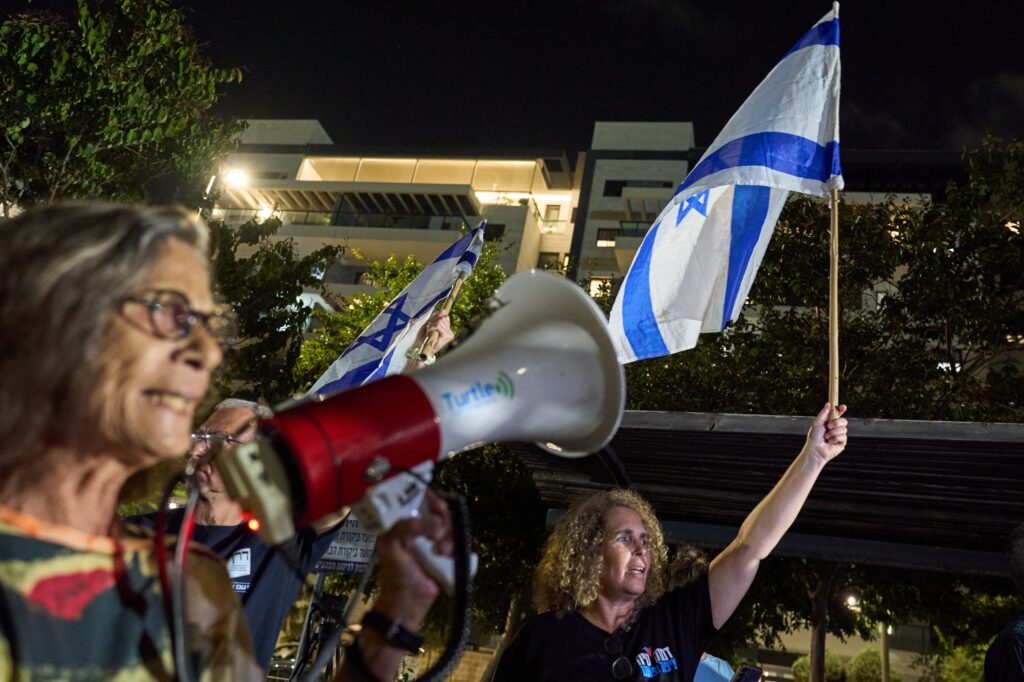
Thousands of Israelis descended on Habima Square in Tel Aviv this weekend to urge Gadi Eisenkot, the leader of the main opposition bloc, to form a government with Arab parties that could topple Prime Minister Benjamin Netanyahu. Some banged on drums, decrying what they saw as pervasive anti-Arab racism in Israel. Others waved placards in Hebrew and Arabic declaring, “Arabs and Jews will only win together.”
But in a corner of the square, a boisterous counterprotest gathered, and quickly snowballed. Backed by loudspeakers blaring rock music and escorted by police, Netanyahu supporters swore their allegiance to “Bibi the King,” vowed to send “terrorists to Gaza, not the government” and confronted Jewish demonstrators, who they condemned as traitors to their own people. Before long, they set off a few minor scuffles.
The febrile scene at Habima Square was a microcosm of post-election Israel: deeply divided over Netanyahu, who is adored and loathed, and intensely conflicted over whether Palestinian citizens of Israel, who turned out to vote in record numbers on Oct. 27, should be part of a ruling Israeli government.
Above all, the dueling demonstrations raised a question that Israelis have faced all along: What role can Palestinian citizens play in the government of a Jewish state?
For members of Israel’s dwindling but vocal left wing, who were out in force at Saturday night’s demonstration, the answer was simple: A vote was a vote.
“They are citizens like all other citizens. They went to the polls, so they should be part of the government,” said Martin Kupiec, a professor of genetics at Tel Aviv University, as he stood in the crowd with an Israeli flag slung over his right shoulder.
For decades, Netanyahu and the right wing had built up the popular perception: “We can’t make a government with Arabs,” Kupiec said. He said he hoped Eisenkot would take the leap and convince his coalition partners to do the same.
“We’re trying to tell Gadi Eisenkot he was voted to govern, so do it,” Kupiec said, as younger demonstrators milled through the crowd distributing signs that read, “Democracy For All.”
“It’s time to give Arabs something,” Kupiec said. “They’ve been marginalized.”
Although most Israeli voters repudiated Netanyahu’s coalition, voting for opposition parties last week, Eisenkot’s bloc fell 13 seats short of the 61 needed to wrest control of the 120-seat Knesset. Eisenkot could become prime minister by allying with the two Arab parties, which won a combined 19 seats, but some of his coalition partners, most notably the hardline former defense minister Avigdor Liberman, whose party holds seven seats, have ruled out the prospect.
Eisenkot, a former general and centrist on the Israeli political spectrum, has also expressed reservations.
In a statement over the weekend, Eisenkot signaled that he would be willing to bring the Arab parties onboard if they recognized Israel as a Jewish state, accepted mandatory military or civilian service and agreed that Hamas was a terrorist organization that must be dismantled in Gaza.
The two Arab parties, the Joint List and Ra’am, have indicated willingness to propel him to the prime minister’s office, which they could achieve by joining his government or by propping it up from the outside by not voting against it.
While Eisenkot’s conditions are palatable for Ra’am, an Islamist party that put forward a retired Jewish police official as a top candidate for parliament, some Joint List leaders have declined to denounce Hamas as a terrorist organization. Eisenkot’s other coalition partners would have to accept, or at least not to oppose, such an arrangement, to a preserve a path forward.
Netanyahu, meanwhile, has for months painted Arab parties as dangerously disloyal and Eisenkot as reliant on their support.
Following meetings with the various parties this week, Israeli President Isaac Herzog is set to give a mandate to either Eisenkot or Netanyahu to try to form a government. Many analysts agree that neither leader will be able to amass at least 61 seats and that for Eisenkot’s bloc, a refusal to embrace the Arab parties remains a key stumbling block.
Dahlia Scheindlin, a political consultant and pollster, said Israeli opposition leaders reflected fears, racism against Palestinians aside, that an alliance would trigger a backlash. In truth, Scheindlin said, polling data suggested that many anti-Netanyahu voters would accept a partnership with Arab parties and those fears may be overblown.
“The opposition’s voters are so desperate to get Netanyahu out that they’re willing to live with one of the options” of joining hands with Arab parties, Scheindlin said. “Everybody knew this was a possibility.”
Noa, an Education Ministry employee who attended Saturday’s protest, who gave only her first name to protect her government role, said that outside the political arena, many Jewish Israelis had no problems coexisting alongside Palestinian Israelis.
“Arab and Israeli people already live together on a daily basis,” she said. “Now, we need leaders to be brave instead of this constant gaslighting.”
In 2021, Naftali Bennett, an Eisenkot ally in this year’s election, invited Ra’am into his government and became prime minister — a significant moment in Israeli politics. But his coalition collapsed the following year, after his party leaders began to defect.
In the 1990s, former prime minister Yitzhak Rabin relied on outside support from Arab parties to keep his minority government in power and push through the Oslo accords, which paved the way for Palestinian self-governance. At the time, the deal was bitterly opposed by Netanyahu, a young leader of the Likud party, and in 1995, Rabin was assassinated by Yigal Amir, a far-right Israeli extremist.
On Saturday night, many left-wing protesters began marching through the leafy streets of central Tel Aviv toward Rabin Square, renamed after their fallen hero. As they trickled out, the right wing group swelled in numbers and enthusiasm. Their music ratcheted up, and so did their belligerence.
In a widely circulated video that made headlines across the country, a far-right activist from central Israel invoked the Holocaust as he condemned opposition demonstrators as enemies of their own people.
“You are the first enemies we will send far away, to Birkenau, to Auschwitz,” said the man, who was identified in Israeli media as the 29-year-old far-right activist Yonatan Dahman.
At one point, Netanyahu supporters surrounded a 30-something social worker from Haifa and some began to shove him before police quickly intervened. After he was escorted out of the scrum, the protester, surnamed Paz, quietly seethed.
“They start to fight because they hate everyone who don’t see things their way,” said Paz, who declined to give his first name because he feared retribution. “They cannot let it go,” he said. “They would rather try to start a civil war to stop the formation of the new government.”
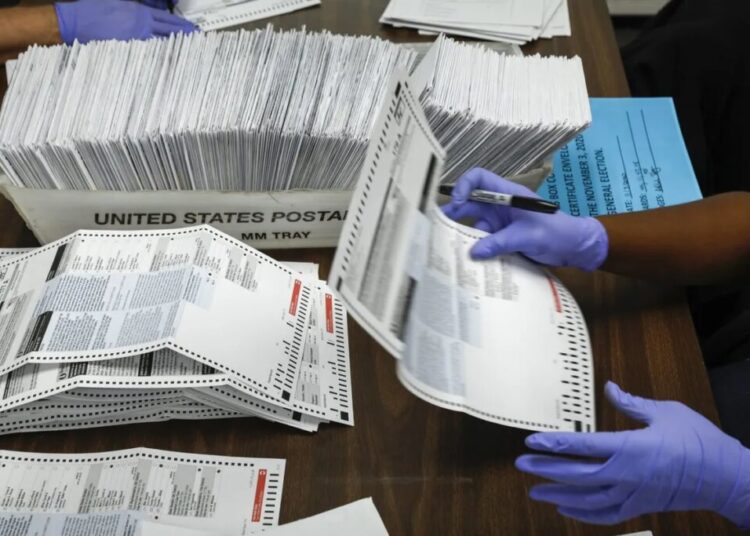
Minutes later, two women who had accosted Paz argued their perspective: The election was stolen, just as Netanyahu had claimed last week. It didn’t matter that Israeli election officials said they had seen no evidence that that the vote was compromised many of Netanyahu’s die-hard supporters organized the counterrally and carpools to Tel Aviv at the last minute after they found the left was calling for Arabs to join the government.
“How can they be identified if they wear hijabs? There are thousands of testimonies of voter fraud,” said a Netayahu supporter, repeating Islamophobic misinformation — there is no evidence of voters using facial concealment to commit widespread fraud. She gave her name as Zehada, but declined to give her full name, to speak freely.
“How can they vote if they can’t read or write? Ninety percent of them don’t go to school,” she said — repeating another false claim.
She agreed there would be unrest if Netanyahu was ousted from power. “We’re going to burn the streets,” said Zehada, a saleswoman from Ramat Gan, a Tel Aviv suburb.
Her friend, Dalia Pilova, said she agreed.
“They’re not going to steal our country,” Pilova said. “We’re asking for a Jewish state. It’s the only country in the world where we can be safe. And Bibi is the only politician who can destroy evil in the world.”
The post Two visions for Israel’s future collide amid uncertain election results appeared first on Washington Post.