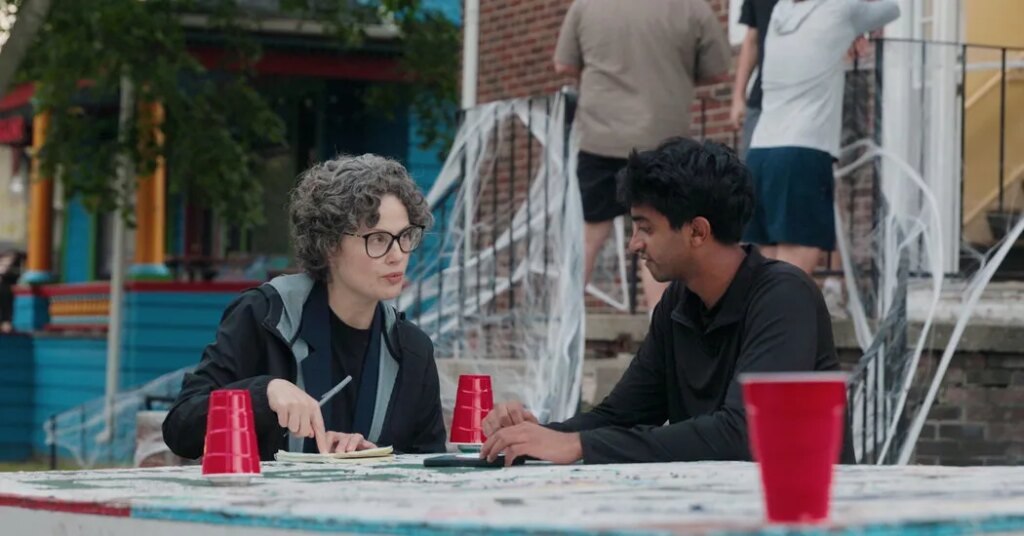
As a national correspondent for The New York Times, my job is to talk to Americans about their political views.
That is becoming harder and harder to do.
A case in point: my recent trips to Michigan. It’s an important state with some crucial races. Coming from my desk in The Times’s Manhattan newsroom, where everybody is talking nonstop about the election, I expected some sort of buzz.
Instead I found silence.
Sure, there were political rallies, and some people were going to those. But I go to places where many people are just going about their lives: grocery stores, restaurants, gas stations and malls. I try to get answers not only from very political people, but also from people who don’t think very much about politics.
Most of the people whom I approached were happy to talk — about the weather, their kids’ Halloween costumes, even the economy and their family finances. But when it came to conversations about politics, I would get a dozen of “no’s” before I got a yes. Some people looked like they’d rather get a root canal.
“No way,” said Daniel Smith, a man looking at his phone in the Rivertown Crossings mall in a suburb of Grand Rapids, when I asked him if he would talk with me about the election. “I don’t talk politics.”
In purple places like Michigan, sharing your political views has become a socially risky thing to do. The internet instantly beams everything to everyone. Even if you trust a Times reporter, what you say might anger your neighbor, your customer, your aunt, your daughter. In short, some people feel that there is no upside of talking to me.
Edwyn Santos, 25, a bakery owner in Grand Rapids, told me no when I asked him to talk. He said he had customers on both sides, so he keeps his opinions to himself. One of his worst fears, he said, is having something blow up online, resulting in a boycott of his business.
“It’s really tricky with social media,” he said, as he emptied some freshly baked Guatemalan pastries into display cases.
Fear of speaking to reporters, of course, is not a new problem. Both Democrats and Republicans have increasingly expressed more reticence. But in my ten years of national reporting, I believe it has gotten worse, particularly in Republican areas where I spend a lot of my time.
Some of the reticence comes from conservatives fearing they will not get a fair shake from what they see as the liberal news media. I spend quite a bit of time telling them about my article, what question I’ve set out to answer and why having their unvarnished view will help me do that. I tell them that, yes, I have views, but that above all I am a journalist who takes pride in figuring out where a society’s head is and what that might say about the future. If I bring a bunch of my own preconceptions to that effort, I will get it wrong.
Then again, it is often the internet that stops people. Will readers go after them online? I have some sympathy for this. Many people I talk to have never spoken to a journalist before and may never again, and the idea of having thousands of strangers leaving angry comments next to a picture of your face can be a shock.
Most worrying, I think, is the reticence that comes from people who feel completely disconnected from politics. These are people, often working class, who don’t vote, or haven’t in years, and are not particularly keen to share that with a reporter.
Like Jordan Blyden, 27, the general manager of a student bar in East Lansing, who said it was all he could do to keep food on the table for his three children. Politics, he said, was like a sport that he did not have time to follow.
Or the man sitting in a barber’s chair in the village of Paw Paw, who said politics was like a game that people like him are not playing. In fact, they aren’t even watching anymore.
As a reporter interested in where America is headed, these people — those who have lost hope and no longer participate as voting citizens — are some of the most important ones to reach. They are a deep part of our national mood and a barometer for our society’s well-being. And we need their perspectives for a full view of where the country is at, even if they are harder to reach.
They are also a huge share of the population — in 2022, a majority of American adults did not vote — and that still was substantially better turnout than in many midterm elections in past years.
The night I stayed in Paw Paw, I passed a laundromat. I could see through the window that three people were inside: two young people engrossed in their devices, and a woman who looked closer to my age. I walked in and introduced myself. The woman, Tiffany Miller, said she was 48 and worked at an auto-parts store, but that she did not want to talk about politics. She eventually revealed that she had recently become homeless, after an apartment she rented fell through. She and her two children, the young people sitting next to her, were now living out of her truck. Politics, to her, felt hopeless.
“I’ve been let down so many times,” she said.
The post Talking Politics With People Who ‘Don’t Talk Politics’ appeared first on New York Times.