Not too long ago, Amazon founder Jeff Bezos was pledging to use his company’s size and scale to galvanize corporate America to confront global warming.
If Amazon “can meet the Paris agreement 10 years early, then any company can,” Bezos said in 2019, laying out how the company would eliminate its planet-warming emissions much faster than the timeline agreed to by the world’s governments. (Bezos also owns The Washington Post.)
Microsoft, Google and Meta subsequently vowed to move even more aggressively.
But now Amazon and the other tech behemoths are setting a very different example. Rather than racing toward their net-zero targets, they are driving emissions sharply higher with their quest to expand AI and cloud computing.
To support their data centers, tech firms are driving construction of a new generation of supersized, gas-fired power plants that could lock in hundreds of millions of tons of climate pollution for decades to come, according to corporate disclosures and an analysis conducted for The Post by a researcher at the Harvard T.H. Chan School of Public Health.
Industry estimates show these projects have put the tech sector on course to grow from a modest driver of industrial carbon pollution into one of the world’s biggest emitters of greenhouse gases. Some anticipate that its share of global carbon emissions will increase as much as fivefold from 2020 to 2030. That would leave the tech industry churning out more than half the climate pollution created by global aviation or shipping — sectors long associated with driving warming.
“AI may feel completely digital, immaterial, but its infrastructure is very physical. It needs land, power plants, transmission, water and fuel, and those choices can last for decades,” said the Harvard researcher, Gianluca Guidi, who based his analysis on air permits, corporate disclosures, community presentations and other materials collected largely by the research firm Cleanview.
Already, Amazon’s carbon footprint reached 80.85 million metric tons last year — 58 percent larger than when Bezos pledged to shrink it. The company has veered far from the path laid out in the Paris agreement, which would have emissions falling steeply by now and dropping to 43 percent below 2019 levels by 2030.
The tech companies say in corporate disclosures and public statements that they remain committed to their net zero targets, and they suggest the emissions surge is temporary — to be mitigated down the road, when new energy technologies enable the data centers to run cleaner and more efficiently.
They also stress that they continue to invest in clean energy and rank as some of the world’s biggest consumers of it. With some complicated accounting maneuvers and carbon credit purchases, their solar, wind and geothermal installations partly cancel out their gas emissions, according to corporate disclosures.
Amazon spokeswoman Margaret Callahan said a recent deal to build a mega-gas plant in Texas “is one piece of a much larger picture — one that also includes the world’s largest portfolio of carbon-free energy, built over many years.”
Those investments can reduce a company’s carbon pollution on paper using market-based accounting. They do not, climate experts warn, change the physical reality that adding fleets of new gas-fired plants to serve data centers ultimately drives warming.
“It is a disaster from a climate perspective,” said Thomas Day, director of corporate accountability at the New Climate Institute, a Germany-based nonprofit that tracks corporate emissions pledges. “These companies are locking in huge fossil fuel projects that will become some of the biggest emitters in the world. It’s not like these are one-offs. We are seeing more and more of them, with no end in sight.”
Committing to gas
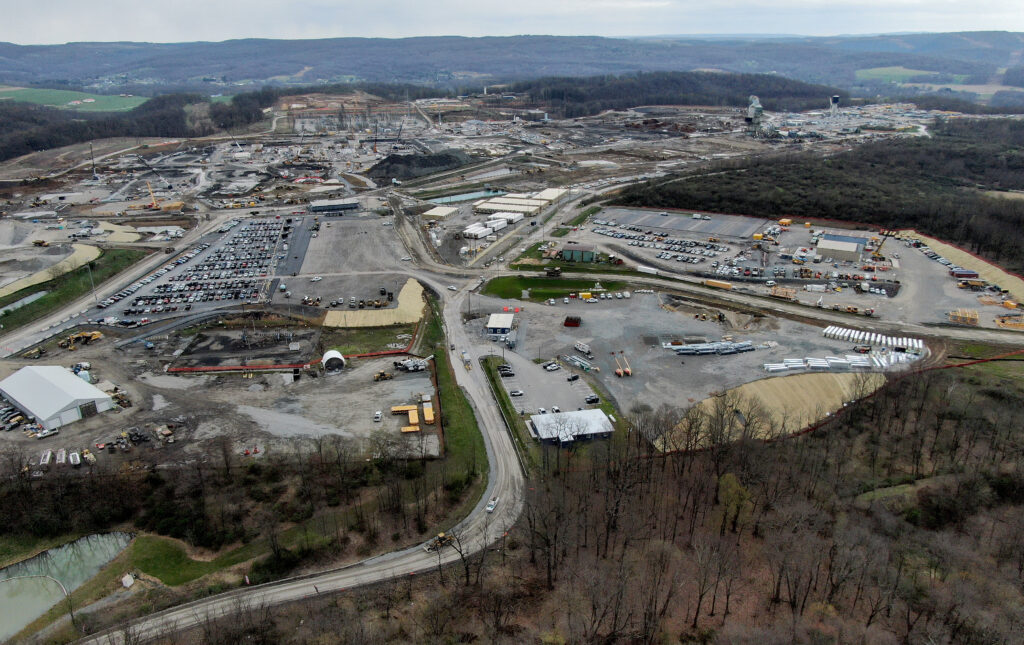
Just two gas projects Amazon recently signed on to, which would power planned data centers in Texas and Pennsylvania, would produce more carbon pollution than the dirtiest facility in the country, the giant James H. Miller Jr. coal plant in Alabama that powers 1 million homes.
The pollution from these gas plants alone would be equivalent to a 28.5 percent increase over Amazon’s current reported greenhouse-gas footprint.
Meta, meanwhile, is building a nearly six-square-mile campus in rural Louisiana that will consume as much electricity as three cities the size of New Orleans. The gas plants powering the operation would create more carbon emissions than all of the emissions the entire Meta corporation now generates, as reported in its most recent sustainability disclosures.
A sprawling Microsoft project in West Texas involving a giant gas plant built by Chevron and a Google project in Wyoming that would consume five times as much electricity as every household in that state would vastly expand the emissions associated with those companies.
A data center campus in Pike County, Ohio, that will support OpenAI’s artificial intelligence operations will consume significantly more gas power, and, therefore, emit more carbon pollution, than the Microsoft and Google projects combined. And AI developer Anthropic is signing on to large gas projects in West Virginia and the Memphis area.
(The Post has a content partnership with OpenAI.)
Once billions of dollars are invested in a gas plant, Guidi said, it is likely to keep running for at least a generation or two, even if the customers it was built to serve ultimately move on to other technologies. “There is a very strong incentive to keep using it,” he said. “So decisions being made for today’s data-center boom can shape emissions long after today’s generation of AI hardware is obsolete.”
Pollution in context
The findings illustrate a trend that is sparking alarm not just among environmentalists, but also among big insurance companies and investors. Data center emissions worldwide are on track to double, reaching 643 million tons of CO₂ annually between 2020 and 2030, absent a substantial pivot back toward cleaner energy, according to a June report from Allianz, the international insurance and asset management giant.
The pace of expansion of the emissions associated with the tech industry contrasts with other major industries which are making strides in slowing the rate at which their climate pollution increases, even as operations grow. Carbon emissions from shipping and aviation are forecast by the International Energy Agency to grow less than 15 percent over roughly the same stretch in which data center emissions could quintuple.
Allianz, which tracks the hazards climate change creates for the insurance industry, calculated the price tag: Absent a rapid, large-scale pivot toward cleaner energy, the tech sector’s emissions threaten to create about $164 billion in annual “climate damages,” which include destruction of property, loss of livelihoods, deterioration of supply chains, and depression of economic growth.
The tech companies say they are just responding to exploding demand and the urgency of an AI innovation race with China. Their regulatory filings say new gas plants are crucial to quickly delivering the around-the-clock power they need. Meta wrote to Louisiana regulators last year that the gas plant will enable “speed to market” for its data center, which “was and remains utterly crucial in our decision” to locate in the state.
Short of compromising that speed, the companies say the best they can do in the near term is to counterbalance the increased emissions with clean energy investments.
Callahan said that Amazon has invested “billions of dollars to enable more than 712 carbon-free energy projects totaling 42 GW worldwide” and that the company is “working toward net-zero carbon emissions by 2040 as part of our Climate Pledge commitment.”
Microsoft notes that last year it met a milestone on its net-zero “journey by matching 100% of our annual global electricity consumption with renewable energy.”
Meta says it, too, is committed to “matching” 100 percent of its electricity with clean energy projects, pointing to contracts for “30 GW of clean and renewable energy across seven countries and 28 U.S. states.”
Neither OpenAI nor Anthropic have released any concrete climate targets. But they point to hefty investments in next-generation, clean technologies.
Ultimately, though, the millions of tons of new carbon pollution projected to spew into the atmosphere in the service of data centers would not materialize without the backing of tech companies.
Some climate advocates worry, too, that Silicon Valley’s newfound enthusiasm for fossil fuels takes the pressure off sectors of the economy that had been balking on the energy transition.
“These tech companies were seen a few years ago as the potential leaders in decarbonizing the power grid and finding the solutions that would guide everyone else,” Day said. “That is no longer the case.”
Unproven remedies
Industry officials argue that the very advancements in artificial intelligence that are driving the pollution will rapidly help unlock the technological solutions needed to slow and even reverse warming.
Tech firms have also talked for years about deploying systems that would trap pollution. Carbon-capture machinery can compress the greenhouse gas into liquid carbon, which can be buried underground.
But almost none of the new gas megaprojects that will power data centers include such equipment. In regulatory filings, the companies point to the steep cost, environmental challenges and delays that carbon-capture technology could layer onto projects.
Several firms are vowing to incorporate it at some unspecified time in the future. Advocates are doubtful they will follow through and warn that even if they do, it would be inadequate.
“There is not even enough geological capacity to store the amount of carbon that would be needed for the tech industry to go that route,” Day said.
Some data center developers privately concede that the economics of carbon capture may never pencil out. “I don’t think the technology is there today to enable it in a market-cost-efficient manner or enable it on the timetable that we need,” a developer of one large project said, speaking on the condition of anonymity to be candid.
If the priority is zero emissions, nuclear energy or a pairing of industrial-scale batteries with wind or solar may be cheaper than burning gas and then trying to bury the carbon pollution underground.
But while the companies are racing to dominate AI innovation, “speed to power” is taking priority over other concerns.
Methodology
Data-center campuses are built in stages, their computing demand rises over time, and power systems retain spare capacity for maintenance, outages and periods of lower use. For those reasons, this analysis approximated annual pollution based on the assumption that the planned gas plants would be operating at 50 percent capacity. The estimates for the Amazon and Microsoft projects, which are the furthest along, were derived from air-permit emissions filings, with short tons converted to the metric tons typical of carbon footprint calculations. For the plants associated with Meta, OpenAI and Google, capacity details were drawn from project announcements. Annual CO₂ was modeled as generating capacity × 8,760 hours × a standard gas-plant heat rate × EPA’s fuel-emissions factor. The scenarios were then multiplied by 50 percent, to reflect the assumed level of operation.
The post Big Tech promised to lead on climate. Now it’s driving a fossil fuel boom. appeared first on Washington Post.