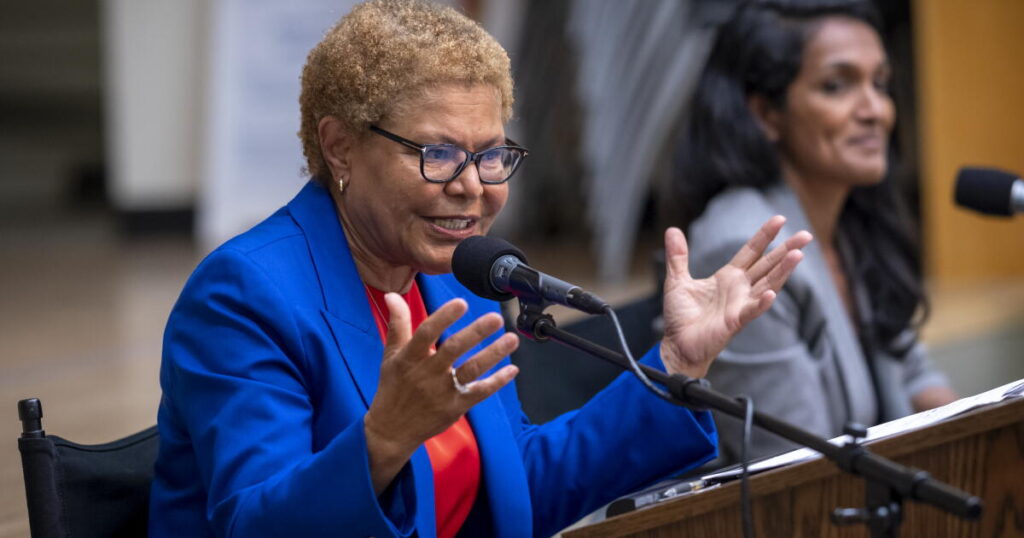
When Karen Bass was first elected to the California state Assembly in 2004, Nithya Raman was halfway across the world, fresh out of college and working in the slums of Delhi, India.
Raman had only visited Los Angeles for the first time a year before. Bass, meanwhile, had already called L.A. home for more than half a century as she built a career as a physician’s assistant, then as an activist, and finally as a politician.
The two women who have charted vastly different life paths are now locked in a contentious battle for mayor of Los Angeles. When the votes are finally tallied after election day Tuesday, the job will go to one of them: Bass, a daughter of South L.A. and the civil rights movement who committed her life to public service, or Raman, who moved to Los Angeles 13 years ago with her husband, hoping, like so many before them, to discover whatever their future might be.
Raman’s relative newness to the city has become a talking point on the campaign trail for the Bass campaign and her surrogates, who have painted the challenger as ignorant of the city’s sometimes painful past, including hammering Raman over a seemingly positive remark she made about former police chief, Daryl F. Gates, who led the force during the 1991 videotaped police beating of Rodney King.
“It’s one thing to be new. That’s the secondary issue,” Bass said in an interview with The Times. “But if you want to lead the city, you would think that you would know some of the most important moments in L.A. history.”
Raman’s response: Los Angeles was built by people like herself who came here seeking a better life and new opportunities.
“This city welcomed me with open arms. So when the mayor keeps saying I’m not really an Angeleno, she’s attacking more than me. She’s rejecting the very DNA of Los Angeles: a city where people from everywhere can find a place to belong and to build a dream,” Raman said in a statement.
‘A word faster than flight’
Karen Ruth Bass was born in South L.A. in 1953, though her family moved to the Fairfax District when she was young.
She grew up a news junkie, watching and listening to the news with her father during the civil rights movement, seeing how difficult integration was in the South.
As she watched the Rev. Martin Luther King Jr. fight racial discrimination in the South, Bass witnessed whites abandoning the Fairfax District as Black families moved in.
“The white neighbors moved so fast I never met them,” she said. “I don’t know if there’s a word faster than flight.”
At 14, Bass signed up her mother to be the precinct leader to campaign for Robert F. Kennedy in the 1968 Democratic primary for president. Bass, instead of her mother, walked the streets and knocked on doors.
She was supposed to be at the Ambassador Hotel the night of Kennedy’s assassination, she said, but her parents made her go to bed because she had school in the morning.
“I was in my bedroom, listening to the radio. I was excited and I heard the whole thing happen and it was a devastating milestone in my life,” she said.
The killing left her disaffected with electoral politics, and she pivoted to activism and community politics.
‘Makes me appreciate Los Angeles’
Nithya Varsha Raman was born in 1981 in Kerala, India, to a family without much money, she said, with her maternal grandparents providing most of her early care.
At 6, Raman and her mother left for the United States on a Pan Am flight, meeting her father who was already here studying engineering. The family put down roots in Burlington, Mass., a Boston suburb.
Her childhood was far less steeped in politics than Bass’ was, but as an Indian girl in a town whose racial demographics were quickly shifting as more South Asians moved in, racial politics bled into her young life. The family lived along Route 128, “a superhighway of tech,” according to Raman’s best childhood friend, Nadia Salim, that became a suburban destination for many South Asians.
“The kids at school were not always super nice to us kids from immigrant families,” said Salim. “For her, it sharpened some sense of empathy and curiosity about people.”
Salim said she and Raman were spit on and called racial slurs.
“My reaction to that stuff was basically to try to disappear,” Salim said. “I remember Nithya being very resistant. … It didn’t change her behavior.”
“The experience that I had growing up makes me appreciate Los Angeles so much,” Raman said in an interview.
‘She quietly did the work’
Bass graduated from Alexander Hamilton High School in West Los Angeles and went to college at San Diego State University from 1971 to 1973, eventually graduating from the physician assistant program at USC Keck School of Medicine. She also earned a bachelor of science in health sciences from Cal State Dominguez Hills in 1990.
In 1973, Bass visited Cuba with the Venceremos Brigade, a U.S.-Cuba solidarity project. She had already been interested in socialism during a post-high school trip to what was then Yugoslavia.
She built houses and listened to speakers in Cuba.
“I was in search for a society where there was equality, where basics were covered, and I didn’t understand why that couldn’t happen in my own country,” Bass said.
As a young adult, Bass began working as a physician assistant at Children’s Hospital and other facilities.
“My day job was in hospitals, but in the evening, I was active on police reform and other issues that were taking place in my neighborhood,” Bass said.
Antonio Villaraigosa, the former mayor of Los Angeles, met Bass in the 1970s, when both were left-wing community organizers participating in the Coalition Against Police Abuse.
“She quietly did the work,” he said. “She didn’t give big speeches. I was giving big speeches. She wasn’t that person. She was the person that, behind the scenes, did all the work. Smart, tough, serious.”
Bass created Community Coalition in 1990, feeling it was imperative to intervene in the crack cocaine epidemic that was plaguing South L.A.
“So many Black people were dying from crack, AIDS and violence,” she said. “So many Black families who were in line to move up in class status fell back, because people got addicted to crack.”
Bass gathered her progressive friends in her living room and pitched Community Coalition to fight the crisis she saw on the streets.
“Half of them supported me, half of them thought, ‘No, we can’t do anything. We need socialism first,’” Bass said. “I said, ‘People are dying. I’m going to do whatever the hell I need to do to save people’s lives,’ and that’s what I set out to do.”
‘No grand plan’
Raman attended Harvard University, where she met her future husband, Vali Chandrasekaran, graduating in 2003 with a degree in social studies.
Like Bass, Raman also went abroad after college, but in her case the destination was Delhi.
“I didn’t have a lot of sense of what I wanted to do in the future. No grand plan,” Raman said.
Shortly after she arrived, more than 100,000 people were evicted from slums on the Yamuna River.
“I was so shocked by the scale of it,” she said. “It felt crazily large and unjust and I wanted to get involved.”
Raman began working with slum dwellers’ organizations in Delhi, first trying to stop the evictions and later documenting conditions in the resettlement colonies, pushing for running water and better sanitation.
From Delhi, she moved south to Chennai, where she pursued similar work on slum dwellers’ rights. She returned to the U.S. to get her master’s degree in urban planning at MIT, graduating in 2008.
She moved back to Chennai after school and started a nonprofit, Transparent Chennai, in 2010. She and her co-founders tried to get the city to invest in sanitation for unmapped slums using data. They mapped out public toilets in some of the poorest regions of the city, created bus routes databases and fought slum clearance policies.
“It was all following the bug of, like, how do we make cities meet their promise?” Raman said of their work.
Raman married Chandrasekaran, who by then was an up-and-coming TV writer, in 2010. In 2013, she left Chennai and moved to Los Angeles.
From organizer to politician
Bass ran for the California state Assembly as a Democrat in 2004, making the jump from community organizer to elected official representing a district that spanned parts of South and West Los Angeles.
She said she found the transition easy because she went to Sacramento with an agenda to further the work she had been pursuing in South L.A. She toiled on criminal justice reform, specifically helping incarcerated people transition back into the community.
In her final term, her colleagues elected Bass as Assembly speaker, the second-most powerful job in Sacramento after the governor.
“She has that way about her that really is empathetic and persuasive,” said Fabian Núñez, who preceded her as speaker.
Bass led the Assembly through the 2008 financial crisis.
“I went up [to Sacramento] to expand these programs and wound up having to cut them. And that was very, very painful, but it’s what I had to do so that the state of California did not default,” she said.
In 2010, Bass ran for Congress, ultimately serving six terms. In Washington, she cemented her reputation as a liberal who was not afraid to work across the aisle with people she disagreed with to try to find common ground and pass legislation.
Bass said she still talks with Republican former House Speaker Kevin McCarthy of Bakersfield, whom she has considered a friend for 20 years.
“I’ve always been about building coalitions, keeping my eyes on the prize, working with people who disagree with me, working with people who don’t like me,” Bass said.
‘Whatever it takes for as long as it takes’
Raman’s early days in L.A. were filled with uncertainty.
“It takes a little while to find a foothold here,” she said.
She eventually landed a gig as a management trainee at the city administrative officer’s office, writing a 2015 report on how Los Angeles was dealing with a burgeoning homeless crisis.
“A lot of money was being spent on addressing the impacts of homelessness … without addressing why people were on the streets in the first place,” Raman said.
Raman began talking with neighbors about starting an organization to serve the homeless, and in 2017 started the SELAH Neighborhood Homeless Coalition, its name an acronym for the communities it serves: Silver Lake, Echo Park, Los Feliz, Atwater Village and Hollywood.
“She was 8½ months pregnant when I met her. She said, ‘I want to end homelessness in L.A.’ I was like, ‘Girl, you can barely get up the stairs,’” said Dorit Dowler-Guerrero, a co-founder of SELAH.
Dowler-Guerrero said Raman had an uncanny ability to get people organized and always had an unwavering belief in her own ability to get things done.
Raman decided to challenge Councilmember David Ryu for reelection in 2020, becoming the first candidate in 17 years to unseat an incumbent City Council member. She had lived in L.A. less than a decade.
Much of her work since joining the council has been geared around something homelessness advocate Mollie Lowery told her when they first met: “Whatever it takes for as long as it takes.”
Raman has had the quote written on the chalkboard in her kitchen for about a decade.
Bass and Raman on collision course
After 12 years in Congress — and making the short list as a potential running mate for Joe Biden in 2020 — Bass ran for L.A. mayor in 2022. Her election completed her career’s arc that began locally, then expanded to California, then the nation and finally returned home.
“What I have so enjoyed about this job is my life has come full circle,” Bass said, adding in the interview that whether she wins or loses, this will be her last election. “These are issues I’ve been working on for the last 30-plus years.”
She was endorsed in 2022 by Raman and returned the favor when Raman ran for reelection to the council in 2024.
The two were considered allies who shared homelessness as their top concern in the city, with Bass leading from her executive office and Raman chairing the City Council’s Housing and Homelessness Committee.
Whatever friendship the two shared was shattered Feb. 7, when Raman announced her last-minute bid for mayor, saying that Bass had failed to deliver on high housing costs, fixing broken streetlights and adequately addressing the homelessness crisis.
Their two paths to power — which led them on vastly different journeys through different countries, organizations and governmental roles — left them on a collision course to lead Los Angeles.
Bass said she and Raman share no similarities in where they come from.
“I don’t think there’s anything similar about our paths,” she said.
Raman said their diverging paths don’t matter, and that Angelenos don’t care about where you come from.
“Part of what makes L.A. so incredible is the fact that it doesn’t ask you about who you are, where you’re from,” Raman said. “It just asks you about your work and what you want to do.”
Both women want to be mayor, and Tuesday’s election will determine which path forward Los Angeles voters want to take.
The post A daughter of L.A. and a transplant to the city. The different paths taken by Bass and Raman appeared first on Los Angeles Times.