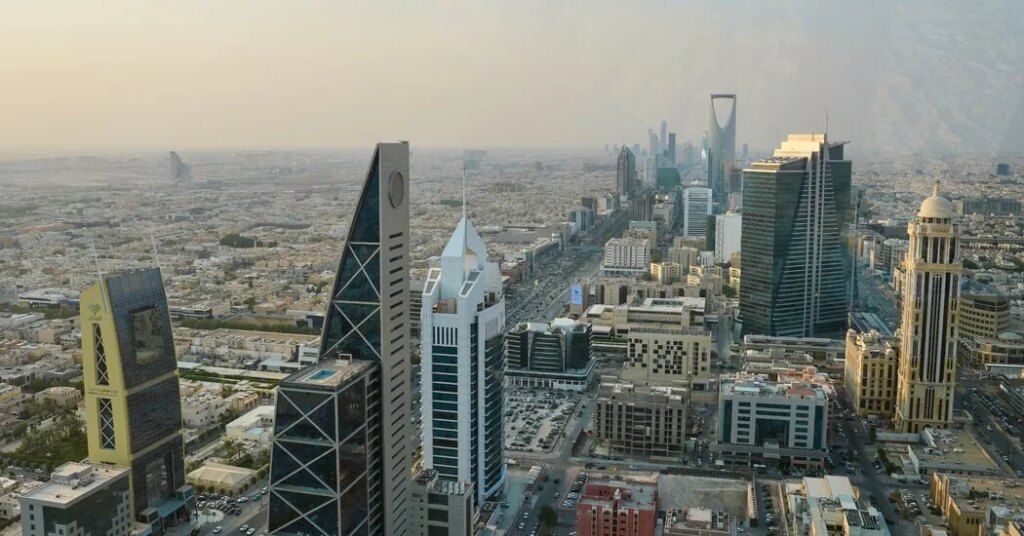
Riyadh Air, Saudi Arabia’s aspiring luxury carrier, is busing international passengers to and from an alternate airport four and a half hours from its hub, which was damaged in strikes.
The marquee Saudi investment conference has been postponed to next year.
The headquarters of the state-owned oil giant Saudi Aramco was struck, as was a critical pipeline. Ships running the gantlet in the vital Strait of Hormuz are still in Iran’s cross-hairs and catching fire from missile and drone attacks. It is a particularly tense time right now, with a heightened risk of escalation of the war.
Throughout the Gulf, the war in Iran, now at the start of its ninth month, and the conflict that has erupted in Yemen are taxing the region’s ability to conduct business as normal.
This week could bring a fresh test. The energy conference ADIPEC, featuring executives and government ministers from around the world, began in Abu Dhabi on Monday. At least one prominent industry leader, Darren Woods, the chief executive of Exxon Mobil, decided not to attend because of security concerns in the region, according to a person familiar with his thinking who was not authorized to speak to the media.
The event’s organizers said in a statement that “high-level participation is very strong” but did not comment on the reasons for Mr. Woods’s withdrawal.
Economic growth across the Gulf Cooperation Council, a regional bloc of Arab states, will tumble by 5 percent this year, according to the International Monetary Fund. Kuwait, Bahrain and Qatar are expected to suffer double-digit contractions, linked to their near-total dependence on the besieged Strait of Hormuz to sell their energy products to the world.
On Sunday, the Saudi government said the kingdom’s economy shrank 3.8 percent from a year earlier in the three months that ended in September. The strongest force behind the decline by far was a 20.4 percent plunge in oil activity.
It could be worse. Pipelines that allow Saudi Arabia, as well as the United Arab Emirates, to bypass the Strait of Hormuz have helped keep oil flowing, as has an extensive operation run by the U.S. military to shield vessels in the strait.
But the fighting, the longer it goes on, is imperiling the two states’ ability to recast themselves as oases of stability in a volatile region and build up economic sectors like tourism and technology.
Government budgets going forward are expected to put higher priorities on resilience projects. That means spending more money on rerouting pipelines or boosting military spending.
Traffic at Dubai International Airport, the world’s busiest hub, remains below last year’s levels, as some international carriers continue to suspend operations to the region.
“Beyond hydrocarbons, tourism, including aviation and hospitality, and real estate have been hit by the confidence shock and remain exposed to prolonged uncertainty about the possibility of re-escalation,” Aurelian Mali, vice president for Moody’s Ratings in Dubai, said in an email.
“Protracted uncertainty and permanently elevated risk perceptions could damage some countries’ non-oil economic models, built on security, safety and macroeconomic stability,” he said.
The one economy expected to expand this year is Oman, the Gulf monarchy with the longest Arabian Sea coastline and thus less dependent on the Strait of Hormuz. Growth is forecast to jump to over 4 percent this year, compared with 2.4 percent in 2025, according to the I.M.F., with Oman benefiting from higher oil prices and its ability to ship products without major disruptions.
But officials elsewhere are racing to build up their buffers to prepare for new rounds of conflict — and keep exports and investments flowing.
In the Emirates, the government, which has almost $3 trillion in sovereign assets, has vowed to bring the country’s dependence on the Strait of Hormuz to “zero,” scaling up investments in alternative ports and pipelines.
The war has even imperiled some of the region’s huge artificial intelligence ambitions, a key plank of the Gulf states’ plans to diversify away from oil. Last year, Qatar, Saudi Arabia and the Emirates announced A.I.-related investment plans of $120 billion. The states have courted some of Silicon Valley’s biggest tech companies to set up data centers in their deserts.
The Emirates used the energy conference on Monday to showcase its A.I. ambitions. Sam Altman, the chief executive of OpenAI, signed four agreements with Abu Dhabi-based companies, including one to deploy the company’s latest business-focused A.I. system at the Abu Dhabi National Oil Company.
But now there are also discussions to spread out the locations of planned data centers and even to build some facilities underground, safe from missiles and drones. Data centers in the Emirates and Bahrain were struck by Iranian drone swarms early in the war.
So far, major investors are still placing bets on the region’s long-term potential.
Last week, Apollo Global Management announced that it was taking a 10 percent stake in Mubadala Capital, the alternative asset management arm of a $385 billion sovereign fund in Abu Dhabi. And Investcorp, a Bahrain-based asset manager, joined a consortium of Saudi investors to buy a local fire safety and equipment company.
The Boston-based private equity company Advent last month joined other financial entities to set up shop in Abu Dhabi.
Many analysts expect the region’s economy to snap back next year. The I.M.F.’s latest forecasts, issued last month, call for almost across-the-board growth in 2027, including 7.9 percent in Saudi Arabia and 18.8 percent in Qatar. Those predictions assume that hostilities will taper off enough to allow a return to prewar conditions in the energy sector next year. Still, the fund said the economic fallout was “highly uncertain” because of the myriad ways the war has eroded trust in the region and caused political balances to shift.
“I think the short- versus long-term question is the crux of the issue,” said Tim Callen, a former International Monetary Fund official in Saudi Arabia who is now a visiting fellow at the Arab Gulf States Institute in Washington.
Rebecca F. Elliott contributed reporting from New York.
The post Gulf Economies, Torn by War in Iran, Desperately Need a Return to Normal appeared first on New York Times.