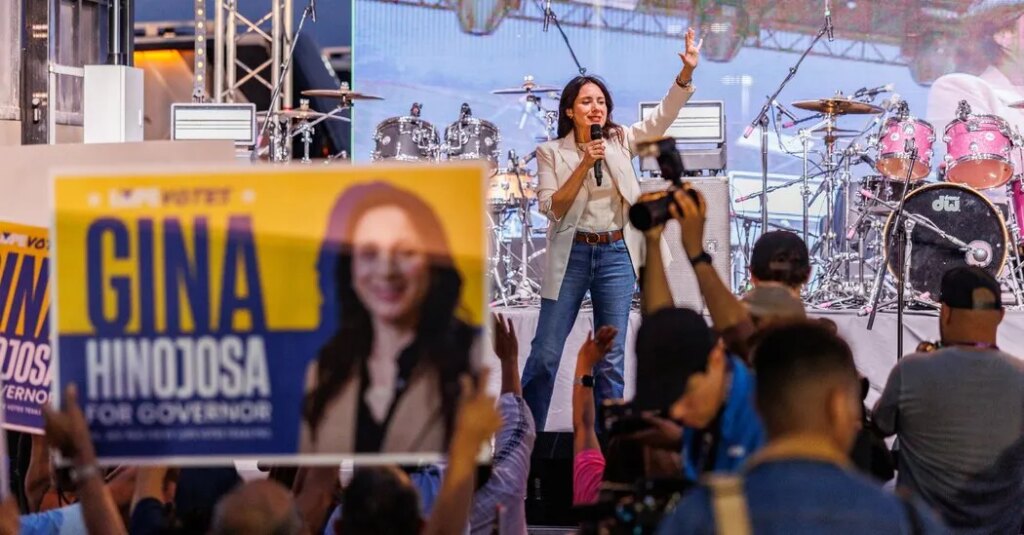
Not so long ago, Gina Hinojosa’s campaign to be the next governor of Texas would most likely have focused on her potential to make history. If she manages to defeat Gov. Greg Abbott this week after a surprisingly competitive campaign, she would become the first Latina to lead the state. She would also be the first woman elected governor since 1990.
And yet Hinojosa scarcely utters a word on race or gender — hers or anyone else’s — and insists she wants to steer clear of “culture wars.” Instead, she has risen in the polls with a disciplined message of economic populism.
“Is this going to be a Texas that is by and for the people?” Hinojosa said at a recent rally. “Or is this a billionaire’s world and we just live here? That is the one fight. It is the one fight of this election. It is the fight in America. And it is the fight for Texas.”
Whether or not Hinojosa wins, her campaign signifies a strong consensus in the Democratic Party this year: Race and gender are out. Class politics are back in.
This is a strategy born of defeat. President Trump reclaimed the White House two years ago largely by promoting himself as the stronger steward of the economy. For Democrats, one of the most humiliating aspects of this loss was that the president nearly doubled his support among Black voters between 2020 and 2024, and he nearly came even with Kamala Harris among Hispanic voters. Asian Americans also shifted right, and Trump’s support among women held even.
The return of Trump was the death knell for a presumption that had dominated American life since the 2010s — that identity was a stand-in for societal progress. Now, the very notion of identity politics is in retreat.
Corporations and universities speak of diversity in whispers, if at all, for fear of attacks from the White House. In 2024, 98 percent of companies in the S&P 500 disclosed the ethnic and racial makeup of their boards. Last year, that figure fell to 66 percent.
The Trump administration is attempting to undo an entire regime of civil rights protections, arguing that it divided the country and led to discrimination against white Americans. The White House has proposed ending questions in the census that ask for race, ethnicity or sexual orientation. “Dismantling the grievance industry, the oppressor-oppressed paradigm, identity politics, and other ideas that rend the national fabric is an essential cause,” Mike Gonzalez, a senior fellow at the conservative Heritage Foundation, wrote in City Journal.
Even as Trump has decried liberal identity politics, the result of his second term has been a de facto promotion of white identity. The government has censored mentions of slavery at historic sites while restoring the names of Confederates to Army bases. It has prioritized the entry of white Afrikaners as refugees while trying to cut legal immigration from much of Africa.
We are entering a strange interregnum on identity. While the right goes on the attack, there has been a sudden retrenchment in discussions of race and gender, with even Representative Alexandria Ocasio-Cortez of New York saying recently that “‘Woke 1’ was crazy.” But identity politics are not going away. In fact, they may be returning to their roots.
The Rise of Representation
Until recently, the importance of diversity seemed unassailable, at least in elite settings. Representation mattered, and counting was paramount. How many senators and Supreme Court justices are women? Did any Black, Latino or Asian Americans win Oscars this year? Does every expert panel at your A-list conference include at least one “person of color”?
This is not exactly what those who originated the term “identity politics” imagined. In 1977, a group of Black feminists called the Combahee River Collective declared in a statement that their race and gender were integral to their politics — not because they hoped to join the country’s highest achievers, but because their identity gave them a singular view of America from the bottom of its class hierarchy. Then, as now, Black women are more likely to be impoverished.
In this version of identity politics, the emphasis on race and gender would act as a corrective to an unequal society. It was all too easy for the feminist movement to focus on the interests of upper-class white women. If feminism included Black women, it would inevitably make bolder demands — a higher minimum wage or universal health care, for instance — that could improve the lives of all Americans.
“We needed to have a place of our own,” Barbara Smith, a member of the group, said in an interview from the book “How We Get Free.” “We needed to have a place where we could define our political priorities and act upon them. And that’s where identity politics come from.”
The country, however, was exhausted from years of bitterness over race and war. Cynicism about government, especially after Watergate, was running high. During the 1970s and 1980s, a new political culture from the right rose to power, in part by persuading many voters that their government was more devoted to minority groups than to them. Ronald Reagan warned of Americans who he said were bilking government programs — advancing the “welfare queen” stereotype — as conservatives laid the groundwork for cutting aid to the poor.
With any chance of resurrecting a New Deal-style program foundering, another project of the liberal left found favor: winning the right for individuals to live and work as they wished.
These goals focused on removing discrimination in workplaces and in colleges, aiming for a purer meritocracy. Women, Latinos, Black Americans, gay men and lesbians all would be welcomed into the circle of comfortable middle-class achievement. Of course, bias still existed. But compared with the 1960s, opportunities became more abundant, at least for the well-educated.
This moment marked a pivotal shift for the Democratic Party, whose base became both more diverse and more professional-class.
In the 1980s, the party also adopted a muted posture toward race. By refraining from sensitive subjects like affirmative action, Democrats hoped to win back white voters who were fleeing the party over its support for civil rights. The new strategy worked to some degree: Black leaders began winning elections in white-majority cities and states, achieving powerful milestones. In 1989, L. Douglas Wilder became the first African American to be elected governor, after winning in Virginia.
At the same time, the party retreated from championing public programs aimed at helping the poor and the working class. Instead, party leaders like Bill Clinton embraced fiscal austerity and free trade policies that tended to favor the wealthy.
Democratic support among Black Americans began to soften, according to Leah Wright Rigueur, a historian at Johns Hopkins University and author of “The Loneliness of the Black Republican.” The wealth gap between white and Black Americans stopped closing in the 1980s. Deindustrialization stripped towns across the country of well-paid union jobs.
A seminal event like Barack Obama’s 2008 presidential campaign electrified Black voters. But such moments could also obscure a deeper discontent with the party itself, Rigueur said. “We’re distracted by the symbolism, which is important,” she said. “But we ignore Black voters’ very loud complaints about the relationship with the Democratic Party.”
On the heels of Obama’s win, the 2010s marked a peak for representation politics. Every barrier suddenly seemed breakable — even the glass ceiling on the presidency. Hillary Clinton, running as the heir to Obama’s multiracial coalition, adopted the slogans “Stronger together” and “I’m with her,” unabashedly trumpeting diversity and identity.
But when white working-class voters delivered Trump to the White House, many blamed the loss on identity politics. Bernie Sanders blasted his rival for failing to address the needs of the working class. “It’s not good enough for someone to say, ‘I’m a woman! Vote for me!’” Sanders said. Mark Lilla, a Columbia University professor, wrote a widely read piece in The New York Times calling for “the end of identity liberalism.”
If anything, this sensibility was about to be supercharged.
In the aftermath of the 2020 killing of George Floyd, the Democratic Party and much of corporate America rushed to demonstrate moral urgency. Human resource offices educated their employees on race. President Joseph R. Biden Jr. fulfilled his promise to put a Black woman on the Supreme Court by nominating Ketanji Brown Jackson. Karine Jean-Pierre was the first Black female White House press secretary, and also the first openly gay person in that role.
These moments carried their own significance. But perhaps the more telling data point during Biden’s term was this: Between 2022 and 2025, the median net worth of Black households fell by 25 percent, while the fortunes of every other racial group improved.
By the time Kamala Harris hurriedly ran for president in 2024, the party was determined to avoid the mistakes of the Clinton campaign. Harris underplayed her race and gender. Still, some supporters fell into familiar formations, organizing Zoom fund-raising calls with names like “White Women: Answer the Call” and “White Dudes for Harris.”
In his second term, Trump easily notched his own “firsts,” for those who are still counting. Kash Patel is the first person who is not white to serve as F.B.I. director. Susie Wiles is the first female White House chief of staff. Usha Vance is the first Asian American second lady.
Returning to the Origin
If the influence of identity politics is indeed waning, it is quite likely because enough Americans have concluded that representation alone cannot feed the family or raise wages. Without addressing economic equality, the project became easy to dismiss as a preoccupation of the upper classes. When the public no longer trusts elites, it doesn’t tend to care what the elite class looks like.
Even as this year’s Democrats replace identity politics with economic politics, race itself is hardly receding as an issue.
Angie Nixon, a Florida Democratic candidate for the Senate, is a 42-year-old Black woman still paying off her student debt, who is running an unapologetically populist campaign focused on economics. But when Vice President JD Vance suggested that she does not “belong in America” because of her views, Nixon did not dodge the issue of race. “What’s frustrating at times is that we’re kind of used to it in the South — the disrespect, being Black people, the microaggressions, and the slights, the ‘Oh you speak so well’ or ‘You’re so articulate,’ the little slights here and there,” she said.
Nixon is the underdog in her race, but her working-class persona is resonating around the country. A recent Wall Street Journal analysis showed that Nixon had become more popular on TikTok than any of the party’s more established figures.
Figures like Nixon, win or lose, could presage a return to something closer to the original conception of identity politics — one that is focused on the working class, first and foremost, but without downplaying the often harsh realities of gender and race in America.
After all, identity politics can only fade so much when awareness of racism itself remains high. A Gallup survey last summer showed that the perception that Black Americans suffer from widespread discrimination is as high as it was six years ago. The country received an education from moments like the Floyd video that it has not forgotten. Trump’s unfettered mass deportation campaign appears to be causing a backlash from Latino voters.
And Trump himself continues to practice the oldest version of identity politics. In the final weeks of the midterms, he again called Somali immigrants “low-I.Q. people” and unleashed an extended Islamophobic rant against Abdul El-Sayed, a Senate candidate in Michigan who is Muslim.
For many reasons, we are not living in the post-racial moment that some Americans thought the Obama presidency heralded. But we seem much less invested in counting how many people in each group can push their way into the upper echelon. When millions of Americans are still waiting for someone to address their material needs, they are demanding far more than symbols.
Jia Lynn Yang is a senior Times writer and the author of “One Mighty and Irresistible Tide,” a book about American immigration in the 20th century.
The post Identity Politics Have Entered a New Phase appeared first on New York Times.