In his quest to become the first Democrat in more than three decades to win a statewide race in Texas, James Talarico has logged thousands of miles, given hundreds of speeches and sat down with prominent podcast and television hosts receptive to his charms.
But perhaps none of that mattered more than sitting down with the butchered vestiges of a cow.
He did this in early June, at Smokey Joe’s BBQ in Dallas. Photographers and reporters gathered to document his ingestion. Before him was a platter of multifarious meat, including Texas Twinkies, which are jalapeño peppers stuffed with cream cheese and smoked brisket and wrapped in bacon. He sampled the splendor. “It’s so good,” he enthused.
And so he proved that he was not the dastardly vegan that his opponents made him out to be — and was gastronomically qualified to represent Texas in the U.S. Senate.
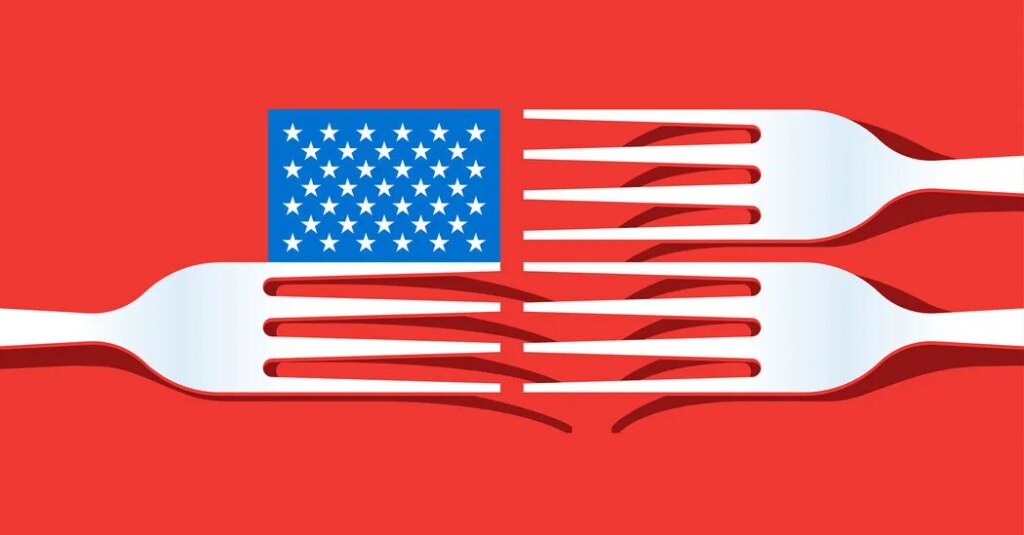
Political contests have long degenerated into food fights, but the ones over the past six months have been especially silly, nasty and disingenuous. That’s in keeping with so much about the 2026 midterms, with everything about the Trump era and with an intensified focus on what we eat (or what we inject or swallow to avoid eating) and how that defines us.
The culture wars have a distinct subset: the cuisine wars, whose history includes Barack Obama’s request for Dijon mustard on a hamburger (“President Poupon,” Fox News called him), former New York City Mayor Bill de Blasio’s use of a knife and fork to eat a slice of pizza (#forkgate on social media) and the revelation early on that President Trump likes his steaks cooked to a crisp and slathered with ketchup.
Each of those details supposedly said something essential about the omnivore in question. With his desiccated and desecrated beef, Trump established himself as a clod bereft not merely of taste buds but of taste. With his gratuitous cutlery, de Blasio emerged as a fuddy-duddy. And with his choice of condiment, Obama confessed his preciousness and elitism.
Those charges dogged Obama anew last week, after he dared to deride a beloved American restaurant chain. Actually, he dissed only its décor. And he did so obliquely, in the service of teasing Trump about his tarting-up of the White House, which, Obama quipped, was starting to look “like Saddam Hussein opened a Cheesecake Factory.”
But that didn’t stop Trump’s aides and allies from histrionically treating Obama’s aside as haughty mockery of every American who’d ever chomped down on one of the Cheesecake Factory’s avocado egg rolls. (That includes me, a wounded veteran of that appetizer, which is not so much inspired fusion as unsavory confusion.) The conservative scold Scott Jennings groused in a social media post that Obama “hasn’t eaten dinner that costs less than $250 in years.”
Treasury Secretary Scott Bessent made the grand gesture of visiting a Cheesecake Factory in Washington for lunch and getting the French Dip Cheeseburger. (I’ve had this, too — and liked it.) Bessent cast himself as a Cheesecake Factory regular. “I would just tell the Martha’s Vineyard set to give it a try,” he said.
The Martha’s Vineyard set? How do they differ from the Hamptons set? Until 2019, Bessent owned a roughly 7,500-square-foot house in Southampton, which he sold for $19 million. His net worth is estimated to be over $500 million. I’d bet a dozen orders of the Cheesecake Factory’s fried macaroni and cheese that Bessent’s budget for dining out dwarfs Obama’s. Maybe Jennings can look into that.
The 2024 presidential contest was all eggs all the time, as their sharply increased price became Exhibit A in Republicans’ lamentations about inflation, which cast President Biden as the enemy of all omelets. The midterms have been meatier, and that’s not just because Robert F. Kennedy Jr., Trump’s health secretary, has never met a carcass he doesn’t like, elevated steaks to the pinnacle of the food pyramid and bopped around the country extolling a less processed, more primal approach to eating.
There are all these beefs about beef that are about more than beef. Some American ranchers fumed at Trump’s announcement in August that he’d play hamburger helper and try to lower the cost of ground beef by reducing tariffs on up to 300,000 metric tons of imported trimmings. That gave foreign producers an advantage over domestic ones — and made Trump the kind of globalist he supposedly abhors.
Both the Republican and Democratic nominees in a closely fought Senate race in Iowa, which is home to many cattle farmers, also cried foul about that. Such unity had eluded them when the Republican, Ashley Hinson, accused the Democrat, Josh Turek, of sacrificing the family farmer on the altar of cutting-edge science. Specifically, she said he was soft on lab-grown protein.
According to a whole bunch of Republicans, Talarico is soft, period, and his diet is the tell.
In 2022, when he was running for a third term in the Texas House, he cited the production of meat as a culprit in global warming, encouraged people to eat less of it and bragged that his campaign was “buying vegan products from our local vegan businesses.”
Four years later, Ken Paxton, Talarico’s Republican opponent in the Senate race, is casting those comments as proof that Talarico is neither a real Texan nor a real man. “Tofu Talarico” and “Low-T Talarico” are what Paxton calls him. Other MAGA wordsmiths prefer “Tala-freak-o.” Senator Ted Cruz, Republican of Texas, said that if “a soy latte could speak, that would be Democrat James Talarico.” He also proclaimed, “This is a guy who makes Pete Buttigieg look manly.”
If you seek an even more potent amalgam of bigotry and puerility, the senior White House adviser Stephen Miller can oblige. Referring to Talarico, Miller said, He’s “clearly transitioning into a female.” He also joked that when Talarico “gets a physical, blood doesn’t come out. Instead, soy milk comes out.”
Alas, the crudest voice in the cave man chorus always belongs to Trump, who can’t shut up about Talarico. “He’s eating meat like a pig,” Trump told the audience at a rally in Mobile, Ala., last month. But, Trump added, “What they don’t show you is that, after every barbecue, he walks to the back of a tent and he throws up all over the place.”
Of course Trump doesn’t have evidence. He has bulimia telepathy. And an appetite for vulgarity that’s as discerning as the rest of his hungers.
Forward this newsletter to friends …
… and they can sign up for themselves here. It’s published every Monday.
For the Love of Sentences
In The Atlantic, Elaine Godfrey recalled her impressions of the Cheesecake Factory when she was growing up in Iowa. “Peering through the windows of the restaurant at Jordan Creek Town Center in Des Moines, I was awed by its sumptuousness: the orange, inviting glow from the knobbly chandeliers; the floral frescoes and painted columns; the generous fountain pops and the dense wedges of cake,” she wrote. “It wasn’t attempting highbrow elegance but, rather, embracing a kind of madcap largess, like a zany aunt who wears a lot of bracelets.” (Thanks to Michelle Foster of Leesburg, Va., for nominating this.)
Also in The Atlantic, Tom Junod reflected on a word that prettied up his father’s infidelity: “I forget when I first came across philanderer. I remember that it struck me right away as a euphemism, a kind of excuse. Though rooted in Greek, it seemed French in intent, a description of a man with a pastime instead of a problem.” It was “a set of linguistic cuff links,” which gave Junod’s dad “what he was so skilled at making: a pass.” (Patricia Caiozzo, Port Washington, N.Y.)
In his newsletter, Ron Charles called Ina Garten — whose newest cookbook, “Simply Ina,” was just published — the “anti-Martha,” as in Stewart: “She’ll never tell you to start preparing a salad by peeling 500 fresh peas that you grew in your own cold frames constructed with wood taken from remnants of the Mayflower.” (Jennifer John, Troy, Mich., and Maryann Hooker, Media, Pa., among others)
In The New Yorker, Nathan Heller profiled James Daunt, the chief executive of Barnes & Noble. “He speaks crisply in what he describes as ‘this ridiculous sort of upper-class accent’ and has the urbane English habit of conveying seriousness by tilting his head forward, locking his jaw, and smiling grimly: resting Brit face,” Heller wrote. (Darlene Townsend, Baltimore)
Also in The New Yorker, Rachael Bedard questioned Defense Secretary Pete Hegseth’s obsession with soldiers’ testosterone levels. “Every relevant medical society recommends against screening asymptomatic men for testosterone deficiency, because it is akin to scouring a hotel room with a black light: you’re going to find a lot of stuff of indeterminate significance that you wish you hadn’t seen,” she wrote. (Daniel Fink, Beverly Hills, Calif.)
In The Guardian, Fiona Harvey examined some experts’ contention that a rise in global temperatures of 6 degrees Celsius would mean widespread famine and “could leave billions of people, in economic terms, suboptimally productive. Or, as the rest of us might say, dead.” (Julia Huston, Newton, Mass.)
In The Times, A.O. Scott contemplated the intersection of regret and resentment: “The rage that defines so much modern politics, in the developed world and the global South, on the right as well as the left, can be understood as a reaction to the feeling that something we once had is gone. Grief manifests itself as grievance.” (John Sitter, Atlanta)
Also in The Times, David French articulated the irrationality — and cruelty — of one of Trump’s signature initiatives: “Mass deportation doesn’t put America first; it puts vengeance first, and vengeance is a poor substitute for a moral and rational immigration policy.” (Barton Wald, Pasadena, Calif.)
Melissa Kirsch commented on couch-rooted, comfort-swaddled men watching a YouTube channel devoted to extreme outdoor adventures: “They’re like house cats watching pumas and jaguars stalk jungle prey from the comfort of their living-room sun puddles.” (Carly Perlman, Santa Cruz, Calif., and Tom Sisk, Helferskirchen, Germany, among others)
And Helen Shaw appreciated the entrance made by the actor Dylan Baker in the current Broadway production of “The Imaginary Invalid”: “Baker flourishes his way through the doorway with a big ta-da! gesture, wearing a gold-and-green ensemble so gorgeously dappled that it looks like the virtuosic costume designer Karen Perry put a belt on a landscape painting by Poussin and called it un jour.” (Rufus Bruce, Marblehead, Mass.)
To nominate favorite bits of recent writing from The Times or other publications to be mentioned in “For the Love of Sentences,” please email me here and include your name and place of residence.
What I’m Watching, Writing and Listening To
-
“The Invite” takes place over one evening in one San Francisco apartment, where one couple, played by Olivia Wilde and Seth Rogen, share charcuterie, tequila, resentments and much more with neighbors (Edward Norton and Penélope Cruz) whom they are just getting to know. It unfurls more like a play than like a movie; I sometimes felt as cramped and restless as the characters. But it bristles with tension, can be very funny and is worth seeing solely for the performances of Wilde, who also directed it, and Cruz, who’s easily one of the most alluring screen actors of her generation.
-
In our online interchange last week, Bret Stephens and I pondered why many of Trump’s previously stalwart supporters are finally turning on him. The week before, we reflected on the fires in France and why so many Europeans are inflamed.
-
Parting Songs: For a fetchingly reedy vocal and clever lyrics with deft rhymes, “What I Deserve,” by Kelly Willis. For pulse-quickening motivation to tack on just three more treadmill minutes, “Every You Every Me,” by Placebo. For inventive dabs of percussion that act as scattered acoustic ornaments, “I Follow Rivers,” by Lykke Li.
Puppy Postscript
When my sister, Adelle, and her husband, Dan, decided to get a dog many years ago, they went looking for one that would share their affinity for boating, beaches and bays. They researched breeds attracted to water, and among the recommendations, which included Newfoundlands and Labradors, they chose a flat-coated retriever. Along came A.J., a spirited girl and an extraordinary athlete. She was indeed happiest when sopping wet.
That wasn’t the case with Marlin, their next “flattie.” He overlapped with A.J., who swam circles around him, largely because he was so lazy, in defiance of anything and everything written about his breed. Mako succeeded A.J. and, as advertised, worshiped the water. But Adelle’s and Dan’s current flattie, Tilly, is an aquatic agnostic.
As a predictor of anything beyond pulchritude, breed is bunk.
That was a point that two leading experts on dog behavior, Brian Hare and Vanessa Woods, whom I spotlighted in a September newsletter, emphasized during our wide-ranging conversations. When I asked them to name the single biggest misconception that people have about dogs, Hare said it’s that “breeds matter.”
“It’s not that breed doesn’t communicate something,” he added. “It’s just that people think it communicates everything.”
It correctly forecasts a dog’s probable height, weight, coat, color. But most breeders “measure nothing that is behavioral — nothing,” Hare said. “They measure everything when it comes to morphology.”
Your pug will have a flat face. She may or may not have a flat affect. Physically, your Dalmatian will be dotty. Intellectually, that’s one possibility among many.
“There are golden retrievers who don’t retrieve,” Woods told me. “I’ve met Border collies who couldn’t round up a bag of cats.” Chance plays a big part in the talents and disposition of a given dog. So does environment, including how a dog is reared. Those were among the conclusions of a widely noted 2022 study, which found that few matters of temperament are truly baked into a breed.
So how do you optimize the odds of a dog without a tendency to bark, if that’s important to you, or one who’s gentle around children, if that’s paramount? “Foster an adult dog,” Woods said. That way, you see its established personality in action.
“This is like a marriage,” Woods added, referring to many dogs’ life spans of more than 10 years. “You’re signing up for a really long time. It’s worth dating.”
Just don’t expect the poodle to pick up the check.
The post ‘Tofu Talarico’ and Texas Twinkies appeared first on New York Times.