On Tuesday evening, millions of Americans will tune in to watch election returns.
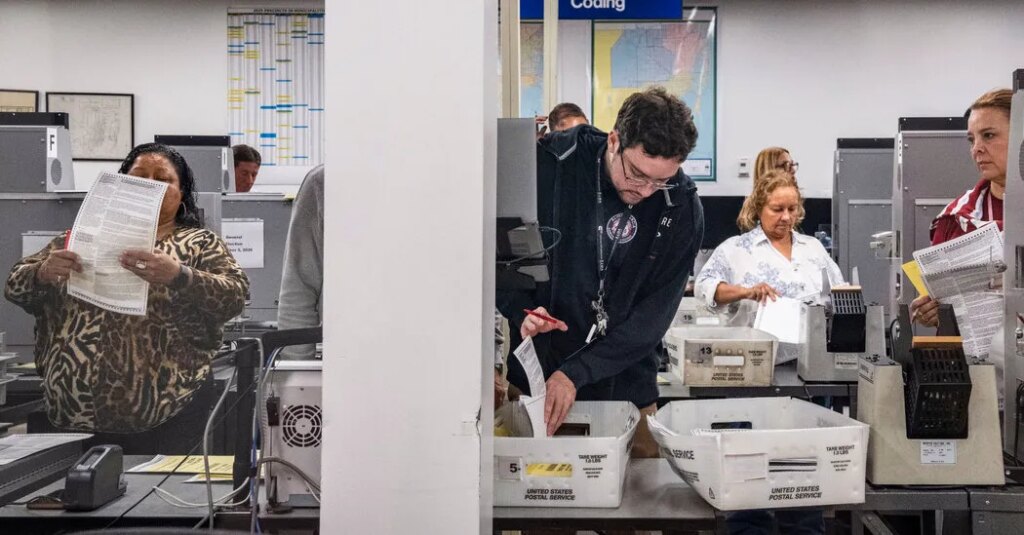
They shouldn’t hold their breath. If history is any guide, the full results of voting from all 50 states are not likely to be known by the time Tuesday turns to Wednesday. Experts say that for various reasons, it could take days and even weeks before results are known in states including Maine, Alaska, Arizona and California.
Races in those states might determine the balance of power in Congress — and they might not. It’s impossible to say if the nation will know before bedtime which party controls the House and the Senate. The chances are greater that control of the House will be known, given how tight virtually all of the key Senate races are this year, including in Alaska and Maine.
Some of the delays have to do with the sheer numbers of voters, while others stem from challenges of geography, or state-specific rules about when mail ballots can be accepted and counted. Maine and Alaska use a ranked-choice runoff voting system, which can also slow the process.
The fact that elections often take time to sort out is not unique to the United States. But the wait can be frustrating for candidates and the public. And in recent years, lagging results have served as a cue for some politicians, most notably President Trump, to fill the void with false claims that the process is marked by fraud. Mr. Trump famously made that claim in 2020, as large numbers of mail votes favoring his challenger, Joseph R. Biden Jr., were counted after Election Day, dooming Mr. Trump to a loss that he continues to deny.
In June, a multiday process of counting votes after California’s primary prompted Mr. Trump to revive such talk, asserting that “BIG cheating” by Democrats had tainted the results. “Why the vote counting DELAY???” the president wrote in one social media post.
There was, in fact, no evidence of cheating in the California primary, but it took six days to determine the results of the Los Angeles mayor’s race, and seven to call the results for governor.
In 2024, it took three weeks to determine the winner in California’s closest House races.
The amount of time the public must wait to learn who wins is often a function of how close a race is. Election experts distinguish between the time it takes for officials to complete their counts and the time it takes for news media to “call” an election for one candidate or another. The Associated Press is one of the most prominent callers of races (The New York Times relies on The A.P. for most calls), doing so when the outlet’s analysis shows that a trailing candidate no longer has a path to victory.
Sometimes the call occurs on election night. Sometimes it takes longer. In 2020, The A.P. called the presidential race for Mr. Biden four days after the election. Two decades earlier, the presidential election between George W. Bush and Al Gore was so close that The A.P. did not call it at all. In the end, the U.S. Supreme Court settled the race, ruling in favor of Mr. Bush in the famous case Bush v. Gore.
“The public’s perception of how quickly a state is counting is probably more related to how quickly the race is called by the media than how quickly ballots are being counted,” said Lawrence Norden, vice president of the election and government program at the Brennan Center for Justice, an election law think tank. “If a race is really close — like, really, really close — it doesn’t matter how fast they’re counting the ballots. It’s going to take a few days.”
That can be a challenge for election officials like Adrian Fontes, the Democratic secretary of state in Arizona.
“We are a battleground state, and our margins are very close,” Mr. Fontes said. “Because we have tighter margins, folks get antsy when the networks and the news agencies can’t make their predictions on election night.”
In Alaska this year, voters will weigh in on one of the most closely watched races for the U.S. Senate, which pits the incumbent, Dan S. Sullivan, a Republican, against Mary Peltola, a Democrat.
If it turns out to be a nail-biter, as polls suggest, it may call for long nails. The state counts mail ballots if they are received within 10 days of Election Day, or 15 days for overseas voters. (The ballots must be postmarked on or before Election Day.) The generous timeline reflects the challenge of delivering the mail across Alaska’s vast distances and challenging terrain, and sometimes in brutal weather conditions.
If none of the candidates in the Alaska race receives 50 percent of the vote, the state initiates the second round of its ranked-choice system — but only after the 15-day waiting period for overseas ballots. The 50 percent threshold could be particularly important this year, because the four-person ballot includes another man named Dan Sullivan. This Mr. Sullivan was recruited as part of a Democratic effort to siphon votes away from the incumbent Mr. Sullivan.
The ploy triggered a lawsuit from the Justice Department, which asked a federal court to block certification if the incumbent narrowly loses. On Sunday, the court dismissed the suit, but the government appealed.
One of the other closely watched U.S. Senate contests is in Maine, which also uses ranked-choice voting for some races.
Unlike Alaska, Maine requires that mail ballots be received by local clerks before polls close on Election Day. But a ranked-choice second round could delay the results. Derek Tisler, another elections expert at Brennan, said that if no candidate receives 50 percent of the ballots cast in the first round, Maine officials will conduct a second, ranked-choice runoff round, which will take several days.
Mr. Tisler noted that there were only two candidates on the ballot for the Senate seat in Maine — Susan Collins, the Republican incumbent, and Troy Jackson, the Democratic challenger — making it likely that one of them will surpass the 50 percent threshold in the first round.
But that is not a given, he said, as several write-in candidates are running as well.
Experts say that if history is any guide, Arizona and California may also take some time to sort out their winners.
California has a seven-day period in which late-arriving mail votes postmarked on or before Election Day may be counted. Arizona does not have such a period. But both states are known for a high volume of late-arriving ballots.
“For whatever reason, voters tend to wait until the last minute to return their ballots,” Mr. Tisler said. “So it’s not really until the few days before the election, or even Election Day, that election officials can start taking all those steps to verify signatures, verify the voters’ information, and then finally count the ballots.”
In California, lawmakers this year agreed to allocate $40 million toward speeding up the process, including initiating a publicity campaign encouraging voters to return their ballots earlier.
Mr. Fontes said Arizona was also working to speed things up. In vote-rich Maricopa County, a new system allows mail voters to walk into polling places and drop their mail ballot off while showing a poll worker their ID, thus avoiding the time-consuming signature-verification process to which such ballots are normally subjected.
It may help some. But none of that guarantees against the possibility that conspiracies will spread again.
“Now we just have to fight against these unfounded allegations in the rhetorical space,” Mr. Fontes said, “versus just being able to do our jobs and spend all of our time and energy taking care of voters.”
The post When Will We Know Election Results? Don’t Hold Your Breath. appeared first on New York Times.