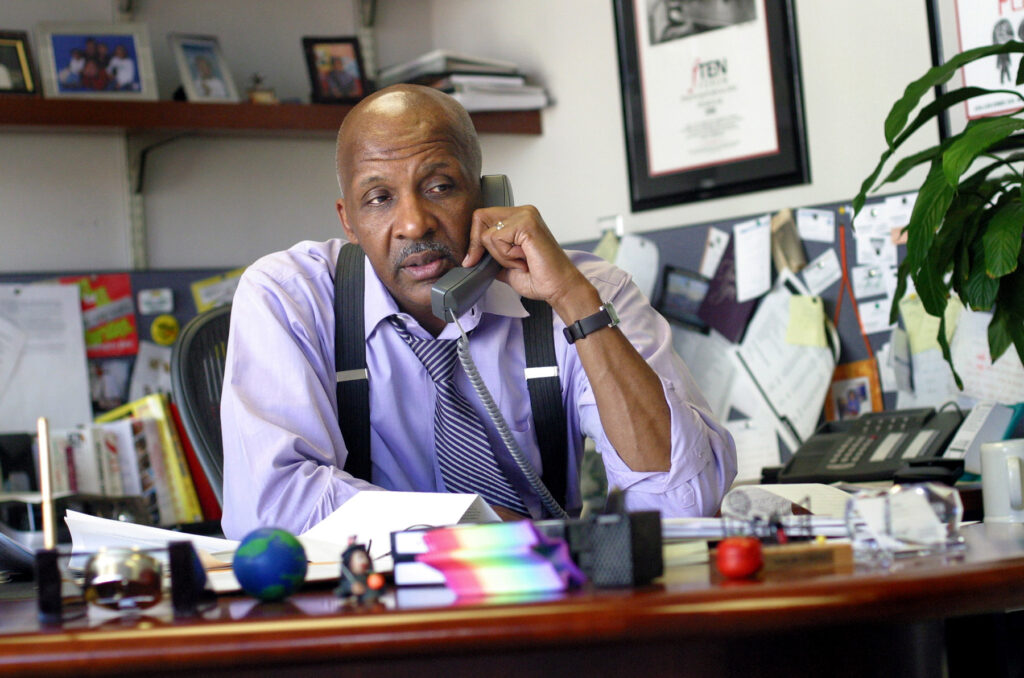
Milton Coleman, a former senior editor at The Washington Post who directed the paper’s local coverage, mentored generations of younger journalists and championed diversity across the news industry, arguing that media outlets have a responsibility to credibly reflect the communities they serve, died Oct. 30. He was 79.
His death was announced in a Facebook post by his son, Sekou Coleman, who said that Mr. Coleman had faced “health challenges” in recent years but did not cite a specific cause.
A Milwaukee native who became the first in his family to graduate from college, Mr. Coleman was a beacon of possibility for aspiring Black journalists, rising through the ranks in a career that started during the civil rights era and lasted through the election of President Barack Obama, whose inauguration coverage he coordinated.
After serving as The Post’s D.C. editor and reporting on national politics during the Reagan administration, Mr. Coleman was named Metro editor in 1986. He was the first African American to serve in that role, directing about 150 journalists in what was then the newspaper’s largest staff.
A decade later, he was elevated to deputy managing editor, the newsroom’s No. 3 job. The position made him the first African American journalist on The Post’s masthead, and among the highest-ranking Black journalists at a major American daily.
Mr. Coleman helped guide news coverage at the paper while also directing recruitment and training programs, seeking to overhaul a culture in which minorities “do not seem to rise through the ranks,” as a newsroom task force put it in 1993. Diversity, he argued, was “not a social experiment” but “an industry imperative.”
“There was a sense of obligation that Milton always felt about our business — that there were a lot of people who fought hard to kind of crash through doors, to build up the diversity of newsrooms, and to represent the struggle to get there well,” said Kevin Merida, who in 2013 became the paper’s first Black managing editor. “He felt like each generation had an obligation to keep moving forward.”
“Milton helped a lot of people’s careers,” Merida added in a 2025 interview for this obituary, recalling how Mr. Coleman served as an advocate for young journalists, especially journalists of color.
Marie Arana, a former editor of The Post’s Book World section, said he was unusually adept at building bridges between Black and Latino staffers, including while working with outside organizations such as Unity, a national alliance of minority journalist groups.
“There was a sense that this was my camp and this was your camp. And he very strongly promoted the idea that no, we represent the people of color, all of us,” she said. “He was very instrumental in that sense of unity at the paper.”
Mr. Coleman was credited with pushing The Post to pay closer attention to Latino communities, both in Washington and around the country. He created new beats and suburban bureaus in Metro, responding to the growth of the Washington area, and helped initiate The Post Co.’s 2004 acquisition of El Tiempo Latino, a Spanish-language weekly.
“You have to keep reinventing yourself,” he told students during a visit to his alma mater, the University of Wisconsin at Milwaukee, explaining how he had learned Spanish to help guide El Tiempo as an adviser.
Mr. Coleman stepped away from The Post’s day-to-day operations in 2009 when he was named senior editor, a job that saw him update ethics and standards policies for the social-media age. After retiring from the paper in 2012, he worked as the ombudsman for the Corporation for Public Broadcasting and taught journalism ethics at Arizona State University.
The subject was deeply personal for Mr. Coleman. Early in his editing career, he shouldered part of the blame for the Janet Cooke scandal, in which he and some of The Post’s top editors were fooled by a fabricated story about a child heroin addict. The article, “Jimmy’s World,” was debunked less than two days after it won the 1981 Pulitzer Prize for feature writing, which the newspaper returned.
Three years later, while working as a reporter on the National staff, Mr. Coleman was thrust into the news when he revealed that Jesse Jackson privately used a slur against Jews while running for the Democratic nomination for president. Some readers angrily questioned why Mr. Coleman, as a Black man, decided to reveal damaging information about Jackson, who was seeking to become the first Black candidate to win a major party’s presidential nomination.
Nation of Islam leader Louis Farrakhan, a Jackson ally, publicly threatened Mr. Coleman and his family, vowing to “make an example” of the reporter in an apparent bid to pressure other journalists into favorable coverage.
The Post’s National editor at the time, Leonard Downie Jr., recalled that Mr. Coleman held firm in the face of criticism, including from fellow reporters who accused him of breaking journalism rules with his reporting on Jackson, who thought he was speaking in “private,” off the record.
“He never complained about it, never reacted to it. No public attacks back. He just did his job,” said Downie, who added that he relied on Mr. Coleman as a sounding board and adviser while serving as The Post’s executive editor, from 1991 to 2008.
“I could trust him in his direction of staff, I could trust him in his own reporting, and I could trust him when I sought advice from him or when he sought advice from me,” Downie said. “It was never about Milton. It was always about the work.”
A reporter’s duty
Milton Richard Coleman was born in Milwaukee on Nov. 29, 1946, and grew up in one of the city’s public-housing projects. His father worked as a general laborer, and both parents were from families that came north as part of the Great Migration, the mass movement of African Americans out of the South.
As a teenager, Mr. Coleman played basketball, drummed in his high school jazz band and was elected student council president. He earned a modest academic scholarship to the University of Wisconsin at Milwaukee, where he studied music history and literature, deciding that he might become a high school band teacher or an ethnomusicologist.
“Absent that $128 scholarship,” he later said, “I don’t know where I’d be.”
Inspired by Malcolm X and the Black Power movement, Mr. Coleman participated in civil rights marches, joining a campaign against segregated housing in Milwaukee. At one point, he said, he was jailed for his activism, which included speaking at a downtown demonstration where he called for “complete freedom of the Black people.”
Mr. Coleman received a bachelor’s degree in 1968 and continued to work as an activist, organizing Black students around the state. By 1969 he had turned to journalism, getting a job as a reporter at the Milwaukee Courier, an African American weekly. He wanted, he said, “to help Blacks get the information needed to make intelligent decisions affecting their lives.”
Over the next few years, he worked for a succession of Black-oriented news organizations, including the All African News Service in Washington. He covered Capitol Hill for the Howard University radio station WHUR-FM, completed a Columbia University summer fellowship for minority journalists and reported on local politics at the Minneapolis Star before joining The Post in 1976, as a reporter on the Metro desk.
Mr. Coleman became known for his deeply sourced coverage of D.C. government and politics, including the administration of Mayor Marion Barry. Tall and athletic, he was likened by one colleague to “a steamroller” for the way he would go after stories.
“He pursues news as though it’s his quarry,” wrote another co-worker, Post ombudsman Bill Green, “and admiring colleagues regard him as highly competitive.”
Mr. Coleman was named D.C. editor in 1980, taking over a job that had once been held by his mentor Herbert H. Denton Jr., a trailblazer for Black journalists at The Post. He was still new to the position when he began working with an ambitious young reporter, Cooke, going over notes she had compiled about a new type of heroin hitting the streets.
“She talked about hundreds of people being hooked,” Mr. Coleman recalled. “And at one point she mentioned an 8-year-old-addict. I stopped her and said, ‘That’s the story. Go after it. It’s a front-page story.’”
The story grew into “Jimmy’s World,” which sparked the biggest scandal in The Post’s history and remains a case study in journalistic malpractice.
Published on the front page on Sept. 28, 1980, it told the story of a child heroin addict who, it turned out, never existed. After Cooke’s résumé was called into question in 1981, she was interrogated by Mr. Coleman and other editors and came clean, acknowledging that she had lied about aspects of her background and fabricated the article.
In the scandal’s immediate aftermath, The Post published a scathing 18,000-word investigation by Green, the paper’s independent watchdog. He wrote that Mr. Coleman and Metro editor Bob Woodward “had primary responsibility” for the piece but concluded that colleagues such as Howard Simons, the managing editor, and Ben Bradlee, the executive editor, were also to blame.
“It was a complete systems failure,” Green wrote, “and there’s no excuse for it.”
Interviewed by Green, Mr. Coleman recalled that he initially saw no reason to doubt Cooke’s material: He told her that she could promise anonymity to “Jimmy” and his family, and when he saw her first draft he was reassured by the details she included about the boy’s home, with its fake bamboo blinds and brown shag rug. The draft included the name “Tyrone,” which he took to be Jimmy’s real name.
As the story made its way to print and was read by senior editors, “we never really debated whether or not it was true,” Mr. Coleman said. “I think — if I can gore my own ox — they kind of took it for granted that Coleman should know.”
Mr. Coleman maintained the support of his bosses and continued as city editor before joining the National staff as a reporter in 1983.
While covering the Democratic presidential primaries, he found himself making news, not just reporting it, as a result of a February 1984 article about Jackson’s fraught relationship with American Jews. The piece was written almost entirely by a colleague, with Mr. Coleman contributing a single sentence.
The line read: “In private conversations with reporters, Jackson has referred to Jews as ‘Hymie’ and to New York as ‘Hymietown.’”
For nearly two weeks, Jackson insisted that he could not remember using the slur. He reversed himself and delivered an apology on the eve of the New Hampshire primary, saying, “However innocent and unintended, it was wrong.”
The controversy was heightened that March after Farrakhan labeled Mr. Coleman “a Judas” and an “Uncle Tom.” He seemed to threaten violence on a radio broadcast, declaring that while “no physical harm” would come to Mr. Coleman and his family for now, “one day soon we will punish you with death.”
Mr. Coleman initially declined to comment about the threats or discuss his reporting. But that April, in an unusually personal 3,400-word Post essay, he addressed the saga in detail, recounting how he came to hear Jackson’s remarks while sitting down for breakfast with the candidate and another reporter.
The group made small talk, according to Mr. Coleman, before Jackson said, “Let’s talk Black talk.” It was a phrase he sometimes used with Black reporters when he wanted to speak on background.
Without taking notes, Mr. Coleman listened as Jackson went on to complain about critics questioning his views on Israel, and used the slurs that later appeared in print.
“Jackson was running for president of the United States,” Mr. Coleman wrote in the essay. “Even in context, even in ‘private’ among reporters, even ‘off the record,’ the remarks suggested an insensitivity to those he referred in the sense that he believed that in unguarded moments with other blacks or with disarmed reporters it was acceptable to make such references.”
Some journalists questioned why Mr. Coleman hadn’t reported on the comments earlier in the year, immediately after hearing them that January. Others accused Mr. Coleman of employing a double standard, saying that Jackson’s comments would have gone unnoted if the candidate were White.
“My view is that we are accountable to our communities, but the leaders shouldn’t be confused with the communities,” Mr. Coleman told the American Journalism Review in 1999, reflecting on the controversy. “I have never heard Black people — honest — say, ‘Please don’t tell me the truth.’ After you tell people something, it may not matter to them, but they’re free to do with it as they will.”
“Our job in the news media,” he added, “is to report what we think people ought to know, and they can make up their minds, and we’ve done our duty.”
Outside of journalism, Mr. Coleman served as a Boy Scout troop leader and volunteered at Peoples Congregational United Church of Christ in Washington. He married Faye Edwards in 1971.
In addition to his wife and son, survivors include three grandchildren.
Late in his career, Mr. Coleman was elected president of the American Society of News Editors and the Inter American Press Association, which represents media organizations in the Western Hemisphere. Those roles offered him a broader platform to speak out about diversity in the media, while also advocating for the importance of a free press.
“As a young man,” he said in 2013, when he became the leader of the IAPA, “I fought for human rights in the civil rights struggles of the 1960s, was arrested and spent time in jail. As a young journalist, I challenged authority in the name of the people’s right to know. I was arrested and spent time in jail. As an experienced reporter, my life was threatened by those who disliked what I reported.
“So now, as an elder statesman in the rights struggle we all fight now, I feel very much at home. I’m no stranger to this cause.”
The post Milton Coleman, a barrier-breaking editor at The Post, dies at 79 appeared first on Washington Post.