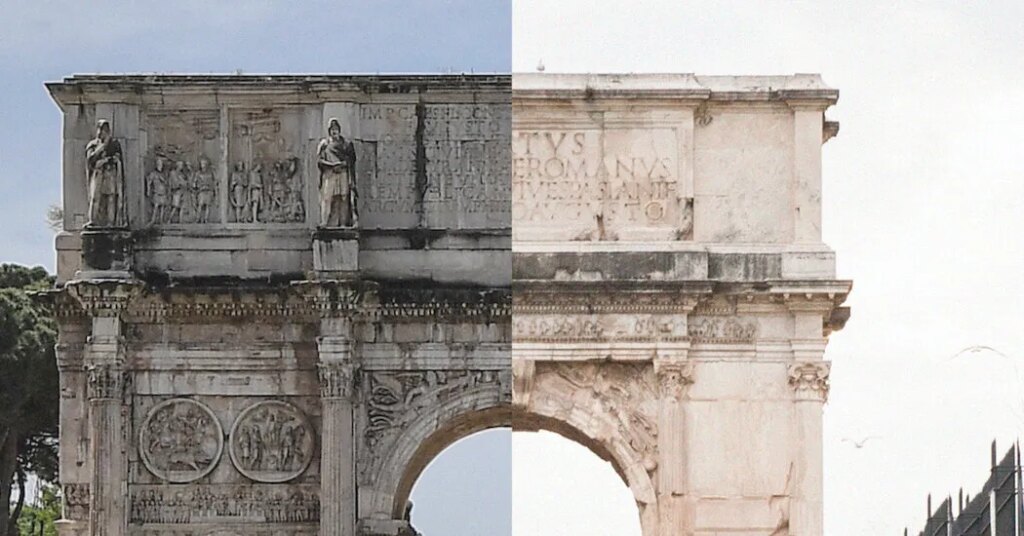
The triumphal arch was a Roman innovation conceived to honor those of good deed who “should be lifted up,” wrote Pliny the Elder, “above the rest of mortals.” Only later did it become associated with victorious generals returning from battle, a symbolic city gate through which triumphators passed.
Among the first was the Arch of Titus, built around A.D. 81 to commemorate the victory of Titus and Vespasian in the siege of Jerusalem a decade earlier. Its panels depict spoils taken from the Second Temple in victory — including the curved menorah featured on the national emblem of Israel.
Much later came the Arch of Constantine, from 315, adjacent to the Colosseum on the Via Triumphalis. It was the largest Roman arch, built to honor Constantine’s victory at the Battle of the Milvian Bridge. Over the centuries, the arches of Titus and Constantine became archetypes replicated around the world for a gamut of glorious purposes. Not coincidentally, the words arch and archetype share the same Greek root: Arkhein, to rule, and arkhos, chief. Triumphal arches enact a vision of power. Sometimes that is a vision founded in reality; at others, it is aspirational, even deceptive, a gesture made to tell a false tale about a country’s place in the world. President Trump’s proposed arch is just another chapter in the long history of heroic architecture pressed into the service of ideology.
The scale and symbolism of the triumphal arch continued to evolve, often to honor the fallen rather than generals, or to trumpet the aspirations of new regimes. The copper-sheeted Narva Triumphal Arch in St. Petersburg, Russia, built in 1814 and weathered to a glorious verdigris patina, honored Russia’s defeat of Napoleon in 1812, while the Arc de Triomphe in Paris — begun earlier but finished decades later — represented the opposite side, venerating those who fought and died for France in the Napoleonic Wars and preceding revolution.
But the classical references remained. The English architect John Nash channeled Constantine for his Marble Arch, originally erected at Buckingham Palace, completed in 1833 to honor the British side in the Napoleonic Wars.
As the self-styled legatee of the Roman Empire, it was only appropriate that England looked to ancient Rome for its monuments. The Marble Arch was also a riposte aimed squarely at the Arc de Triomphe, which was styled on the Arch of Titus.
New York reconstituted both archetypical arches, too: Stanford White’s exquisite Washington Arch channeled Titus; John Russell Pope’s Theodore Roosevelt Memorial — the monumental Central Park entrance to the American Museum of Natural History — aped Constantine.
The Soldiers’ and Sailors’ Arch just outside Prospect Park, completed in 1892 and topped by Frederick MacMonnies’s soaring quadriga, brought the triumphal arch back around to honor the fallen.
So did Paul Philippe Cret’s Titus-inspired National Memorial Arch at Valley Forge National Historical Park — dedicated in 1917 “to the officers and private soldiers of the Continental Army.”
Nor were triumphal arches confined to Europe and the Americas. George Wittet’s Gateway of India, completed in 1924 on the Mumbai, then Bombay, waterfront, employed elements of 16th-century Gujarati architecture to mark George V’s arrival in December 1911 — the first time a British monarch visited the subcontinent after nearly 300 years of British presence. Ironically, it would later mark the end of British rule: Through its archway in February 1948, the very last British troops departed newly independent India. “This was where the British landed,” wrote Jan Morris, “and this is where, in the end, they left.”
Arch-bloat seems to know no bounds. The tallest triumphal arch in the world was finished on the eve of World War II in Mexico City, the Monumento a la Revolución. At 220 feet, it rises to over three times the height of the Arch of Constantine.
But its standing almost ended just three years later. In 1941, Albert Speer presented plans to his Führer for a monumental arch that would tower nearly 400 feet over Berlin. Taller than the towers of the Robert F. Kennedy Bridge in New York, it would have been twice the height of the Arc de Triomphe, which could have fit snugly within its cavernous maw. Speer’s gargantua anchored the monumental axis of Hitler’s “World Capital Germania,” the proposed rebuilding of Berlin for the Thousand-Year Reich.
Today, all that remains of the megalomanic arch is a concrete cylinder used to test the load-bearing capacity of the marshy Tempelhof site — the 13,644-ton Schwerbelastungskörper.
But megalomania will endure so long as humans have the run of the planet, and so too will outsize arches rise. In North Korea, Pyongyang’s Arch of Triumph, the second tallest in the world, was erected to commemorate Korean independence after World War II. Inaugurated on Kim Il Sung’s 70th birthday in 1982, it consists of 25,500 granite blocks, each representing a day Dear Leader had lived to that point.
Unless you count the Gateway Arch in St. Louis — a polished-steel vault that celebrates manifest destiny and nods to, rather than embraces, the tradition of triumphal arches — Americans have fallen out of the triumphal arch habit this century. That, of course, may well change if Mr. Trump has his way. Despite opposition from a panoply of architectural and preservation organizations, the United States Triumphal Arch would rise to 250 feet, surpassing the Mexican arch as the world’s tallest. That would make it well over twice the height of the Lincoln Memorial and almost 100 feet taller than the Arc de Triomphe.
One issue with the so-called Arc d’Trump is its proposed location at Memorial Circle, just over the Potomac and on axis with the Lincoln Memorial and Arlington National Cemetery. Washington is a city of vistas and sightlines; few are more sacred than this one. It was to protect this visual axis that landscape architect Gilmore D. Clarke, then-chair of the U.S. Commission of Fine Arts, convinced President Franklin D. Roosevelt not to build the Pentagon at Arlington Farms, where it would have obliterated the backdrop of tiered headstones and Arlington House. The War Department was furious, but had to concede. The Pentagon was built instead well out of the way. But today’s so-called War Department may have revenge of a sort: The Arc d’Trump could be the first in history designed to also serve as a military installation, an aerie for snipers and drones.
But the real issue is that of purpose. What exactly is Mr. Trump’s behemoth meant to celebrate? Our abnegation as a force for good in the world? Our bitter internal divisions? Will it be another desperate display of might by a state in decline, an India Gate on the Potomac? Will it be mostly made in China? In the end, of course, it will be a taxpayer-funded monument to the vainglory of our outer-borough emperor, Donald Trump. After all, the English word trump — and thus “triumphal” — is derivative of the French word triomphe.
Thomas J. Campanella is a professor of city planning at Cornell University.
The Times is committed to publishing a diversity of letters to the editor. We’d like to hear what you think about this or any of our articles. Here are some tips. And here’s our email: [email protected].
Follow the New York Times Opinion section on Facebook, Instagram, TikTok, Bluesky, WhatsApp and Threads.
The post The Rise and Fall of the Triumphal Arch appeared first on New York Times.