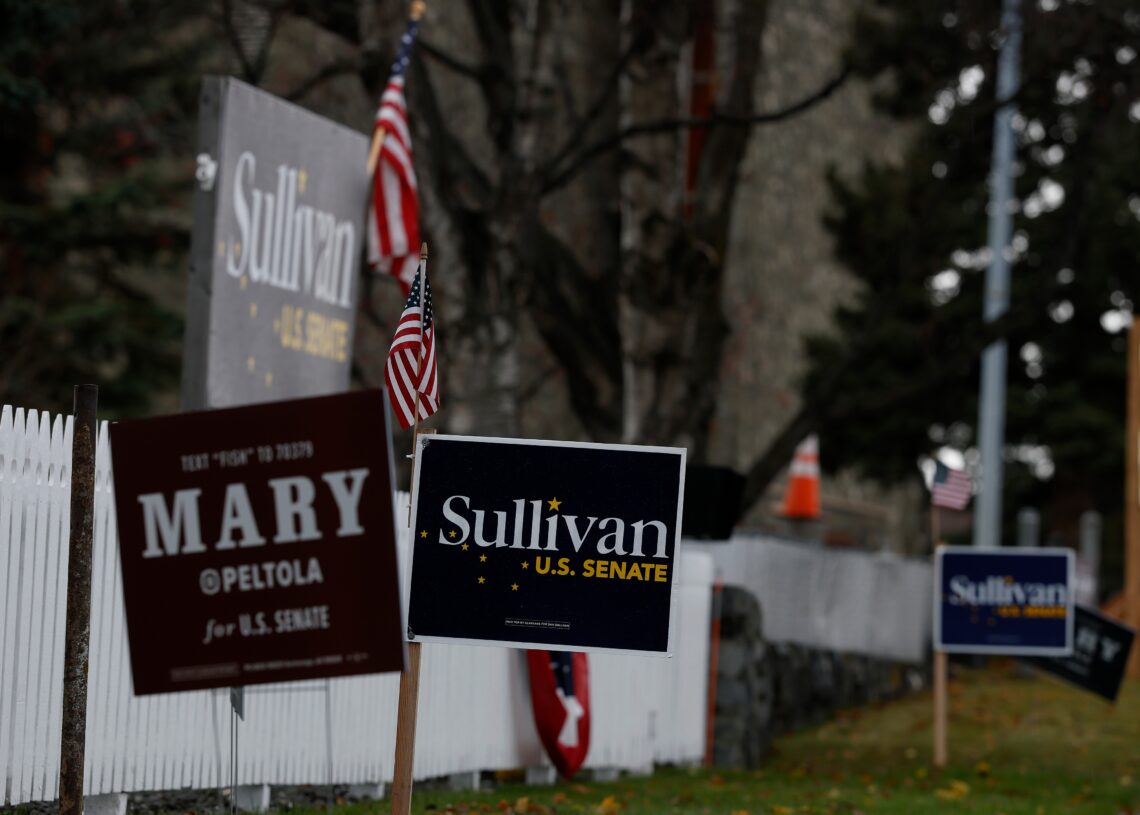
Democrats in Alaska are facing public criticism and investigations for their alleged recruitment of a spoiler candidate to confuse voters in the state’s highly competitive Senate race.
The circumstances in the latest incident are unusual, because the spoiler candidate shares a near-identical name to the incumbent Republican senator.
But both parties engaged in horse trading and cross-aisle spending to try to game Alaska’s Senate primary system this year. Republicans invested hundreds of thousands of dollars into supporting nonviable Democratic candidates in the primary. Democrats dropped candidates to try to splinter Republican votes.
The machinations are drawing greater scrutiny after Democratic Senate candidate, former congresswoman Mary Peltola, was allegedly involved in a scheme to recruit a spoiler candidate with the same name as her opponent, Sen. Dan Sullivan (R). The scheme, revealed in a New York Times report, has prompted state and federal investigations into her role. Peltola has denied any knowledge or involvement.
“Democrat operatives know their candidates’ policies are deeply unpopular, so they’ve resorted to manipulating Alaska’s election system to their own benefit,” said Nate Adams, a spokesperson for the incumbent Sullivan.
Republicans engaged in their own efforts to pick a suboptimal ballot for the other side.
Two perennial candidates, Democrat Carol Hafner and Green Partier Richard Grayson, got substantial boosts in the weeks leading to the Senate primary from a super PAC that was later revealed to be wholly funded by Republicans.
Hafner and Grayson were not viable candidates — neither live in Alaska and neither raised any serious sums of money. Hafner’s son, Eric Hafner, is another perennial candidate who ran for the U.S. House seat in Alaska from a federal prison in New York this year and in 2024 against Peltola.
Grayson, who has run as a candidate for numerous parties in various offices in numerous states, said in an interview that his candidacy is no more than an eccentric hobby he’s been doing since the 1970s. He said Anton McParland, Peltola’s longtime top aide, texted him early in the cycle to encourage him to withdraw. McParland did not respond to a request for comment.
“I call it performance art,” Grayson said of his numerous runs, adding that he never wanted to take votes from Peltola, whom he supports. “I do it for fun.”
Hafner said in an interview that she was running because she was saddened by the impact of Typhoon Halong on western Alaska but has never been to the state herself.
The super PAC, Fair Deal Alaska, spent more than $1,600,000 combined boosting Hafner and Grayson with ads praising them as progressives in the mold of Sen. Bernie Sanders (I-Vermont) and Rep. Alexandria Ocasio-Cortez (D-New York). The funders of the super PAC came shortly before the primary, allowing them to avoid identifying themselves until after the primary under FEC regulations.
When they were made public in filings this fall, the funders were revealed as Republicans. The Senate Leadership Fund, the party’s main super PAC for the chamber, contributed $650,000 to Fair Deal Alaska. The only other donors were Last Frontier PAC, whose backers are known Republican donors and Sullivan’s own joint fundraising committee, and First Principles Digital, a pro-GOP group for pro-crypto candidates.
“Republicans have a long history of recruiting and propping up candidates in an attempt to boost their own campaigns — including recruiting a prisoner with a New York address to run against Mary Peltola and spending nearly half a million dollars to secure a spot on the ballot in Alaska for an Arizona resident in the Senate race this cycle,” the Democratic Senatorial Campaign Committee said in a statement after the Times report.
None of the groups responded to requests for comment. Grayson and Hafner said they had no contact from national party groups. Grayson didn’t know about the ads until a friend in Anchorage told him about them. Adams, the Sullivan spokesperson, said all Sullivan joint fundraising committees were focused solely on reelecting the senator.
Critics to the scheme to recruit a second Dan Sullivan distinguish the move by saying recruiting a candidate with the same name was another level of intentionally attempting to deceive voters than simply boosting an existing candidate with another name. Still, the state Supreme Court ruled this summer that operating in bad faith was not in itself disqualifying for a run.
Supporting nonviable candidates for the opposite party is not unique to Alaska and is common in states with traditional partisan primaries. Democrats spent heavily to boost far-right candidates in multiple states in 2022 House races, and Republicans did the same with leftist Democratic candidates this year.
The moves this year have nonetheless drawn greater scrutiny of Alaska’s unique primary system, which allows the top four candidates of any party to advance to the general election, which is then decided by ranked-choice voting. The system is intended to give greater say to the state’s independent voters, who make up more than 60 percent of the electorate.
“This [is] yet another example of what a scam Ranked Choice Voting is,” Republican gubernatorial candidate Bernadette Wilson posted on X about the multiple Dan Sullivans. The state GOP is backing a ballot measure this year to eliminate Alaska’s nonpartisan primaries.
The four-candidate system could give Democrats an advantage in the state’s competitive governor race, where only one Democrat, former state representative Jonathan Kreiss-Tomkins, is running against three Republicans. Wilson, the Republican candidate endorsed by President Donald Trump, urged the two other Republican candidates to drop out to avoid splintering the ticket, but they have refused.
It’s the general election field Democrats were hoping for. Kreiss-Tomkins and fellow Democrat, former state senator Tom Begich, had made an agreement that whoever came in first in the primary would be the party’s sole nominee in the general election and the other candidate would drop out, regardless of whether they were in the top four. Begich came in second with more than 20 percent of the vote — more than any Republican — but agreed to drop out and support Kreiss-Tomkins.
Democrats pulled a similar move in the race for the state’s sole U.S. House seat, where Democrat Matt Schultz dropped out to make way to independent candidate Bill Hill. A former school administrator and fisherman, Hill now has the support of the Democratic Congressional Campaign Committee and Alaska Democratic Partyin his bid against Republican incumbent Rep. Nick Begich (whose uncle is the Democrat Tom Begich).
The post Both parties tried to game Alaska primary field appeared first on Washington Post.