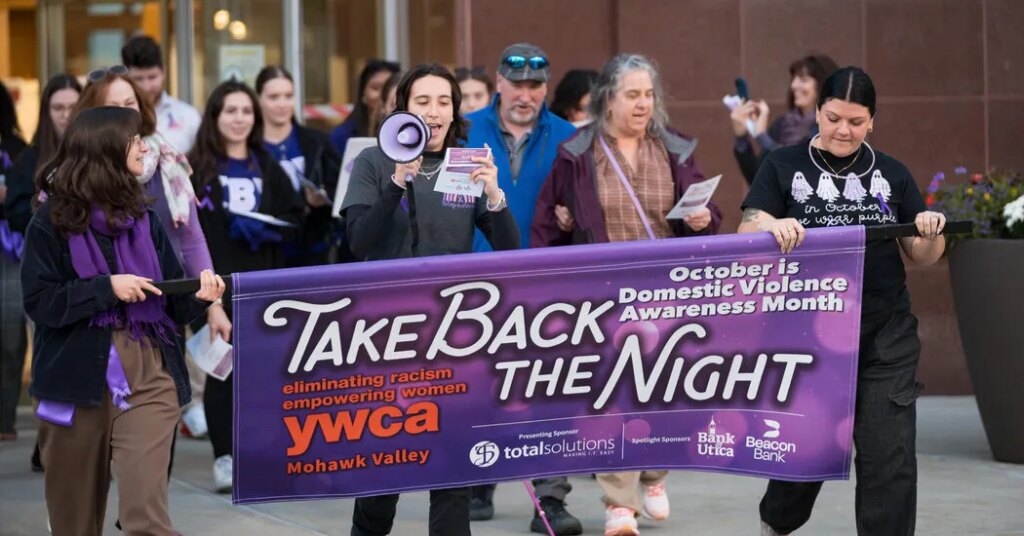
For decades, Take Back the Night, an international organization that has spoken out about sexual violence, has rallied on college campuses across the country and protested around the world.
Active as a grass-roots coalition since the 1970s, the organization has used marches, rallies, protests and speak-outs to push for an end to sexual violence in all forms.
One of the earliest known marches came in 1972, when women at the University of Southern Florida took up witches’ brooms and donned black capes as they marched across campus using the phrase “take back the night” to demand more resources and increased safety for women.
More than five decades later, sexual violence continues to be a problem on college campuses. The most recent high-profile example occurred at Cornell University, where a woman sued the school and fraternity members there whom she said had sexually assaulted her.
On Sunday, students across more than 90 campuses are expected to march in solidarity with the woman and push to end sexual violence.
Here’s what to know.
What is Take Back the Night?
The movement began as a loose coalition of groups organizing protests and marches in the 1970s. In 2001, Katie Koestner officially founded the organization Take Back The Night.
Some of the earliest protests by the movement rallied for the safety of women. In 1973, supporters of the movement in San Francisco protested violent “snuff” pornography films. In 1976, women from more than 40 countries came together in Belgium to call for safer streets for women.
In subsequent decades, hundreds of colleges and universities across North America held candlelight vigils, chapel speak-outs and rallies and marches.
At one march at Dartmouth College, protesters stopped in front of fraternity houses where rapes had been reported and dripped candle wax in honor of the survivors who were assaulted there, said Ms. Koestner, the executive director of Take Back the Night.
It was one of dozens of Take Back The Night events Ms. Koestner spoke at after she came out publicly at the age of 18 about being a survivor of date rape on her college campus.
Her case led universities to rethink what they understood to be the definition of rape in the 1990s, she said. Rather than a crime of resistance by the victim and force by the perpetrator, it became a crime of consent, she said.
Why now?
There has been a particular focus on sexual assault prevention in recent weeks, after a woman’s lawsuit against Cornell University in upstate New York and fraternity members there whom she said had sexually assaulted her in their fraternity house in 2024.
The men have denied that the claims, and none of have been criminally charged. But the woman’s lawsuit brought a flood of criticism to the Ivy League university over how it handled the accusations — two of the men were expelled while others were later allowed to return to campus — as well as the broader handling of sexual assault on and off college campuses.
Ahead of the Sunday rally, Take Back The Night is selling merchandise saying “I am Jane Doe,” in an effort to stand with the anonymous woman who filed the lawsuit.
Earlier this month, a 21-year-old woman also reported that she had been sexually assaulted at a fraternity house near the University of Chicago.
“Every single student should be able to go to college and not be worried about their sexual safety,” Ms. Koestner said in an interview.
What is Take Back the Night calling for?
Take Back the Night’s virtual rally programming will feature several speakers. Each campus that participates is asked to read five mandates aloud. That includes Cornell University, whose students are holding their march at a local church.
The mandates are directed at the trustees, presidents and administrators of colleges and universities across the United States.
They include calls for:
-
Evidence-based prevention education for every student.
-
Trauma-informed investigations and independent oversight.
-
A 24-hour emergency response and protection for those seeking help.
-
Monthly public reporting and transparency on campus sexual violence.
-
The modernization of outdated sexual assault laws.
The post What to Know About ‘Take Back the Night’ Rallies appeared first on New York Times.