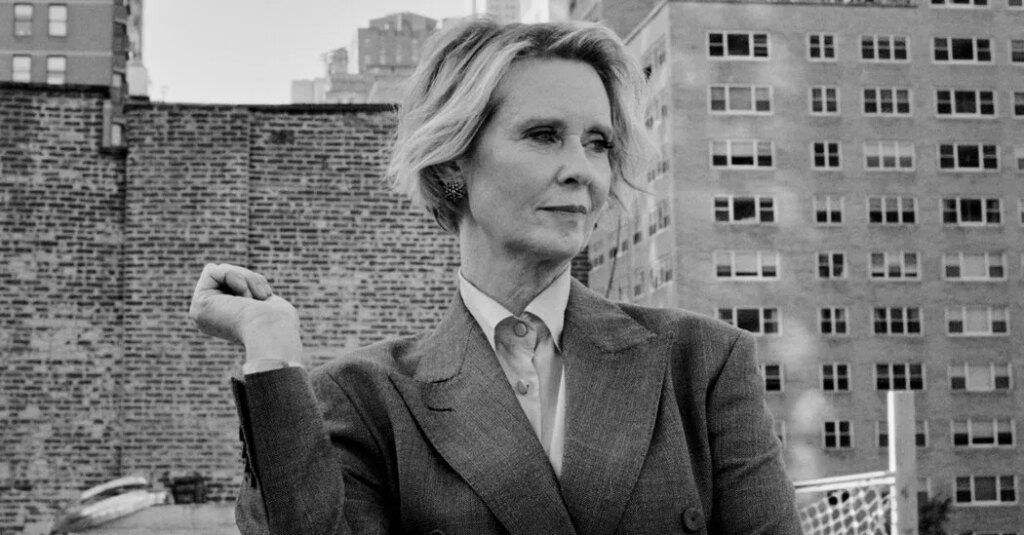
Cynthia Nixon knows what you are thinking when you see her on the street. She has blond hair now. She walks with less aggression and rarely wears a power suit. But if you pass her on a Manhattan sidewalk, you will recognize her as Miranda Hobbes, one of the characters who made the HBO comedy “Sex and the City” a generational hit.
Nixon, 60, who began acting professionally as a New York City teenager, played Miranda off and on for over 25 years — on the show from 1998 to 2004, then in two feature films and in the follow-up series “And Just Like That …,” which ended last year. Despite a glittering Broadway career, which includes two Tony Awards, a more modest film career and a run for governor of New York in 2018, it is Miranda, a professionally ambitious and personally messy attorney, who defines her.
“Miranda seems to eclipse everything else,” she said, with cheerful resignation, on a recent morning at her home in Manhattan.
Nixon — warm and mellow until you get her on the subject of politics — is no Miranda, even as she admires her. We were speaking in the yellow-tiled kitchen of the Murray Hill townhouse Nixon shares with her wife, Christine Marinoni, and their child. (Nixon has two older children, now grown, from a previous relationship.)
Congenitally hospitable, Nixon offered tea, muffins and half a dozen varieties of fruit, even going so far as to slice an apple for me when I at first declined. (Miranda would never.)
Playing and promoting that character had been a joy, but also often weird. “The clothes and the heels, it was a lot,” she said.
Nixon wears fewer heels these days, but the clothes are still a lot. She is a star of “The Gilded Age,” the rococo HBO historical drama that returns Sunday for its fourth season. Nixon plays Ada, a childless woman in an old-money Manhattan family who shares a home with her domineering older sister, Agnes (Christine Baranski).
When Nixon isn’t jeweled and corseted, she can often be found directing and acting Off Broadway or, as a person of longstanding political conviction, at various fund-raisers. But these days, loosed from the role that defined her, she is taking a lighter approach to her craft.
“I can be very planned as an actor,” she said. Now in heels or flats, in corsets or unlaced, she is learning to let that go.
A lifelong New Yorker, Nixon first achieved fame, as an 18-year-old Barnard College student, for appearing in two Broadway shows simultaneously: Tom Stoppard’s “The Real Thing” and David Rabe’s “Hurlyburly.” Baranski played her mother in “The Real Thing.”
“She was this sprightly teenager, for God’s sake, a college girl,” Baranski said in a phone interview. “She was as bright as a button and rather has retained that marvelous, bright quality about her, a sparkle that’s never really faded.”
Nixon kept working, steadily if unspectacularly, until she was cast in an HBO show about four Manhattanites navigating relationships and careers, often in vertiginous shoes. The success of “Sex and the City” startled Nixon, who assumed a Tony nomination at 28 would be her career high point. She enjoyed that success, particularly as it meant that she finally had the name recognition to play starring roles on Broadway. Still, she turned down many of the TV and movie parts she was offered in those years, mostly because they were also urbane lawyer types. Settled in Manhattan and raising her younger children, she became increasingly involved in advocating for public school funding.
After the show ended, she continued her political involvement, which culminated in a run for governor as a progressive Democrat in 2018. Her fame was both an advantage, in terms of name recognition, and catnip to the opposition.
“They just went to town on that,” she recalled. “They just trotted out cosmos and heels.”
She lost the primary to Andrew Cuomo, but she remains proud of her run. “Also, it is nice to see how many people who worked on our campaign or volunteered, including Zohran [Mamdani, now the mayor of New York City], go on to just to carry those ideas with them, and get to a place where they can have an impact,” she said.
She loves when people approach her at an event to say they voted for her. Is that better than her Emmy win for “Sex and the City”?
“Oh yeah it is,” she said.
Kristin Davis, her co-star on “Sex and the City,” said Nixon’s politics are intimately connected to what makes her distinct as an actress and a person.
“She’s so interested in people,” Davis said in a phone interview. “This is what led her to run for governor, which was unexpected and incredibly brave.”
A few years after that campaign, Michael Patrick King, a “Sex and the City” showrunner, and Sarah Jessica Parker, another co-star, approached Nixon with an idea for a continuation of the original series. At first she resisted, worried that it would be just a retread. But King and Parker persuaded her that “And Just Like That …” could be something more.
“I became convinced that we could really do interesting, dangerous things,” she said. “And that we could make up for some of our past mistakes, the chief one being that it was a such an overwhelmingly white show.”
Reaction to the show was mixed, and the integration of characters of color was not exactly seamless. Nixon avoided much of the discourse, but she absorbed some of the dissatisfaction with Miranda’s fumbling.
“They were so horrified by her sadness and alcoholism and awkwardness at trying to become a woke person at this advanced age,” she said of the show’s viewers. “But I loved that.” She also loved directing a handful of episodes.
When Parker and King announced that the show would end after its third season, it caught Nixon by surprise. “I was not at all ready,” she said. “Not at all.”
Still, “The Gilded Age” meant she wasn’t left idle. The sweet, reticent Ada could hardly be more different from the tart and brazen Miranda. That made her familiar to Nixon.
“In my youth, I played so many waifs, and Ada is kind of a waif,” she said.
But Ada doesn’t remain a waif. The “Gilded Age” creator, Julian Fellowes, thought of Nixon for the role partly because he knew Ada would eventually come into her own.
“I felt that Cynthia could do that,” he said in a recent video interview. “Because I’d seen her play congenial and amiable people, rather gentle people, but I also knew that she was very political and had strong opinions.”
This season Ada even dares to order new curtains, a revolutionary act in her heritage-obsessed household. “I want something a little less traditional,” she says proudly.
As “Sex and the City” ran its course, Miranda drew closer to Nixon, becoming a wife, a mother, softer around the edges. Ada has made a similar, if opposite, journey, growing stronger and more progressive — within the decorous limits of the series, anyway.
Curtains and a misguided temperance crusade aside, Ada is hardly a political activist. Nixon still is. There were reports that she was arrested earlier this year for protesting Prime Minister Benjamin Netanyahu of Israel outside the United Nations. But she left before the handcuffs came out.
“I was doing back-to-back fund-raisers for Justin Pearson and Angie Nixon,” she said, referring to the Democratic congressional candidates. “I thought, I can’t get arrested. Maybe next time.”
She remains hopeful that Democrats will do well in the midterms, even as she worries about gerrymandering and the political shifts of recent years. She is particularly troubled by the actions of ICE, by climate rollbacks and by policies that affect her personally, like the Trump Administration’s aggressive efforts to weaken protections and support for transgender people.
“It’s scary as a queer person, as the mother of a trans man,” she said. “It’s a little bit devastating.”
So as not to despair, she hosts fund-raisers. She makes phone calls and donations. She hopes for another season of “The Gilded Age,” and there is an Off Broadway play she is eyeing and another at Steppenwolf.
More than 40 years in, with that same sparkle, she is still trying to make her acting more effortless, more natural — a little less Miranda, a little more Cynthia. Effort, that’s for politics, not art.
“The more I can just get in there and do it,” she said of her work, “the better.”
Cinematography by Gus Aronson.
The post Cynthia Nixon Is Not a Miranda appeared first on New York Times.