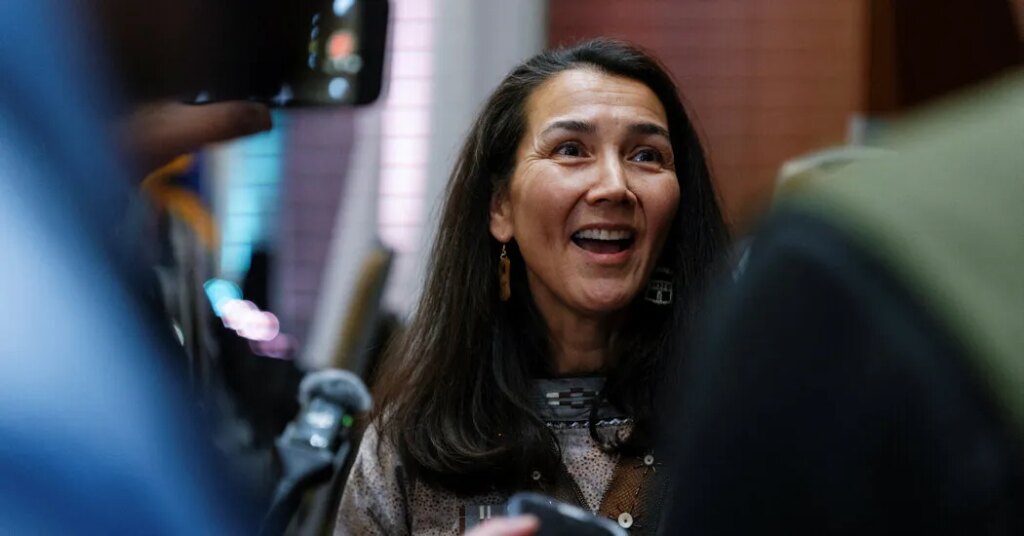
Organizers of a ballot measure that would end Alaska’s ranked-choice voting system say the effort by Democrats to boost Mary Peltola’s Senate bid by stacking Tuesday’s ballots in an attempt to confuse voters should be the system’s death knell.
Since Alaska voters approved open primaries and ranked-choice general elections in 2020, opponents — most of them Republicans — have argued the system is too confusing for the average person.Now it’s been tainted by scandal involving the recruitment of a challenger with the same name as the incumbent. That has led to federal legal action, a Justice Department investigation and a separate state investigation.
There have been similar attempts to fool the electorate with same-name candidates under other election systems in Alaska and elsewhere.
“I mean, there it is,” said Judy Eledge, a longtime conservative activist in Alaska and chairwoman of the campaign for Ballot Measure 2, the effort to repeal Alaska’s current electoral system that voters will decide next week alongside the race for U.S. Senate. “They’ve done our work for us.”
A similar referendum two years ago lost by 737 votes. Backers of the system still say it encourages bipartisanship and gives voters an extra layer of protection against dirty tricks and bogus candidates by offering multiple choices.
“This situation is actually an object lesson in why you need ranked choice voting: You can’t have a spoiler when voters have multiple options,” said Joelle Hall, a longtime labor leader working against Ballot Measure 2.
But that argument got much more difficult to make after The New York Times reported a successful effort by Democrats to recruit a candidate named Dan Sullivan to appear on the ballot alongside Senator Dan Sullivan, the incumbent Republican whom Ms. Peltola, a former Democratic House member, hopes to defeat.
Besides Ms. Peltola and the two Sullivans, another name is on the ballot, Gerald Heikes, a conservative Republican and frequent candidate who said he too was recruited to run for the Senate by an outsider. A liberal political action committee is promoting Mr. Heikes in hopes of siphoning still more votes from the incumbent.
So two of the four choices may be on the ballot because of skulduggery.
Alaska Governor Mike Dunleavy, a conservative Republican leaving office in December, told Fox News this week that “we wouldn’t be having this conversation if we didn’t have ranked choice voting.”
Under current law, candidates for state and federal office in Alaska compete in one open, nonpartisan primary, with the top four advancing to November. Voters rank them in order of preference. If no candidate wins a majority of first-choice votes, the last-place finisher is eliminated and those votes are redistributed according to voters’ next choices. The process repeats until someone wins a majority of the remaining votes.
Ballot Measure 2 would return Alaska to primaries open only to voters registered to a particular party. That would be followed by a traditional general election where voters choose just one candidate. The initiative would also repeal campaign-finance disclosure requirements adopted with the current system. Proponents of the current system have made the loss of that transparency the heart of their argument to voters.
Even before the controversy over the two Dan Sullivans, the ballot measure was emerging as a proxy fight in a broader national battle over how America votes. Elon Musk, the world’s first trillionaire, and Jeff Yass, a billionaire, donated heavily to the repeal effort, while Michael Bloomberg, Marc Merrill and Kathryn Murdoch, themselves deep-pocketed donors, backed the campaign to keep the system.
The Times investigation has put proponents for the ranked-choice system in the awkward position of arguing that this kind of attempt to mislead could happen under any voting system because it’s comparatively easy for people to file to run in Alaska.
“This has nothing to do with ranked-choice voting,” said Scott Kendall, an Anchorage lawyer who designed the system. “It’s just a dirty trick.”
Ms. Peltola’s effort to unseat Senator Sullivan is critical to Democratic hopes of retaking the chamber. In response to the allegations of chicanery, Vice President JD Vance told reporters Thursday, “It seems to me that you have an election, the person who wins the most votes should win.”
President Trump said on a Kansas City radio broadcast, “You need about a 190 I.Q.” to understand the system,” though each ballot has fairly simple instructions and the state elections division, overseen by a Republican lieutenant governor, took pains to differentiate the candidates: Dan S. Sullivan is identified on the ballot as the incumbent and a registered Republican, while Daniel J. Sullivan Jr. has no identification next to his name.
Proponents of ranked-choice voting say it just gives voters more than one chance to decide who they support — and a simple solution, supporters note, to any confusion about which Dan is which: Rank them both.
Alaskans who rank Daniel J. Sullivan or Mr. Heikes first could still help Senator Dan S. Sullivan win, provided they also rank him ahead of Ms. Peltola. Only if they rank Ms. Peltola higher, or leave the incumbent off their ballots entirely, could the maneuver deprive him of votes he might otherwise receive.
Alaska Republicans have a history of refusing to rank their choices, and the senator’s latest radio ad features a catchy jingle encouraging people to rank “Dan S., Daniel, Gerry, just don’t rank Mary.”
“Republicans can be very stubborn,” Ms. Eledge said. “Some of them don’t like the system, so they don’t use it.”
That approach could be even more consequential in the race for governor, also on this year’s ballot.
A Democrat hasn’t won the job since 1998, but Democratic candidates finished first and second in the top-four August primary, which featured 17 candidates — 12 of them Republicans.
The second-place Democrat dropped out to clear a path for the other, a former state legislator, Jonathan Kreiss-Tomkins. The top Republican finisher, Bernadette Wilson, urged the other two Republicans on the November ballot to do the same, but they refused. Earlier this month, President Trump backed Ms. Wilson and called on the other two Republicans to leave the race.
It all has some conservatives worried their voters will ignore repeated party instructions to “rank the red” and instead list only one candidate.
A similar approach helped Ms. Peltola defeat two Republicans, Sarah Palin and Nick Begich III, in a 2022 U.S. House race. The combined first-choice vote share for the two Republicans exceeded Ms. Peltola’s. But about a fifth of Mr. Begich’s voters only ranked him. When he fell out of the race, Ms. Peltola took the lead.
Polls have shown Mr. Kreiss-Tomkins leading the governors race, and he has promised to build a politically balanced cabinet and work closely with Republicans and independents in the legislature, which has been governed by a bipartisan coalition.
Proponents of the current system say its repeal could make such cooperation more difficult, by bringing back partisan primaries, which favor the extremes in both parties and gives Republican and Democratic leaders far more power to keep members focused on the party line.
That’s exactly what Ms. Eledge and other opponents of the current system want.
She’s eager, for example, to punish Senator Lisa Murkowski, a Republican, for her recent cross-party endorsement of Mr. Kreiss-Tomkins.
If Ballot Measure 2 passes, Ms. Eledge predicted, “she won’t run again.”
She added, “she knows she wouldn’t make it out of the primary.”
Of course, Ms. Murkowski could do what she did in 2010 when she lost the Republican primary to a hard-line conservative: launch a successful write-in campaign, without ranked-choice.
The post Did the Peltola Campaign Seal the Fate of Alaska’s Ranked Choice Vote? appeared first on New York Times.