The Franciscan friars had left behind a world they had known in Spain for a new one across an ocean, dispatched to missions along the marshy coastline of what would one day become the state of Georgia. The men believed they had been sent there on an assignment handed down to them by God.
The missionaries learned the language of the Guale people, the region’s Indigenous inhabitants. The friars forged relationships, working to baptize them and bring them to Christianity, researchers found. But eventually, a rupture emerged. The teachings of this new faith collided with traditions that had existed long before these outsiders arrived. And in a bloody rampage, five of the Franciscans were killed.
More than 400 years later, the Catholic Church took a rare and sacred step to advance the friars toward sainthood. Decades of inquiry and deliberation culminated on Saturday when the church officially declared them as “blessed,” positioning them to join a cohort of roughly a dozen American saints and to possibly become the first connected to the South.
The friars — Pedro de Corpa, Blas Rodríguez de Cuacos, Miguel de Añon, Antonio de Badajoz and Francisco de Veráscola — had been forgotten for centuries by all but a few. But now, after the enduring efforts of fellow Franciscans and the Catholic community in South Georgia to revive their memories, the church has recognized them as martyrs, killed in defense of their faith.
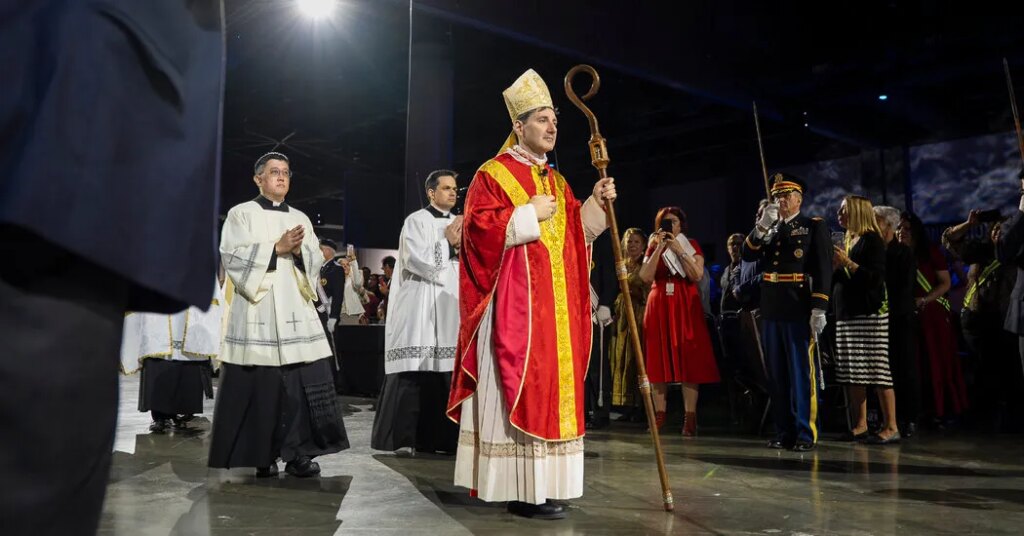
“They reflect the light of Christ in the challenges and complexities of a wounded world,” Cardinal Frank Leo, the metropolitan archbishop of Toronto, told a crowd of thousands who had gathered for the beatification Mass he presided over in Savannah, Ga.
“They lived and labored, served and suffered so long ago,” Cardinal Leo added, and they were “now being raised at the glory of the altar.”
In the generations since the missionaries were killed, Christianity has flourished in Georgia. There are the many small towns where the steeples of Protestant churches seemingly rise above every block. Evangelical megachurches sprouted in the suburbs. Black congregations in Atlanta became the spiritual home of the civil rights movement.
Yet Catholicism has had a limited foothold. The charter establishing Georgia as a British colony specifically forbade the faith. These days, just 3 percent of the population in South Georgia identifies as Catholic, according to the local diocese.
Part of the jubilation now was a reassurance for the local Catholic community of how deep their roots run here, too.
“Often, we may be misunderstood,” the Most Rev. Stephen D. Parkes, the bishop of Savannah, said of Catholics in a place where Christians of other denominations could be skeptical of some of their traditions and practices, especially the veneration of saints. “It’s an opportunity for us to help spread the good news of the Catholic Church.”
Still, the legacy of the missionaries is also interwoven with a broader and darker history of conquering and conversion, with Native American groups saying the beatification was a reminder that the tragedies of that era were by no means limited to the deaths of the friars.
The descendants of Native Americans in Georgia were largely displaced from their ancestral homes. The Guale people no longer exist as a distinct group; some fled, some were killed and some were absorbed into other tribes, including the Muscogee (Creek) Nation, which was itself expelled from Georgia by the U.S. government two centuries later.
“The events of 1597 occurred during a complex and often violent period of Spanish colonization, when Indigenous peoples struggled to preserve their sovereignty, cultural traditions and ways of life,” RaeLynn A. Butler, the secretary of culture and humanities for the Muscogee (Creek) Nation, said in a statement. “While the killing of the friars was tragic, the history of the Guale people extends far beyond those events and deserves to be understood in its own right.”
The service on Saturday was threaded with somber reflection, with acknowledgments of the discord and bloodshed that had brought the worshipers together. But the atmosphere was overwhelmingly one of joy.
A convention hall — a secular cathedral of gray and beige — was transformed by reverent pageantry.
A parade of dozens of bishops and priests, all in robes and vestments, processed nearly the length of the hall as organ music rumbled. Banners with images of the friars hung from the rafters. A makeshift altar was draped with marigold and maroon curtains.
The beatification comes at a moment of renewal and optimism for American Catholics as the church has tried to shake a cloud of scandal. The emergence of Pope Leo XIV, the first American pontiff, has helped inspire enthusiasm. Some of the country’s largest dioceses welcomed more converts into the faith this Easter than they have in more than a decade.
And in September, another American joined the ranks of the blessed: Some 50,000 people packed into a stadium in St. Louis for the beatification Mass of Archbishop Fulton J. Sheen, who became a household name as a missionary using mass media to draw thousands toward Catholicism.
By contrast, the Franciscan friars ministered on a much more modest scale, their lives and deaths largely obscured by history.
The bodies of the men were lost. The missions where they served had been reduced to archaeological ruins or had vanished altogether. But those who devoted years of their lives to pursue sainthood for the friars operated with a certainty that a solid-enough historical record had survived.
“This case, despite the amount of time it has taken, is really very simple,” the Rev. Conrad Harkins, the Franciscan who helped lead the effort before his death in 2020, told The Augusta Chronicle in 2007 as he prepared to travel to the Vatican with almost 500 pages of records.
“You’re either going to accept the historical documents,” he said, “or you’re not.”
Pope Francis certified their martyrdom last year, just a few months before his death. There is no definite timeline for when they might be canonized, the final step to attaining sainthood.
According to research compiled by the church, the friars had lived peacefully among the Guale, converting many within that community, including relatives of a local leader.
But the break came when the nephew of a Guale chieftain and his likely heir shared plans to marry a second wife, as had been custom. The Franciscans informed the man that doing so violated the faith he had been baptized into, and if he proceeded, the order would oppose his elevation to chief.
The man returned with other men and bludgeoned Pedro as he prepared for Mass. His severed head was impaled on a pike. The rampage continued, killing the other four friars and then holding and torturing another until his release was negotiated by the Spanish after 10 months.
Some scholars have argued that the men were killed as part of a broader power struggle. The church concluded through its investigation that the motivation had been religious, finding the friars had been killed “in hatred of the faith.” Some of the friars were even encouraged to flee, but they refused.
Church officials have presented them as defenders of marriage as a sacrament. If they proceed to full sainthood, the Rev. Roger Lopez, a leader in the Franciscan province for the United States, said he could imagine them as patrons for those who evangelize “the beauty of marriage.”
But Father Lopez also drew a more personal lesson from the friars’ experience. He, too, could be called to die for his faith, he said, and he needed to be prepared. It meant forgiving who he should forgive, making peace where it was needed and making sure those he loves knew of his love.
“I want to be ready, just like these brothers,” he said. “Not out of fear, but out of a sense of living a life that is whole, that is full.”
The post Centuries After Their Slaughter, Missionaries Move Toward Sainthood appeared first on New York Times.