The District of Columbia and Virginia on Saturday sued the Trump administration to block construction of the president’s planned 250-foot arch, which he wants to begin building as early as next week.
“This project is flagrantly unlawful,” the lawsuit states.
The suit accuses the Trump administration of violating the Commemorative Works Act and a section of federal law that requires the federal government to obtain specific congressional authorization before building a monument on federal land in Washington.
The plaintiffs cite the Administrative Procedure Act, the National Environmental Policy Act and the National Historic Preservation Act, which require a process of consultation and considering alternatives before rushing forward with the project. The suit also says plans for the arch violate the Height of Buildings Act, which with limited exceptions prohibits structures taller than 130 feet in the capital.
“In their rush to break ground on the arch, defendants have made only half-hearted gestures at complying with these requirements,” the suit states. “Perhaps recognizing that the project is legally indefensible, defendants have made clear that they will attempt to outrun judicial review.”
The suit was filed by Jay Jones, Virginia’s attorney general, and Brian L. Schwalb, Washington’s attorney general.
It is one of several challenging the legality of Mr. Trump’s arch, which the president has said is for himself but top administration officials now also claim is necessary for national security.
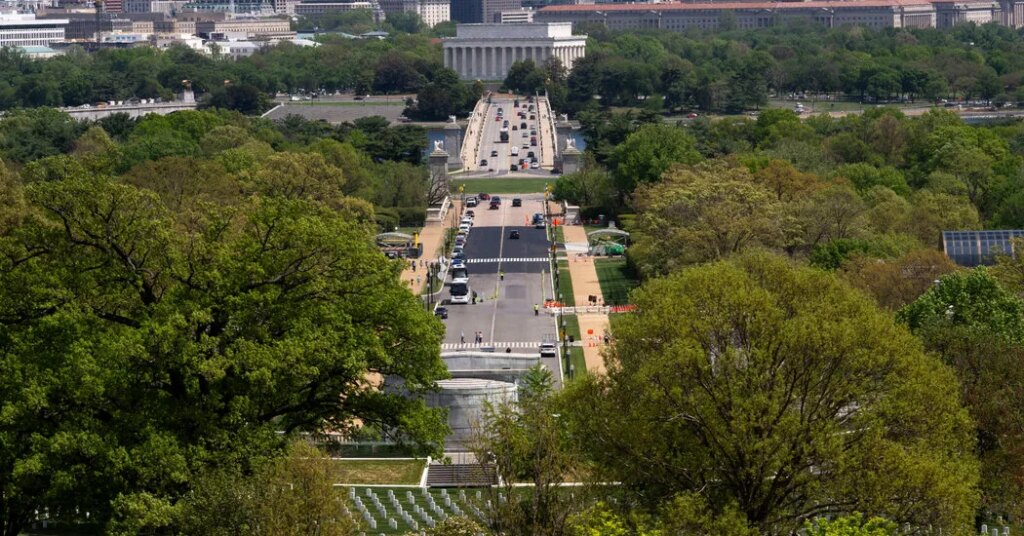
Arlington County, which borders the site of the planned arch, also has sued, citing traffic and safety concerns. A group of Vietnam War veterans also has sued to stop construction of the arch, which would block the view of Arlington National Cemetery from the Lincoln Memorial. That lawsuit also claims the project is unconstitutional without approval from Congress.
A federal judge hearing the veterans suit expressed skepticism Friday over the Trump administration’s new argument that the president’s planned 250-foot triumphal arch is needed for national security purposes.
Defense Secretary Pete Hegseth and Markwayne Mullin, the homeland security secretary, contended in sworn statements that even though national security was never invoked in the initial proposal for the arch, the project was now needed to keep the United States safe from drone attacks.
“The arch is a generational national defense opportunity to mitigate these evolving threats,” Mr. Hegseth told the court.
But on Friday, Judge Tanya S. Chutkan of Federal District Court in Washington questioned what she called the “brand-new” national security justification.
“I’m wondering about the timing of this argument,” Judge Chutkan said, before asking for more details about Mr. Trump’s plans for snipers, drones and ammunition to be stored at the arch.
“Can you give me some support?” she asked. “Can you show me any piece of paper?”
Robert N. Stander, a deputy assistant attorney general, said he could not.
The Trump administration has tried to get that suit dismissed by contending that the veterans group lacks standing.
One of the plaintiffs, Michael Lemmon, an Army veteran who served in Vietnam, testified Friday that the proposed arch, which he called a “monstrous edifice,” would interfere with the solemn way he experiences the Arlington cemetery.
The administration says the arch will be a tourist attraction, bringing up to 22,000 tourists a day to the area. Mr. Lemmon called that “disturbing and frankly disrespectful” to the families of those buried at the site.
“The pain is real for us veterans,” he testified.
In arguing that the veterans lack standing, lawyers for Mr. Trump pointed to a recent Supreme Court ruling that shot down a legal challenge to the luxury ballroom Mr. Trump is building on White House grounds after he demolished the building’s East Wing. The court ruled that the plaintiffs, a preservationist group chartered by Congress, did not have the legal grounds to sue because they were not directly harmed by the project.
The suit from the District of Columbia and Virginia appears to present different challenges for the administration by detailing a list of what they say are concrete harms from the arch’s construction. The suit cites traffic concerns and emergency response problems, as well as issues concerning the environment and historic preservation.
“The construction of the arch will inflict immediate and irreparable harm on the district and Virginia,” the suit filed on Saturday states. “The arch is slated to be built on a busy traffic circle that abuts the border between the jurisdictions, at the center of a historic viewshed, in a river whose environment the district has a statutory responsibility to protect. Both the construction of the arch and the completed monument will disrupt the operations of both jurisdictions.”
Even so, the arch is slated to receive final approval next week from the National Capital Planning Commission, which is led by allies of Mr. Trump’s. Administration officials have told one federal court that they could break ground on the project immediately after the vote of the planning commission.
The post Trump’s Arch Faces New Legal Challenge From Virginia and D.C. appeared first on New York Times.