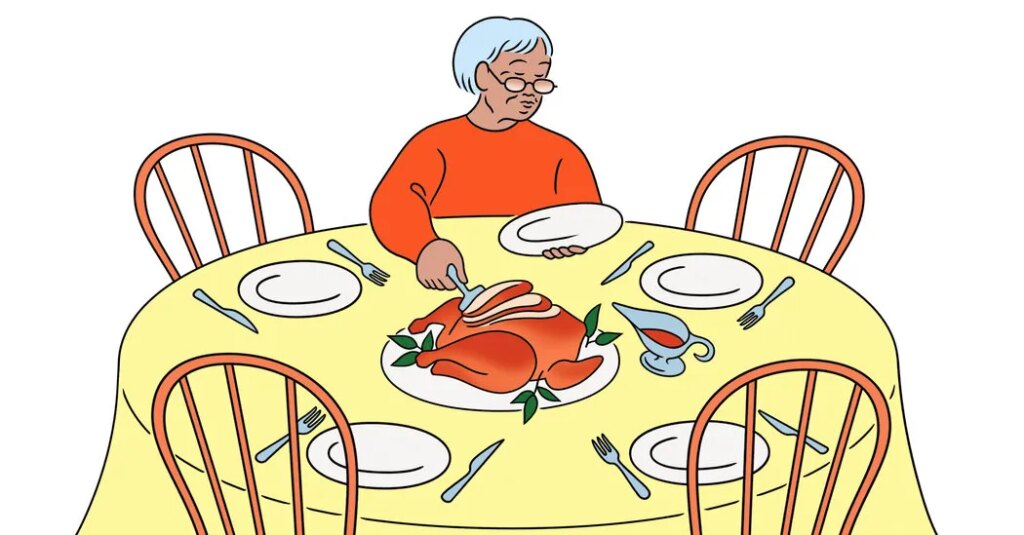
Last summer, my 85-year-old mother moved 3,000 miles to be closer to me. My sibling recently moved here, too. The move has had mixed results: My mother enjoys being closer, but I am not able to see her as often as she would like. She has made some friends, but she’s turned out to be needier than I thought. The facility where she lives has not been as welcoming or active as we were led to expect. She also came at a time when my difficult mother-in-law was in hospice. Our holidays and those of my spouse’s family here revolved around my mother-in-law’s care for a long and wearying time. She passed this summer. As you might expect, we’re all ready to relax.
The concern here is that my sibling is going out of town for Thanksgiving with his family. My spouse and I would also like to go away for the first holiday we’ve had to ourselves in a long time! But there’s my mother. She’s pretending our proposed getaway is perfectly fine with her and that she’ll find some way to spend the holiday, but she’s clearly not looking forward to it.
I’m torn between thinking, She’s a big girl, she’ll manage, and thinking that my spouse and I should suck it up this year and have Thanksgiving with my mother, and then maybe next year things will be different. I’d appreciate your thoughts. — Name Withheld
From the Ethicist:
Your mother would be happier if you all spent Thanksgiving at home together; you and your spouse would be happier if you spent the holiday elsewhere. There’s no solution, then, that will be best for everyone. In circumstances like these, the ideal is for the parties to discuss the options. You’ve done that. And your mother has offered, in effect, to give up her preferred option so you can have yours. It would be a mistake to suppose that, because she’s your mother and you’re her child, her wishes must always come second. (Or first, depending on your cultural assumptions.) But it would also be a mistake to deny her the opportunity to make a generous choice. If that’s what she’s doing, you can accept her offer with gratitude.
There are some psychological complications worth considering, though. Even with your mother’s blessing, you may spend Thanksgiving guiltily imagining her alone. Then again, if you cancel your trip out of a sense of duty, you may resent your mother, and she may sense it. What was supposed to be a gift could turn into a cheerless occasion for you both. You’ll want to think about the prospective emotional costs of your going … and of your not going.
On balance, I’m inclined to think you should take the trip. But you should also give some thought to what your mother might enjoy doing that day. Perhaps she has friends she could spend it with, or perhaps there’s an event at her residence she’d welcome attending. You might help her make plans, and have her over for a family celebration of your own on another day.
There’s a larger question here, of course. Your mother moved across the country with the expectation of having a fuller family life, and things haven’t worked out as she hoped. You and your sibling should consider how you can help her build a more satisfying life where she now lives. That’s a good deal more important than whether you’re together on the fourth Thursday in November.
Readers Respond
The previous question was from a reader who was keeping a secret about family medical history. He wrote:
My oldest nephew is a kind, sincere man with a good soul. My sister contracted rubella while pregnant with him, and he has struggled with learning disabilities and cognitive limitations throughout his life. … He has repeatedly lost jobs because he couldn’t meet performance standards and was even discharged early from the military. He has been chronically in debt, requiring repeated family bailouts. … At one point, his immediate family left him homeless as an exercise in tough love. He now lives in a residence for men facing hardship and works at a big-box store. He has also suffered serious medical crises, including leukemia. As far as I know, no one has ever told him that his difficulties might be related to his mother’s rubella infection. … Should he be told? Would knowing help him make sense of his failures, or damage him psychologically? … I also worry about my sister, who I suspect harbors deep feelings of guilt and may resist acknowledging any connection between her illness and his limitations. … Or would everyone be better off if I remained silent? — Name Withheld
In his response, the Ethicist noted:
Congenital rubella syndrome (C.R.S.) can have serious consequences, including deafness, eye problems and heart disease, along with cognitive and developmental impairments. So if your nephew’s problems are indeed the result of C.R.S., he would seem to have escaped some of the worst possible effects. But it’s unclear what he would gain from knowing that rubella might explain his disabilities. The diagnosis suggests no obvious treatment, though you could ask a doctor whether it might be useful to his medical care in other ways. I suppose there’s a scenario in which your theory might come as a relief to him; he may welcome the possibility that some of his difficulties stem from a prenatal infection. But, equally, there’s a scenario in which it leaves him feeling permanently damaged, makes his mother feel accused or leads him to resent her. And the connection remains conjectural. … I wouldn’t conceal it if your nephew expressed curiosity about the possible origins of his difficulties. But there’s no compelling reason to offer him a conjectural diagnosis. … I’m in favor of telling people important facts about their situation; I’m not persuaded that your speculative explanation counts as an important fact.
(Reread the full question and answer here.)
⬥
I’ve been a physician for over 40 years. You don’t have the right to conceal anyone’s medical history. It belongs to the patient. — Michael
⬥
People should rarely withhold medical information, especially when the information is about an adult and could possibly affect his health and his future. Having worked in disability insurance, I know a diagnosis alone doesn’t guarantee Social Security disability benefits. But an actual diagnosis of congenital rubella syndrome would give the nephew a coherent, documented origin for physical or cognitive problems that might otherwise look scattered and unrelated. That would definitely help any claim he might have, as well as provide his doctor with the whole picture. The letter writer should first give his sister a chance to tell her son herself. If she won’t, the nephew still deserves to know. — Jane
⬥
I live with chronic back issues related to scoliosis. Anytime I showed some discomfort, my mother was very fond of making pitying remarks about how it must have to do with “my difficult entry into the world.” I was born premature, and spent significant amount of time in the N.I.C.U. Ultimately, I do not agree with her assessment. But regardless, there’s nothing empowering about being told you are somehow broken from the get-go. I’m sure it’s obvious to this man that he has challenges, just as everyone does. Don’t disempower him and make him feel like a victim of circumstances out of his control, regardless of the truth of the matter, which, as the Ethicist points out, is no more than conjecture on your part. — Jeffrey
⬥
My brother was one of the very earliest people to be diagnosed with Fragile X Syndrome, which causes cognitive deficiencies, among other symptoms. After much family discussion, we decided to tell him. His reaction was profound relief — it wasn’t his fault. It didn’t change any treatments, but it sure helped him! — Marjorie
⬥
As a pediatrician, I think it’s important to acknowledge that C.R.S. may have already been ruled out as a cause of the nephew’s challenges. As our understanding of the genetic basis of many cognitive impairments has increased, it’s also possible that testing was undertaken during his leukemia work-up, and since that medical information is private, it seems unwise to share unsupported information that may only distress and confuse the nephew and family. A strong community support program would be the best option. — Lori
The post Is It Wrong to Leave My 85-Year-Old Mother Alone on Thanksgiving? appeared first on New York Times.