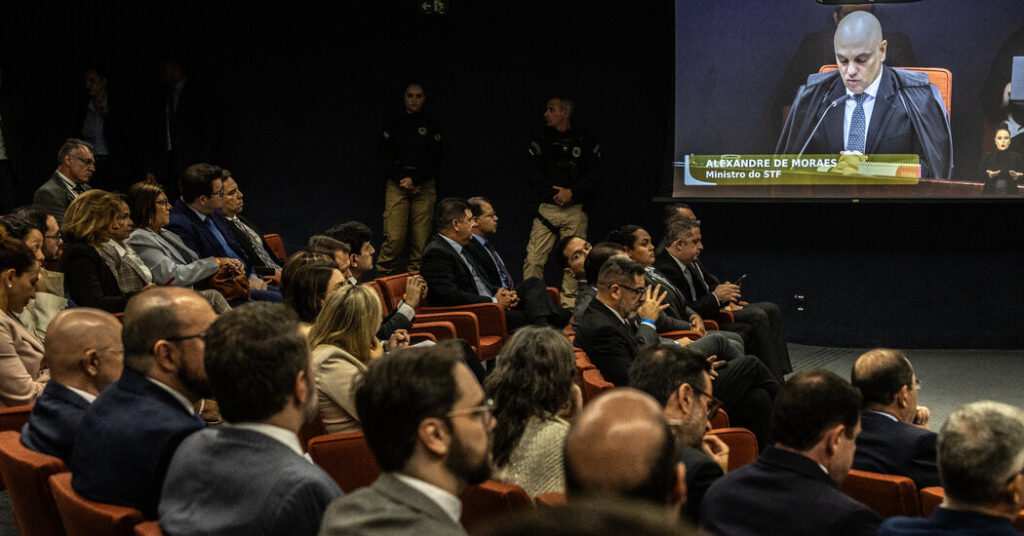
The United States on Friday lifted sanctions against a Brazilian Supreme Court justice who had presided over the conviction and imprisonment of former President Jair Bolsonaro for attempting to overturn the country’s 2022 election.
The U.S. government imposed sanctions against the justice, Alexandre de Moraes, in July under the Global Magnitsky Act after the case was brought against Mr. Bolsonaro, a Trump ally. The Magnitsky Act is a rarely used law that allows the United States to impose asset freezes and travel bans on foreigners accused of serious human rights abuses or corruption.
The justice’s wife, Viviane Barci de Moraes, and her law-training firm were also hit with sanctions. But according to a notice issued by the Treasury Department on Friday, Justice Moraes, his wife and her firm, Instituto Lex, were removed from the sanctions registry.
The Treasury Department said in a statement to The New York Times that maintaining the designation was no longer consistent with U.S. foreign policy interests. No further information was immediately available.
Neither Brazil’s Supreme Court nor Justice Moraes immediately commented on the decision.
Justice Moraes has aggressively targeted perceived threats to democracy in Brazil, in addition to overseeing the trial of Mr. Bolsonaro, drawing sharp criticism from President Trump. The former Brazilian president was arrested on charges that he had overseen a coup plot and a plan to poison Luiz Inácio Lula da Silva, who defeated him in the 2022 vote. The case was seen by as a crucial test of the country’s democracy.
Mr. Bolsonaro denied plotting to kill Mr. Lula and said what the police portrayed as a coup attempt was simply his efforts to study “ways within the Constitution” to remain in power.
Mr. Trump sent a letter to Mr. Lula describing the prosecution of Mr. Bolsonaro as a “witch hunt” that should end immediately. He also accused Brazil’s Supreme Court of unlawful censorship directed at U.S. social media companies.
As tensions escalated, Mr. Trump imposed tariffs on Brazilian exports, including steel and agricultural goods. The United States is Brazil’s second-largest trading partner after China, and Brazil supplies about one-third of the coffee consumed in the country, as well as significant beef exports. U.S. coffee prices rose sharply amid the tariffs and weather-related supply shortages.
Mr. Lula threatened to retaliate, stressing that the Bolsonaro case was a matter for Brazil’s independent judiciary. In September, Brazil’s Supreme Court convicted the former president and sentenced him to 27 years in prison. He remains in federal police custody in Brasília, the capital.
Ultimately, tensions between the countries eased. The tariffs were lifted last month, after a series of diplomatic talks, including phone calls between the two presidents. After the calls, Mr. Trump said the leaders had discussed sanctions and trade.
“We had a very good talk,” Mr. Trump said of Mr. Lula. “I like him.”
Brazil’s foreign minister, Mauro Vieira, speaking to reporters on Friday, said the lifting of the sanctions had been requested by Mr. Lula as part of ongoing talks with U.S. government officials.
“It was a long negotiation, but it was done,” Mr. Vieira said.
Allies of Mr. Bolsonaro criticized the U.S. decision. In a public statement, Eduardo Bolsonaro, a son of the former president, said he was “saddened” by the move to lift sanctions against Justice Moraes but expressed hope that Mr. Trump’s decision would succeed in defending what he called the strategic interests of the United States.
The younger Mr. Bolsonaro, a federal lawmaker who has been living in the United States since March, has said he does not plan to return to Brazil, citing what he describes as political persecution.
The post U.S. Drops Sanctions on Brazilian Justice at Center of Bolsonaro Trial appeared first on New York Times.