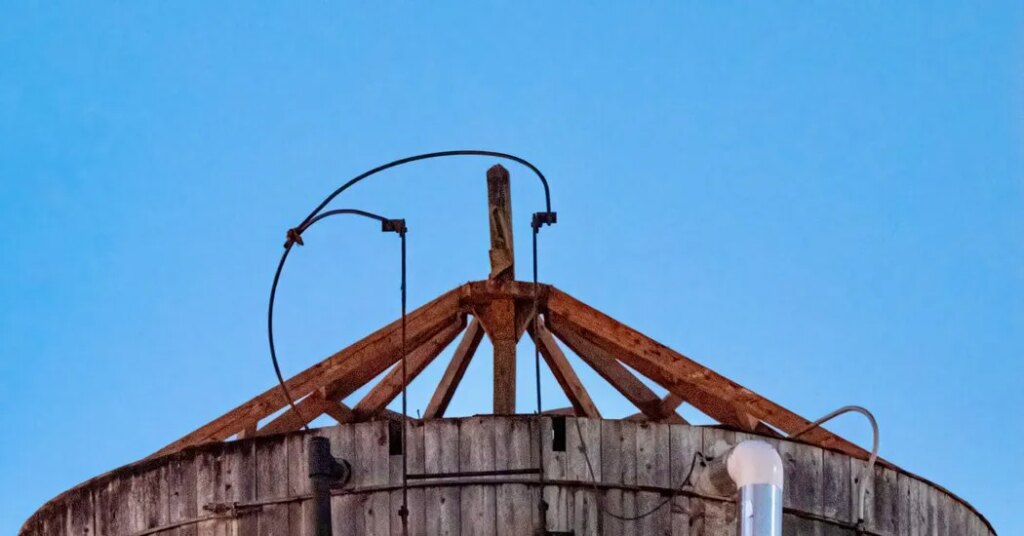
A family of barn owls — as charming to see in Manhattan as they are rare — became minor celebrities this month for nesting inside a derelict water tower on the Upper West Side.
Bird lovers gathered near Central Park to catch glimpses of the family: a mom, a dad and at least five babies, who spent their days sleeping inside the tower and spent their nights on its roof.
When the parents returned from evening hunting trips in Central Park, the owlets hopped and screeched, excited for a supper of rats delivered warm and squirming.
Then, this week, disaster.
On Thursday morning, workers arrived on top of the building, at 15 West 75th Street, and ripped away the water tower’s roof. Alerted by neighbors and birders, New York State’s Environmental Conservation Department sent officers, who warned the building’s managers to stop demolishing the water tower until further notice, according to the department.
The work stopped, and hours later, the owls returned. As birders watched from a sidewalk on nearby Central Park West, two adult owls flew to the water tower carrying food to five of their waiting offspring.
But on Friday morning, the work crew had returned. It was unclear exactly what they were doing, but observers on the sidewalk heard hammering around the water tower, said Jessica Wilson, executive director of the NYC Bird Alliance, who was there. Bird watchers saw the workers handling a wooden board that appeared to be covered in nest detritus, said Ms. Wilson and David Barrett, the birder behind Manhattan Bird Alert, a popular account on X.
“I am shocked that they would continue this work,” Ms. Wilson said, especially after receiving orders from the state to stop.
The water tower had been in disrepair and been causing “issues” for some time, Joselyn Rosales, the building’s superintendent, said on Thursday. She referred other questions to PMI Waypoint, a property management company. Efforts to reach the company for comment were unsuccessful.
Word that work on the water tower had resumed traveled quickly on Friday. Someone called the state Environmental Conservation Department, which sent an officer to deliver a written cease-and-desist order to the building’s managers. Observers also called 311, which resulted in police officers being sent to the building.
Late Friday morning, Erik Bottcher, the state senator who represents the neighborhood, and Brad Hoylman, Manhattan’s borough president, joined a crowd of people outside the building. They banged on the front door, but no one answered. “I was aghast,” Mr. Hoylman said.
Barn owls are not an endangered or threatened species in New York State, but they are protected under state wildlife laws, and it is illegal to destroy an active nest. Such nests also are protected under the federal Migratory Bird Treaty Act, said a representative of the U.S. Fish and Wildlife Service. Construction is paused, and the agency is investigating to see whether the law was violated. The state environmental agency is working with the federal government, the construction company and the property’s managers to find new roosts for remaining fledglings, said Adanna Roberts, a spokeswoman for the agency.
How the birds might respond to the disruption is unknown. Barn owls are not new to New York — there are a number of permanent barn owl nests in Jamaica Bay and on Staten Island. But according to Ms. Wilson, the water tower nest was the first time in modern history that the owls were known to have built a home in Manhattan.
Before the owls arrived, the water tower seemed abandoned, said Elisabeth Williams, a neighbor who was among the first people to spot the birds.
It also happened to provide an excellent spot for owls.
The aerie overlooked alleyways and Central Park — great places for an owl to hunt. The babies — at least five, but some birders claim to have counted six — could sleep inside during the day, then climb to the roof to receive food and begin learning to fly.
With the water tower’s roof removed, the family has lost its daytime hiding spot, Ms. Wilson said. The juveniles had started to fly recently, she added, but they relied on their parents for hunting. Deprived of their common spot to congregate in the evenings, the owlets risk missing their parents’ food deliveries.
In the wild, less than half of barn owl babies survive their first year, said Matthew Johnson, a professor of wildlife habitat ecology at California State Polytechnic University, Humboldt. It’s impossible to predict whether destruction of the nest will cause the young to starve, he added, or to simply to fly away and start living on their own.
“The fact that birders have observed them flying is encouraging,” Mr. Johnson said. “But flight alone does not mean they can feed themselves.”
Two hours after sunset on Friday night, eight bird lovers gathered on Central Park West. They saw an adult owl flying near the water tower, and one fledgling. It was still unknown whether the owls would continue gathering at the site, or how many would survive.
“Now everybody’s worried and waiting and watching to see what’s going to happen,” Ms. Wiliams said.
Ed Shanahan and Miles G. Cohen contributed reporting.
The post Birders Fear for N.Y. Celebrity Owls Over Construction Near Their Nest appeared first on New York Times.