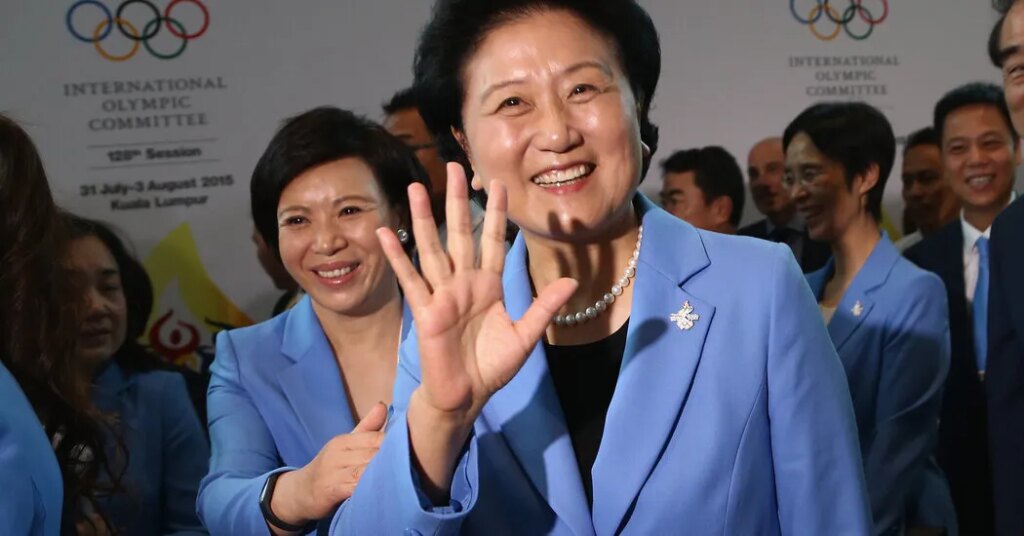
Liu Yandong, one of the few women to reach the upper echelons of the Chinese Communist Party, but whose career also illustrated the limits for women in China’s ruling elite, died on Wednesday in Beijing. She was 80.
Her death, after a long illness, was reported by the state news agency Xinhua and confirmed by her family.
Ms. Liu’s revolutionary pedigree, prestigious education and time toiling in a factory helped pave the way for her rise in the 1980s. As one of just six women to have ever served on the Politburo, the party’s elite policymaking body, she demonstrated what women in politics could achieve, spearheading diplomatic efforts and gaining recognition for her personal approach.
Yet her portfolio of duties overseeing education, science and technology, health and women’s and children’s affairs — some of which are typically relegated to female politicians — underscored the constraints on that power.
In its announcement of her death, Xinhua eulogized Ms. Liu as “an excellent Party member, a time-tested and loyal communist fighter” and praised her for her work on the Politburo. But her position on that committee — the party’s second-most powerful group — which she joined in 2007, was not evidence of a liberalizing Communist Party, said Minglu Chen, an associate professor at the University of Sydney who studies gender and politics in China.
“The party leadership has always been a boys’ club,” Ms. Chen said, noting that three of the six women who have reached the Politburo were also charged with overseeing health and women’s and children’s policy, areas that have traditionally been considered softer. Today, there are no women in the Politburo.
Ms. Liu was born on Nov. 22, 1945, and grew up in Nantong, a city in the coastal province of Jiangsu. As the daughter of Liu Ruilong, a military commander and former vice minister of agriculture, she was what is known as a princeling, or a descendant of a senior party official. That may have given her a keener sense of political strategy than her peers. But she began to carve a path in politics only after studying engineering at Tsinghua University, and then working in factories for a decade in the 1970s.
She took a job in the municipal government in Beijing in 1980 and, not long after, joined the Communist Youth League, a training ground for many of China’s top leaders. It was there that she started to be groomed for a political career, and where she got to know Hu Jintao, who was China’s president from 2003 until 2013.
It was not until 2002, when Ms. Liu became head of the United Front, which works to make alliances outside the party, that she started amassing broader political influence. China had just joined the World Trade Organization, opening the country to international trade and the global economy.
Her approach to her own work reflected that outward turn. In the United Front, Ms. Liu took her responsibility for building relationships beyond the party seriously. She drew acclaim during a 2006 visit to Mount Sanqing, in Jiangxi Province, when she insisted on climbing the mountain to the summit, beyond the reach of the cable cars, in order to meet with Taoist priests, who said “they had never seen such a high-ranking official before,” according to state media.
The following year, Ms. Liu was promoted to the Politburo, and in 2013 she became a vice premier, among the country’s highest-ranking officials.
During that period, as trade between China and the United States was booming and their economies were growing more intertwined, Ms. Liu became known for cultivating deeper cultural ties between the two countries. Together with Hillary Clinton, then the secretary of state, she led an initiative in 2010 to deepen the bilateral relationship beyond trade into areas like education and sports.
During her visit to Beijing to announce the program, known as the China-U.S. High Level Consultation on People-to-People Exchange, Mrs. Clinton quipped, “I think Madam Liu and I are going to revive the ping pong diplomacy.” She was referring to the visit of American table tennis players to China in 1971 that helped pave the way for the two countries to restore relations after years of Cold War tensions.
Ms. Liu later gave Mrs. Clinton a photograph of her father, telling her that he had rescued American pilots during World War II. Mrs. Clinton said she would hang it in her office.
Ms. Liu also oversaw planning for the 2008 Olympic Games in Beijing, and under China’s current leader, Xi Jinping, helped support the development of computer chips, semiconductor manufacturing equipment and high-end manufacturing, helping to lay the foundation for China’s increasingly dominant position in areas like electric vehicles. She also worked to lower the steep cost of drugs and oversaw reforms of public hospitals.
She had the leadership style of “a cautious, dependable administrator operating within a strongly hierarchical system,” said Fubing Su, a professor of political science at Vassar College. “She projected steadiness rather than charisma, rarely asserting a distinctive personal identity or an agenda of her own,” he added.
To climb the ranks of the Communist Party, officials must demonstrate that they can strengthen the economy in cities and provinces under their purview. Women, however, are almost never given those jobs, said Dali Yang, a professor of political science at the University of Chicago.
Despite those limits, Ms. Liu made significant strides. But a woman has never been on the Standing Committee, the highest decision-making body in China.
“If she had been a man,” said Professor Yang, “she would most likely have made it to the Politburo Standing Committee.”
Murphy Zhao contributed research.
The post Liu Yandong, Rare Woman Among China’s Political Elite, Dies at 80 appeared first on New York Times.