One theme has risen above every other this election, as inflation ticks up and inequality yawns ever wider. Say it with me: affordability.
Rising prices — and the financial strain that comes with them — have become a talking point for candidates across the nation.
But the personal finances of most of the top Senate candidates put them far out of touch with regular Americans’ economic concerns.
Earlier this fall, I asked my colleague Matt Zdun, a data reporter, if he could help me comb through the financial disclosure forms that candidates for the Senate are required to put on file with the federal government.
We learned that running for the Senate is, by and large, a rich person’s game. At least half of the 63 major Senate candidates who have filed financial disclosure forms so far have a household net worth of at least $1 million.
Let’s dig into the findings.
Hotels, cows and an airplane
The median American household net worth was $215,900 as of 2025, according to the Federal Reserve. Most of the people running for Senate are worth considerably more than that.
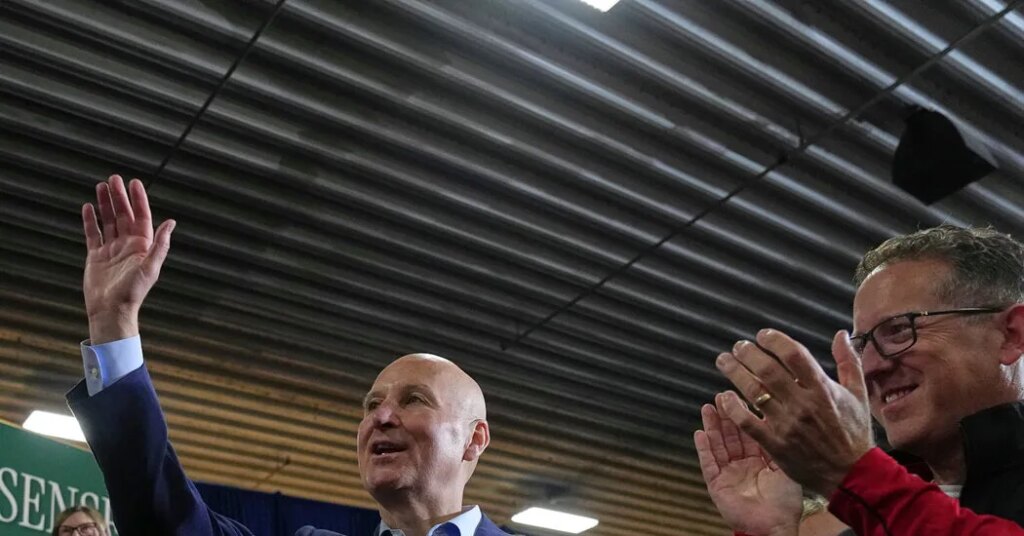
Two incumbents — Senator Pete Ricketts of Nebraska, a Republican, and Senator Mark Warner of Virginia, a Democrat — have nine-figure household net worths.
The candidates’ wealth comes from all kinds of places. Dozens have business interests; 26 of them, or their spouses, own property that generates income. The wife of Representative Kevin Hern of Oklahoma, the Republican nominee for Senate there, owns at least one airplane, and a hangar to go with it. Senator Mike Rounds of South Dakota is an investor in hotels. Senator Cindy Hyde-Smith of Mississippi has cows.
There are limits to what financial disclosure forms tell us. Candidates report the value of their assets and liabilities in huge ranges, not hard figures. And they don’t have to report homes that don’t generate income. But even the minimum possible net worth for most candidates makes them richer than your average American family.
Strikingly, just two Senate candidates themselves have the financial baggage weighing down many Americans: student loans. They are Charles Booker, the Democratic nominee in Kentucky, and Justin Murphy, the Republican nominee in New Jersey.
When wealth is political
Running for office while wealthy is not necessarily a bad look to voters. George Washington was fabulously rich. President Trump has long used an image of wealth and business success to burnish his political appeal.
But this year, some Democrats running for the Senate are seeking to turn their opponents’ personal wealth into a political liability, while campaigning on their own modest means.
-
An ad from James Talarico, the Democratic nominee in Texas, highlights the vast real estate portfolio of his Republican rival, Ken Paxton. “Vote for James Talarico,” the ad says. “He has one house.”
-
In Iowa, an ad for the Democratic nominee, Josh Turek, promises that he won’t be another millionaire in the Senate. “I was a kid wearing Goodwill hand-me-downs, with the wrong color lunch ticket,” Turek says in the spot, adding, “It’s families like mine who pay the price for Trump’s health care cuts.”
Overall, there appears to be a partisan tilt when it comes to wealth: Of the 32 candidates whose disclosures establish them as millionaires, nearly three-quarters are Republicans.
On the Trail
The final sprint
-
Trump is in Daytona Beach, Fla., tonight to rally for Byron Donalds, the Republican nominee for governor, and Senator Ashley Moody.
-
Trump will travel to Iowa and Kansas for rallies on Sunday. He had canceled weekend events in both states yesterday, saying he preferred to use that time hosting virtual rallies, but reversed that plan today.
-
Former President Bill Clinton is scheduled to appear in Tupelo, Miss., to boost the Democratic Senate candidate, Scott Colom. And former Vice President Kamala Harris is speaking at a fund-raising dinner in Fulton County, Ga.
-
Representative Alexandria Ocasio-Cortez is joining Representative Eugene Vindman in Virginia tonight for a get-out-the-vote rally.
Get Caught Up
-
A federal appeals court said the Trump administration’s attempt to force California to set aside more than 20,000 mail-in ballots would amount to “undermining the Constitution’s plain text.”
-
Mary Peltola denied being aware of the scheme to recruit spoiler candidates in Alaska’s Senate race. “I just want to clear the air,” she told supporters last night. “I knew nothing about any other candidates on the ballot except for me and the incumbent.”
-
Michael Bloomberg has put another $36 million into Democrats’ midterm efforts. Some $16 million of that went to a House-related PAC, and another $12 million to Everytown, a gun-safety group that Bloomberg helped found.
The divide threatening Democratic hopes
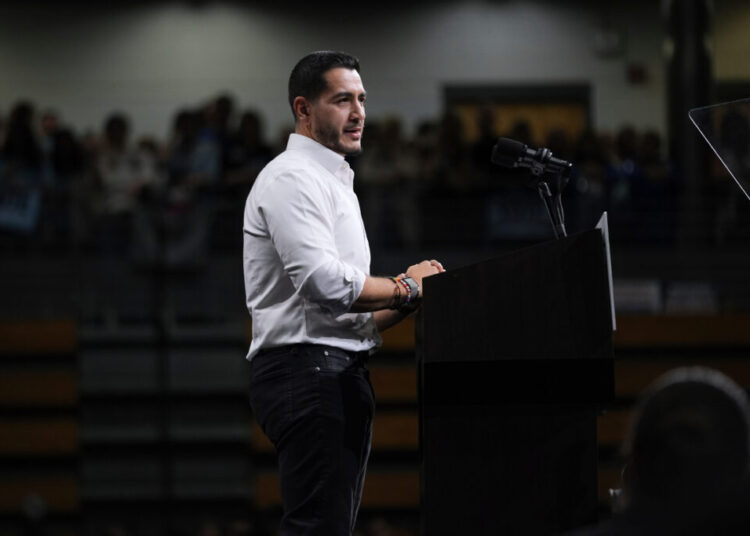
Michigan could prove crucial to Democrats’ efforts to win control of the Senate. But the party has struggled to move past the divisions of the primary. Dr. Abdul El-Sayed, the nominee, has put off some Jewish voters with his criticism of Israel. This week, Haley Stevens, his former primary opponent, finally agreed to campaign with him — but also demanded that he apologize for past comments.
My colleague Jennifer Medina recently traveled to Michigan to report on the tensions in the race. She spent much of her time in Oakland County, a historic center of the state’s Jewish community that has seen its Muslim population expand rapidly over the past two decades. But first, she made a stop in Ann Arbor. She sent this dispatch about what she saw there.
I wanted to hear former Representative Andy Levin, who represented parts of Oakland County in Congress, speak alongside Brad Lander, a Democratic House candidate in New York City. Both men were there to convince skeptical Jews to vote for El-Sayed.
There have been similar events in living rooms across the state. They are designed so that Jewish voters can ask questions, express any discomfort and hear from Jewish politicians who are backing El-Sayed. The night I joined, there were countless questions about his policies on Israel, but also about the tone he uses when speaking about the Jewish state and the number of times he invoked the pro-Israel lobby during the primary. Nothing was off limits.
In essence, Levin and Lander were conveying the same message again and again: that El-Sayed cares deeply about American Jews — even if they disagree wildly on major foreign policy issues.
At one point, Levin invoked the diversity of Oakland County, where El-Sayed also grew up.
“I’m a Jewish person who’s been a friend with him for a long time, and I know he’s not an antisemite,” Levin said. El-Sayed, he said, had grown up around “a lot more Jewish kids than I did.”
He added, “He went to a lot more bar and bat mitzvahs than I did, too.”
The room roared with laughter, including several people who said they still had no plans to vote for El-Sayed. — Jennifer Medina
Your polling questions, answered
Are the polls right this year? That’s what readers are asking Nate Cohn, our chief political analyst. In his newsletter, The Tilt, he responded to some of their questions and concerns about polling this cycle, which has looked strong for Democrats.
One reader asked:
“In the past, the issue of nonresponse bias and weighting techniques have come under discussion. Did the recent polls have evidence that these issues persist?”
The most common reason to think polls will overestimate Democrats’ strength, Nate explains, is “nonresponse bias” — the possibility that polls will be biased because Trump’s supporters don’t respond to surveys.
Is that still a thing?
“The short answer is, yes: Democrats continue to be likelier to respond to surveys than Republicans (among white voters),” he writes.
But, he says, that doesn’t doom the polls, either. Pollsters apply different weights to different types of voters to account for different response levels. Nate notes: “Back in 2022, white Democrats were likelier to pick up the phone at a pretty similar clip, but the polls wound up being solid in the end.”
Related: In a Washington Post poll of Kansas, registered Democrats were more than twice as likely as registered Republicans to complete the survey.
Quote of the Day
“The polls have me a little nervous.”
That was Senator Darline Graham, whose race appears to be much closer than is typical for South Carolina, one of the country’s most conservative states.
Graham, who was appointed to complete the final months of her brother Lindsey’s tenure, is now seeking a full six-year term. But voters have expressed wariness about her campaign stumbles and lack of experience.
At a recent event, Emily Davies reports, a supporter tapped Graham on the shoulder and told her, “Don’t lose the Senate.” She replied, “I’m trying real hard not to.”
ONE LAST THING
Pontiff at the polls
Pope Leo XIV made history as the first American pope. Now, he has done so again, as the first pope to vote in a U.S. election.
Leo cast a mail-in ballot in Illinois, the Vatican said today. According to state records, he has voted in at least 10 general elections since 2000. He has also voted in both Democratic and Republican primaries over the years.
A Vatican spokesman said: “The Holy Father expresses his belief in the right and the duty of citizens to participate in democratic processes.”
The post A Millionaire’s Game appeared first on New York Times.