When Notre-Dame burned, in 2019, it looked to the world like a tragic bonfire of European cultural patrimony, sparked perhaps by a dropped cigarette. When the Limoges city hall went up in flames on Oct. 17 — ignited by arsonists amid France’s largest and most contentious protests in at least a generation — it seemed to reveal something more alarming: not just the ungovernability of the country but also the brokenness of the whole social compact. To many watching from abroad, it looked as if liberalism itself were burning.
There were 800,000 people marching in the streets that day, demonstrations several times the size of the largest protests against climate-motivated gas taxes in 2018, which were mounted by rural voters who came to be known as the gilets jaunes, or Yellow Vests. What began as a movement of students angered by the poor condition of their schools — and the sense that their futures were now determined by an unfamiliar black-box algorithm that would deliver their university placement with all the consideration of a free chatbot — had, by then, fused with growing outrage over sharp increases in the cost of living and frustration with the broken promises of the French state.
Thousands of veterans of the gilets jaunes, as well as trade unions, firefighters and schoolteachers, had joined the students. Labor leaders called for a general strike, and students at the right-leaning Alsace law school joined in, in solidarity. Protesters were often beaten back, arrested or tear-gassed by police, and into the apparent chaos swarmed masked youths rioting and looting without such obvious political intent. Still, 72 percent of the country has said it supports the demands of the protesters, and on the following Saturday, 800,000 people again took to the streets. Right-wing observers in France and abroad, meanwhile, fretted about the menace of anarchism and “Islamo-lefitism.”
To many Americans, this may just seem like France being France, where revolutionary cosplay has been a rite of passage for generations and where the streets of Paris, it’s often joked, represent the fourth branch of government. But the school protests that engulfed the capital earlier this month originated not in France but on Mayotte, a French territory made up of tiny islands in the Indian Ocean, 5,000 miles away. They then jumped across Africa and the Atlantic to French Guiana, a faraway French outpost of the European Union, tucked between Brazil and Suriname. When the rage that burned in the periphery finally arrived in what the French sometimes call “the hexagon,” it ignited first in provincial cities, then in the banlieues, or suburbs, and only last in central Paris.
The phenomenon is, in fact, a global one: generational frustration with the basic bargain of the status quo, and such deep-seated exasperation with existing institutions and establishment politics that building an enduring governing majority starts to look like an impossible task.
In India, a remarkable cross-class Gen Z coalition has come out to protest corruption, disenfranchisement and above all the rule of Narendra Modi. There has been similar generational unrest in Italy and Spain and Belgium — and even Albania, where Jared Kushner and Ivanka Trump’s play to develop Sazan Island as a luxury resort inspired a national uprising. There have been genuine Gen Z revolutions in Bangladesh, Nepal and Sri Lanka in recent years, and a student movement just ousted Serbia’s populist authoritarian president.
In Brazil, in the several weeks between the first round of national elections and the second, millions took to the streets and then swarmed to the polls to deliver a contradictory result. The far-right scion Flávio Bolsonaro, who triumphed in the first vote, failed in the second — the first time in the country’s modern history that the outcome flipped between the initial round and the runoff. The leftist president Luiz Inácio Lula da Silva was returned to office, in a heroic comeback immediately celebrated by liberals the world over.
But in his fourth term, the progressive icon will be dealing with the most reactionary Congress in modern Brazilian history, an opposition led by four other members of the Bolsonaro family, widespread skepticism about the validity of the results and almost universal distrust of the country’s Supreme Court. The shock result may make Lula look like the world’s most successful 21st-century politician, as many of his admirers have argued. But it also lands the country in what looks like irresolvable political deadlock. And it’s not exactly a healthy sign that the man he defeated fled the country.
In the United States, the road to the midterms hasn’t been blockaded by mass protest or pockmarked by social unrest. But even a blue wave on Election Day seems likely to yield only a quarrelsome divided government and a lame-duck version of Donald Trump’s imperial presidency. An ascendant Democratic Party still isn’t clear what it stands for, or what to fight for, or how long its claim on political power is likely to last.
That the country lurches from one so-called vibe shift to another is a sign that the enduring vibe is dissatisfaction. Almost certainly, 2026 will be the seventh straight election to deliver a repudiation of the party holding the presidency. Quite likely, that will happen again in 2028. Perhaps it will open a new horizon for American politics. Or perhaps it will just mean the other party becomes once again the source of disappointment and rage.
The mood of political futility didn’t arrive with price spikes from the Iran war and crippling heat waves sweeping Europe this summer. In 2024, when more people went to vote in elections around the world than in any previous year in human history, the party in power lost ground almost everywhere, in what some have called “a bonfire of the incumbents.”
This was a remarkably uniform judgment against the political order that had governed much of the world since roughly the end of the Cold War. But the conventional explanation for why was straightforward. Populist resentment had been growing almost everywhere since the financial crisis of 2008, yielding a dark global weather system into which rapid inflation, mass migration and pandemic backlash arrived to create a perfect storm of anti-incumbency.
Each of those crises has cooled since 2024, with the pandemic increasingly in the rearview mirror, the postpandemic surge in global migration down considerably from its 2023 peak and inflation more manageable almost everywhere (despite the war in Iran). But the mood simply hasn’t changed much. Global politics is still defined not by what political scientists long ago identified as the incumbency advantage but by its opposite: a structural preference for those out of power and a reflexive hostility toward those already wielding it.
For a decade now, the anti-establishment turn has looked like a crisis to the champions of the old order, confused by what might have produced it — with the threatened disruption of A.I. now added to the list. But just as important may be where it all leaves us: with what feels like a new political metabolism that chews through majorities and renders even inspiring victories short-lived. The resulting whiplash isn’t just discombobulating; it also risks becoming self-perpetuating. Voters dissatisfied with the way things stand are quick to turn on new leaders, depriving their governments of the popular legitimacy necessary to achieve anything lasting, only to then blame them for that failure too.
The global pattern isn’t entirely uniform: Left-of-center leaders in Mexico and Canada are remarkably popular, and charismatic politicians like Lula or Trump can win additional time in office even in the face of widespread disappointment and frustration.
Yet the broader pattern still looks fairly clear. The populist politics of the last decade haven’t meant a universal rightward march, as so many feared. But they have meant that very few leaders anywhere have managed to build and sustain majorities that allow them to do what we used to think of simply as governing: designing new policies to improve the lives of their citizens, then implementing those changes over time. Franklin Roosevelt was still figuring out what the New Deal was supposed to be well into his second term, and Reagan’s “morning in America” was affirmed by his landslide re-election and the subsequent victory of his successor, George H.W. Bush. Even though Barack Obama won the closest thing to a true landslide in modern American history, he still needed to win again in 2012 to secure the Affordable Care Act.
But in America the window of policy opportunity now seems to shrink with each cycle. If you want government just to stand by and stand down, turnover and turmoil works fine. But if you want real social change? Even in an age of desiccated expectations, leaders have to be able to deliver something concrete if they hope to survive the rage of voters.
In France, Emmanuel Macron is coming to the end of a decade in power that began with promises to resolve the nation’s crises and divisions with a sort of technocrat’s magic wand. Nine years later, that project has failed, and Macron himself is catastrophically unpopular. One recent poll put his approval rating at 15 percent. Since dissolving Parliament in the summer of 2024, he’s been struggling to maintain a governing coalition and has barely managed to pass a budget — doing so this year without parliamentary approval in the face of two no-confidence votes.
But what’s just as striking is that the alternatives don’t seem to hold much appeal for the French, either. The leading candidate to succeed Macron is the far-right candidate Marine Le Pen. But though she has consolidated the French right and is seen abroad as a kind of unstoppable force, she remains remarkably unpopular at home, with only about a third of the country behind her and most of the voting public divided among a half-dozen candidates who have essentially no chance of winning. (In a runoff, she’s widely expected to triumph, by collecting second- and third-choice votes.) It’s enough to make the near future seem unmanageable: Close to 90 percent of the country believes it is heading in the wrong direction, but none of the leading candidates can claim the support of more than one-third of its voters.
Politics isn’t just a popularity contest but the way nations deal with structural change. And here the case of France is especially telling. The country is aging, growing slowly when it grows at all and being squeezed by social welfare obligations and ballooning debt. The average French retiree now makes more money than the average working person. And though the problem isn’t quite as stark in most other wealthy countries, it is hard to find one whose politics haven’t been distorted by what the American conservative commentator Russ Greene has called “total boomer luxury communism” — the hoarding of resources by the old and ailing.
This is especially galling to French youth, given that Macron’s governments have cut taxes on corporations and the wealthy as well as services but made no obvious improvements to their own prospects, which look relatively dim. But it is also the case that France spends more of its budget on schools than most other countries in Europe, and considerably more on health care and pensions. Most French people would tell you that the quality of all public services is in obvious decline, but fewer seem to trust that the state is capable of improving them. And while you can find prominent economists with a sunnier story to tell about the economic vitality of the continent, few voters believe them — and to the young, that relative optimism sounds like a cruel joke. Sound familiar?
It isn’t just the French who’ve been caught, viselike, between what seems unacceptable and what seems unachievable. The question is what it might take to break the vise.
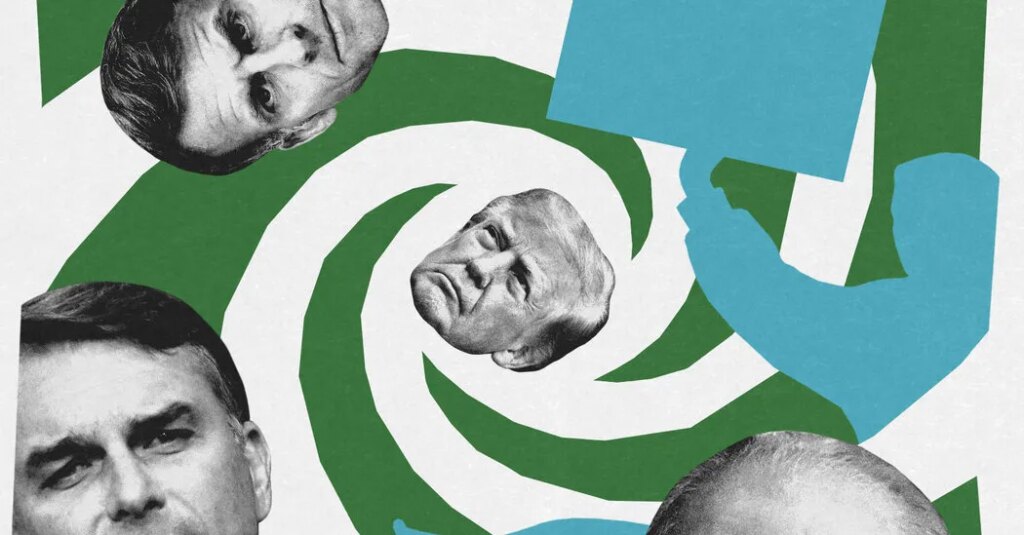
Source images for illustration above: Elyxandro Cegarra/Anadolu, via Getty Images; Mélanie Salaün /Hans Lucas/Agence France-Presse — Getty Images; Alexandre Schneider/Getty Images; Manu Brabo/Getty Images; Nelson Almeida/Agence France-Presse — Getty Images; Kevin Dietsch/Getty Images; Anne-Christine Poujoulat/Agence France-Presse — Getty Images; Teresa Suarez/Agence France-Presse — Getty Images.
David Wallace-Wells is a staff writer for the magazine and the author of ‘‘The Uninhabitable Earth: Life After Warming.’’
The post The Vibe Is Dissatisfaction. The Result Is Endless Political Deadlock. appeared first on New York Times.