The United States is pointing to gains in the Strait of Hormuz, intent on demonstrating that weeks of complex and secretive military operations there have returned oil flows to near prewar levels and chipped away at a key piece of Iranian leverage ahead of a threatened return to all-out war after the U.S. midterm elections next week.
An increase in vessel traffic and the small percentage of ships disabled by Iranian strikes are signals “clearly demonstrating that the United States and regional partners control the international waterway,” read a statement this week from U.S. Central Command announcing that Brad Cooper, the head of the command, had visited the strait.
But while U.S. allies in the Persian Gulf have welcomed the operations along with oil industry and shipping firms, serious questions remain about how sustainable they are in the face of escalating Iranian attacks, according to two people with knowledge of the matter and two Western officials based in the region, who like others interviewed for this report spoke on the condition of anonymity to share sensitive information. Also unclear, they said, is whether the U.S. military would be able to maintain the operations in the strait at the same time as resumed heavy strikes on Iranian territory after the U.S. midterm elections, as President Donald Trump has threatened.
In addition to increasing the volume of strikes on shipping, Tehran also appears to have adjusted its targeting in recent weeks, increasingly taking aim at engine rooms to disable vessels rather than just damage them, according to one of the people with knowledge of the matter, who is close to the shipping industry. United Nations data shows that two ships have sunk this month as a result of Iranian attacks.
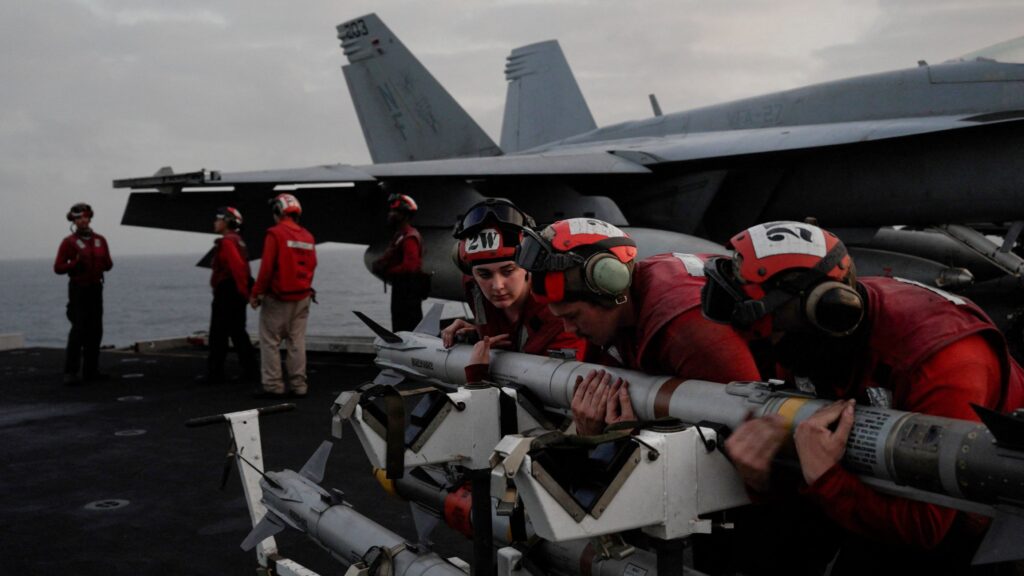
The U.S. operations that have enabled the dramatic increase in oil exports are some of the most complex of the war, according to a European security official and the two people with knowledge of the matter. U.S. forces have integrated air defenses, fighter jets, drones and warships to protect vessels in layers as they pass through the waterway, running a harrowing gantlet of Iranian attacks far beyond what ordinary seafarers sign up to face on the job. The European security official likened the operations to creating “a bubble” that moves along the strait as vessels make the transit.
Iranian attacks have made this month the most violent in the waterway since the war began. At least 25 ships in the strait have been hit in October, according to data collected by the U.K. Maritime Trade Operations center, a maritime monitoring body affiliated with the British military.
But oil exports have also surged during the same period. Figures vary, but maritime analytics firm Kpler found that average daily oil exports reached 14 million barrels for the week ending on Oct. 18, about 80 percent of prewar averages. The rebound has been remarkable: In July, daily averages over a seven-day period were as low as 7 million barrels. U.S. Central Command doesn’t release daily averages, but it said that “since summer,” oil exports through the strait had reached 1.5 billion barrels.
The U.S. Army’s elite 82nd Airborne Division leads the mission and runs a joint operations center in the United Arab Emirates, according to one of the people with knowledge of the matter.
The UAE Embassy in Washington did not immediately respond to a request for comment on the country’s role in the Hormuz operations.
At least 30 ships per day have transited the strait so far this month, according to the two individuals with knowledge of the matter. U.S. Central Command has released little information publicly about efforts to protect shipping in the strait, but it said Sunday that over the past six months, more than 3,000 commercial vessels have transited the waterway.
The resumption of traffic through the strait — which nearly ceased amid the U.S. and Israeli war with Iran — has brought a critical lifeline for U.S. allies in the Persian Gulf as well as the shipping and energy industries. “Everyone wanted this,” said the second person with knowledge of the matter, who is in contact with industry leaders and government officials. But that person cautioned that the private sector and U.S. allies in the region view the effort as an imperfect, temporary measure. The two Western officials based in the region said they have heard similar concerns about the operations in the strait.
Since U.S. operations ramped up in August, seven seafarers have been killed and 18 injured, according to United Nations data. The risk levels are currently so high that nearly all the vessels willing to make the trip are state owned and operated. Most private companies continue to refuse to use the strait even under U.S. protection, according to the individuals and officials.
“The situation is completely unsustainable,” said one of the Western officials based in the region. While vessel traffic has increased for oil exports, the official said, few vessels carrying liquefied natural gas have taken the risk. “If one of those gets hit, it’s not just an oil spill; it’s an explosion,” the official said.
The fact that Iran has escalated attacks on shipping is itself a demonstration of U.S. successes in the waterway, according to Gregory Brew, an energy and Iran analyst at the Eurasia Group, a political risk consultancy firm.
“The U.S. has achieved something pretty considerable, overcoming Iran’s closure of the strait earlier this year, but it’s not enough,” he said, referring to energy prices that have remained high despite increases to traffic.
Iran has demonstrated that it doesn’t need to completely close the waterway to keep prices high, but the U.S. has found that even partially reopening the strait isn’t moving energy markets the desired amount, according to Brew. “As long as it’s contested, then Iran is achieving their objective,” he said.
But Kevin Donegan, a retired vice admiral who served in Bahrain as the commander of the Navy’s Fifth Fleet, said he sees the operations differently. Compared with the escort operations of the “tanker wars” in the 1980s, current U.S. operations have a smaller footprint and are more nimble, he said.
“During the tanker wars, ships were lining up and being escorted with lots of naval vessels, big convoys,” he said. “We’d brute-force them through in groups. That’s not what’s happening now.”
Donegan said he couldn’t share further details of the operations, but he described them as “a piece of maritime superiority” that can be turned on and off and moved to where vessels are most vulnerable.
“Think of it as a moving sanctuary,” he said.
Every day, the vessels registered to make the crossing assemble off the coast of the United Arab Emirates and are delivered guidelines to follow, including the instruction to turn off the Automatic Identification System (AIS) transponders that broadcast the vessel’s location with satellite and radio signals. The vessels are then given coordinates marking the safe passageway, with labeled checkpoints denoted by the NATO phonetic alphabet.
Once the vessels have exited the strait, they transfer their cargo to privately owned ships in the Gulf of Oman before traveling back to the Persian Gulf to load up again. Because so few vessels are willing to risk Iranian attacks, roughly the same group of vessels is making the trip back and forth from the Persian Gulf to the Gulf of Oman.
“It’s a de facto shadow fleet,” said the Western official based in the region, using a term to describe vessels that attempt to evade sanctions on Russian and Iranian oil by switching off AIS and moving oil with ship-to-ship transfers.
Donegan, the retired vice admiral, said the operations also appear to be having a secondary function: They are beginning to build the framework of a future regional coalition to counter Iran. He cited support for the operations from the Emirati, Kuwaiti and Iraqi governments.
The Trump administration “has to continue to build this coalition of countries saying that what Iran’s doing is not acceptable,” he said.
“The way forward is to get the Iranians to a tipping point.”
The post A resumed Iran war after midterms would put fragile gains in Hormuz to the test appeared first on Washington Post.