Troy Jackson’s most viral moment of the midterms was also an insight into his biggest weakness.
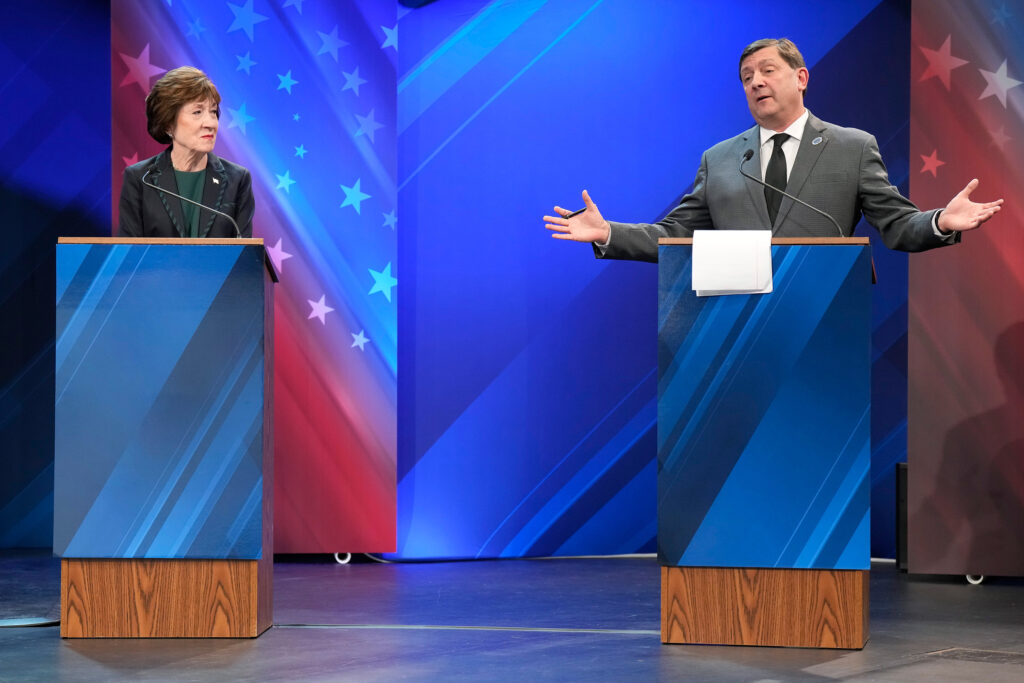
“We can’t eat road salt,” the Democratic Senate candidate in Maine quipped during his first debate against Sen. Susan Collins (R) in early October. Collins was highlighting the rock salt exemption she secured from President Donald Trump’s tariffs on neighboring Canada. Jackson attacked her careful politicking with concerns about affordability.
And it’s true, you can’t eat road salt. But Collins knows a state like Maine won’t eat without it, either.
Small towns in northern Maine were worried about having to cut services to afford road salt. Frenchville, for example, appealed to the senator, fearing an extra $10,000 in costs for the town of about 1,000. According to Collins’s campaign, Maine’s Department of Transportation estimated the tariffs would have cost the state an additional $2 million annually to maintain roads in Aroostook County.
Attention to small, unglamorous details like the price of road salt has marked Collins’s candidacy from the beginning. Last week, she secured another slate of tariff exemptions for Maine’s agriculture industry as Trump continues to wage his trade war with Canada. Those included items such as corrugated paper, plastic boxes and cases, and edible seaweed products.
Voters can point to projects that Collins has helped bring home. In July in southern Maine, Marty Grohman, former mayor of Biddeford, told me that Collins obtained “transformational money” for the city’s wastewater infrastructure. “I think it’s hard to find a mayor or a county commissioner who won’t sing the praises of Senator Collins,” he said. At a parade up north in Fort Fairfield, retired resident Darryl Peters told me Collins has been “true to her state,” naming resources such as firehouses and funding for homelessness that have come from the senator.
In the closing days of the tumultuous Senate race, Collins has continued to run on a strong record of local results. Her Democratic opponents have defaulted to anger at Washington.
If Collins loses, it won’t be because she was a flailing incumbent — it will be because enough voters decided that voicing national frustrations was more important than maintaining her effective constituent services.
I’ve covered many races across the country this cycle, but none so closely and for so long as Maine’s. I started writing about the Pine Tree State’s Senate race over a year ago, when a buzzy Graham Platner was still unscathed by his (now covered-over) Nazi tattoo.
Platner’s macho brand of angry populism drew Democrats’ delight after the party was chastened for its excessive wokeness in 2024. And for a time, his scandals seemed only to bolster his (mostly bogus) working man’s mystique. He ousted Gov. Janet Mills in the June primary. Platner racked up an impressive list of endorsements until the sexual assault accusation that felled his candidacy in July. Platner denies that allegation. His backers included the likes of Sen. Elizabeth Warren (D-Massachusetts), Sen. Bernie Sanders (I-Vermont) and Rep. Ro Khanna (D-California).
That trio has backed Jackson, who emerged from a scrum of Democrats who sparred to take up Platner’s working-class mantle. More notable, however, was the extended absence of an endorsement from Mills. That ended on Thursday when Mills posted that she voted for the Democratic ticket, including Jackson. Until then, the governor had only said she was “open” to discussing an endorsement.
Mills is plenty familiar with Jackson’s record. Though he has fashioned much of his persona around his days working as a labor organizer and logger, he’s served in Maine politics for about two decades, including a stint as president of the state Senate until 2024. That political résumé couldn’t even carry him through this year’s Democratic gubernatorial primary: Jackson came in third in the June contest.
An unremarkable candidate like Jackson is benefiting from a remarkable national moment. Trump, the leader of the Republican Party, isn’t just unpopular — he’s abysmally so. And in Maine, where local policies and decisions made in Washington have driven energy prices to some of the nation’s highest, kitchen table issues loom large. Collins has held on as New England’s lone Republican senator because of her effectiveness. But a sense of malaise about incumbents might engulf even a five-term senator who has worked carefully to avoid the smugness that fuels that discontent.
It’s those frustrations, not Jackson himself, that have made this such a close race. Set aside the partisan warfare happening across the country, and there would be little reason for a rural state such as Maine to give up representation by the chair of the Appropriations Committee for a freshman senator with an underwhelming record. But to some voters, national ambitions are enough.
Earlier this month in Oxford County, Linda, a voter who declined to give her last name, told me she wasn’t so much voting for Jackson as she was sending a message to Republicans. “I don’t know too much about Troy Jackson, but it seems like he’s a good, hardy Mainer,” she told me. “I think at this point it’s about, for me, saving democracy. We need to flip the Senate in order to have some leverage against Trump.” She bristled at Collins’s vote to confirm Brett M. Kavanaugh to the Supreme Court.
When I spoke to Jackson in July, his main pitch hinged on the generic notion that voters want a “government that works for them.” He parroted legitimate voter frustrations: high health care costs, overzealous immigration enforcement, a costly war in Iran. Jackson has argued that Collins is less effective than she seems and is inextricably linked to the national issues troubling Mainers.
In a minivan outside his July rally in Portland, Jackson told me that “what Senator Collins has brought back the state of Maine is a pittance to what we’ve lost.” His most recurring example has been Collins’s motion to proceed on Trump’s One Big Beautiful Bill. “The money that we’ve lost in that bill took away from health care, took away from hospitals,” he said. In a recent debate, Jackson erroneously accused Collins of advancing the bill “out of committee.”
The bill never received a Senate committee vote. Collins’s procedural vote brought the legislation to the floor. Collins maintained that she wouldn’t vote for final passage without significant changes. In the end, she voted no, citing Medicaid cuts, but not without pushing for the bill to include a rural health care fund.
The final legislation established a $50 billion fund to be distributed over five years. Critics complain the rural health care money won’t offset $137 billion in estimated Medicaid cuts to rural areas over the next decade, but politics is more often a game of damage control.
That fund is already being put to use — and by Democrats. The state received $190 million for the Rural Health Transformation Program. Mills announced earlier this month that Maine would direct $2.8 million to Penobscot Community Health Care as it faced bankruptcy. PCHC is Maine’s largest federally qualified health center, serving about 50,000 patients.
Republican candidates across the country have made themselves vulnerable by not standing up to the president. Collins is not one of them. She’s rebuked Trump’s trade war, criticized his actions in Iran and pursued reforms to immigration enforcement.
Ideal outcomes don’t exist in politics. When she can’t pull off a major win, like ending tariffs for Canada, Collins uses her leverage to secure road salt exemptions. Jackson can’t pretend to have the same influence. Tuesday will test if he needs it.
The post Collins is the clear choice for Maine. Will it matter? appeared first on Washington Post.