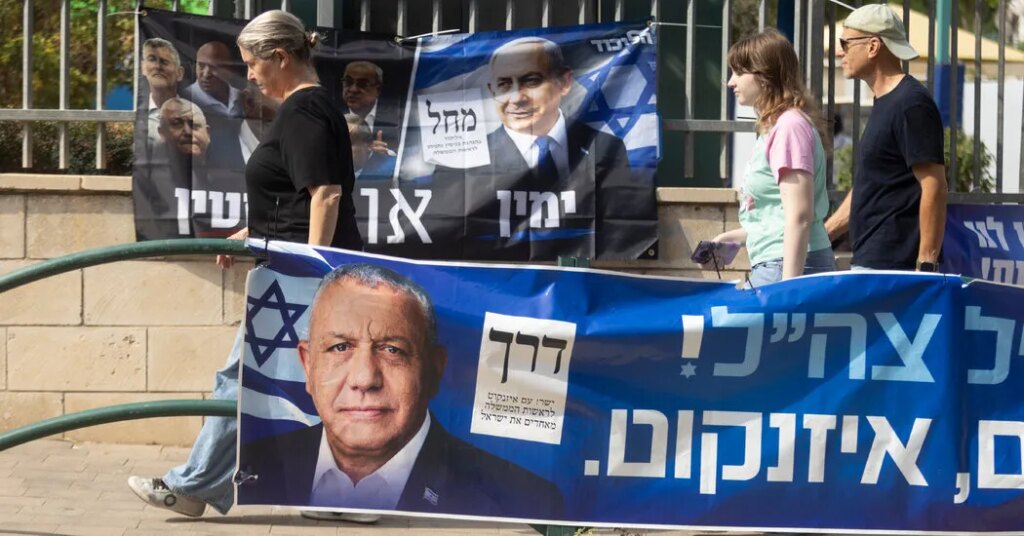
To Israelis, the two leading contenders after the election, Prime Minister Benjamin Netanyahu and Gadi Eisenkot, a former chief of staff, offer sharply different personalities, styles and even paths to the future.
But to the rest of the world, they don’t seem substantially different in their approach to Israel’s security or in their opposition to a Palestinian state.
If neither can form a government, Mr. Netanyahu could remain as a caretaker prime minister for weeks or months to come. In this period of instability, there is concern, analysts say, that settler violence in the Israeli-occupied West Bank will increase and that Mr. Netanyahu will push President Trump to start bombing Iran again.
If Mr. Eisenkot manages to emerge as prime minister, Israel’s overall foreign policy is not expected to shift much. The tone may be more accommodating on the margins, but few expect Israel to embrace a two-state solution to establish an independent Palestine or abandon its active conflicts with Hamas in Gaza, Hezbollah in Lebanon and the Islamic Republic in Iran.
All that means Israel will still find itself increasingly isolated internationally.
The vote sends a message to the world that the current government’s approach to the region, which has prompted an international backlash, “is not just a Bibi problem,” said Gina Abercrombie-Winstanley, a former American diplomat now at the Atlantic Council, referring to Mr. Netanyahu. “It represents today’s Israel writ large.”
Israel’s reputation in the world has suffered over the past few years. Sympathy and support after the Hamas-led attack on Oct. 7, 2023, have been gradually undermined by the extensive Israeli bombing campaign in southern Lebanon and especially Gaza, as well as the rising settler violence in the West Bank. The war against Iran, which Israel encouraged President Trump to join, has been deeply unpopular in much of the world, including the United States, driving up energy prices and inflation.
Natan Sachs, an expert on Israeli politics at the Middle East Institute, a Washington-based research group, said Israel has “now entered a very dangerous phase in its official relations with other countries.” He cited a general increase in anti-Israel, anti-Zionist and antisemitic sentiment in the West and recent European moves to impose sanctions on Israeli products and businesses in the West Bank, which could also damage the economy.
In the United States, Israel faces an erosion of trust. Support for Israel has been waning among Democrats, who appear to be in a strong position to at least take the House of Representatives in elections next week. Changing that relationship “will be even more difficult if Bibi Netanyahu is still in charge of Israel and there is absolutely no hope of Israeli politics or policies changing,” said Rachel Brandenburg, Washington director of the Israel Policy Forum, a research institution that supports a two-state solution.
Several European nations, including Britain and France, have been in watch-and-see mode with the election, holding off implementing the sanctions announced last month. Their hope, if limited, was that an Eisenkot government would crack down on settler violence, stop claiming more territory in the West Bank and cooperate with governments trying to promote a peaceful settlement with Palestinians.
“There is a deep animus between most European leaders and Netanyahu that has built up for at least a decade,” said Robin Niblett, former director of the Chatham House research group and now the warden of New College, Oxford. “That makes Europe’s ability to contribute to peace in the region that much more risky even to attempt politically.”
Mr. Eisenkot is also tough on security issues, he added, but would “try to find a way to cooperate for stability and peace instead of making the Europeans the enemy.” Even that effort, Mr. Niblett said, “would give more space for Europe to support Israel.”
Officially, the European Union was polite after the vote, praising Israel’s “vibrant democracy” and high turnout in a statement. It said the bloc looked forward to engaging the next government “on the basis of our longstanding relationship and commitment to democratic principles and common values,” based “on a frank and open dialogue.”
But the election has only increased uncertainty. Israelis could face political deadlock for months, and if no one can form a stable government, they could be headed back to the polls.
Few expect much give from Mr. Netanyahu in the interim. That means he is unlikely to compromise on Gaza or to restrain illegal settler activity in the West Bank, especially since it would likely anger the far-right partners in his coalition. Wounded by the election, Mr. Netanyahu may also want to prove that he alone, alongside Mr. Trump, can “finish the job” in Iran.
“He will probably feel more confident and empowered to present himself as Mr. Security, and the impact will spill over Israel’s borders,” said Sanam Vakil, director of the Middle East program at Chatham House.
“The ticking clock of a war with Iran is speeding up and seems all but inevitable,” she added. “It won’t accomplish anything, but it could convince all the parties it’s time to make a deal.”
“Europeans should prepare for volatile weeks ahead under Netanyahu’s far-right caretaker government,” said Beth Oppenheim, who studies the Middle East and North Africa for the European Council on Foreign Relations. “He will have greater incentive to escalate, whether with Iran after the U.S. midterms on Nov. 3, or in the West Bank or Gaza.”
Seen coldly, the election was a clear repudiation of Mr. Netanyahu’s coalition, with a majority of Israelis voting for opposition parties.
But Mr. Eisenkot appears likely to need the support of Arab parties to govern, which some members of his coalition have rejected. And Mr. Netanyahu, by questioning their loyalty, has cleverly split the opposition between Jewish and Arab parties, despite a historically large turnout among Arab voters eager to reject him and his far-right partners.
That risks disenfranchising Israel’s Arab citizens, who make up some 21 percent of the population, and worsening Israel’s reputation as a democracy.
Given the high turnout of Arab voters, said Ms. Brandenburg, “if you then go ahead and say, ‘Oh, we have to go into new elections again because they don’t count,’ that’s not a good look for Israeli politics and Israeli government and frankly, Israel as a democracy.”
The post Israel’s Election Is Unlikely to Change Its Policies and Global Isolation appeared first on New York Times.